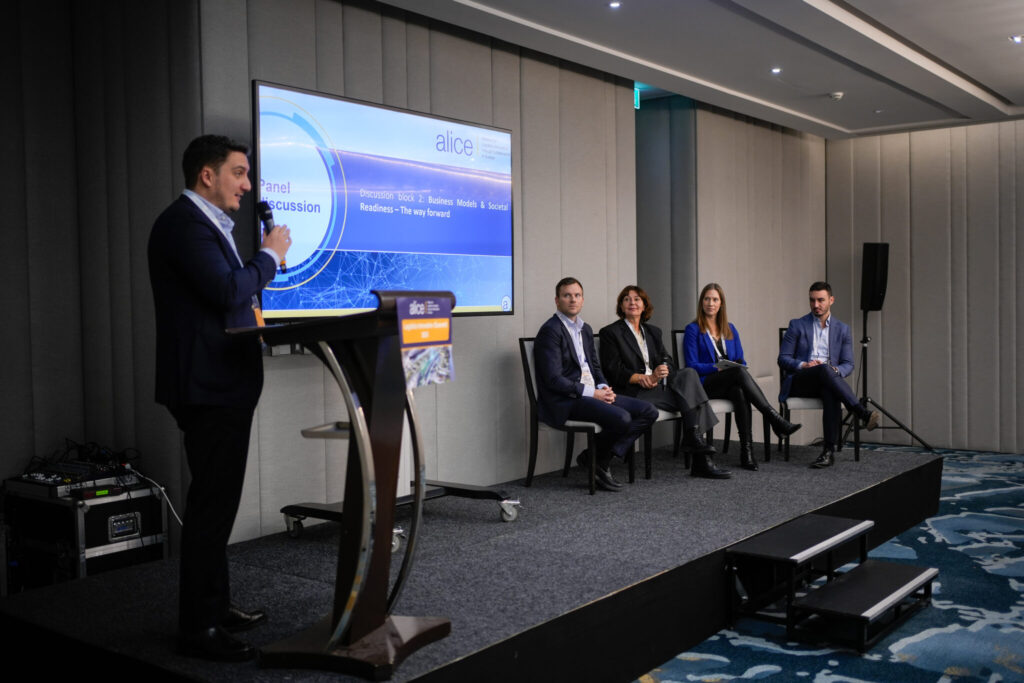
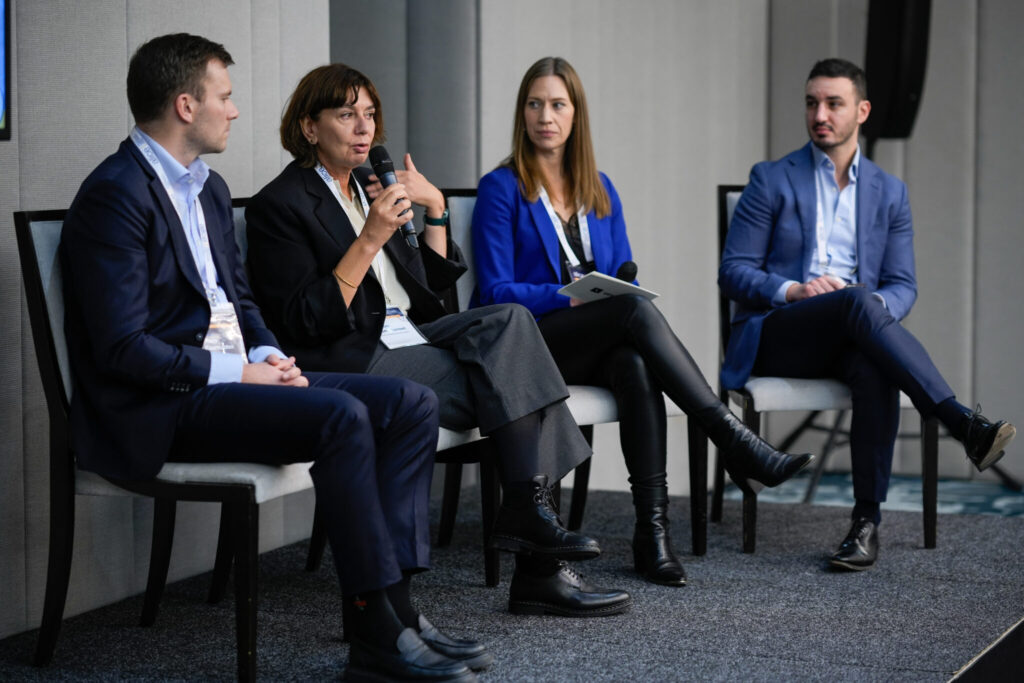
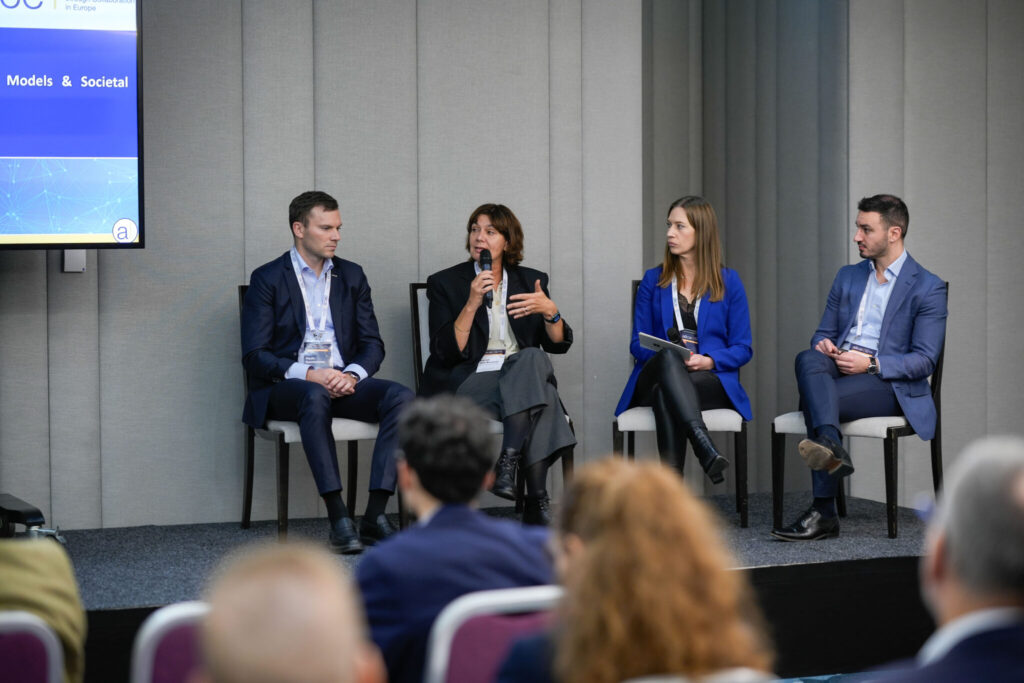
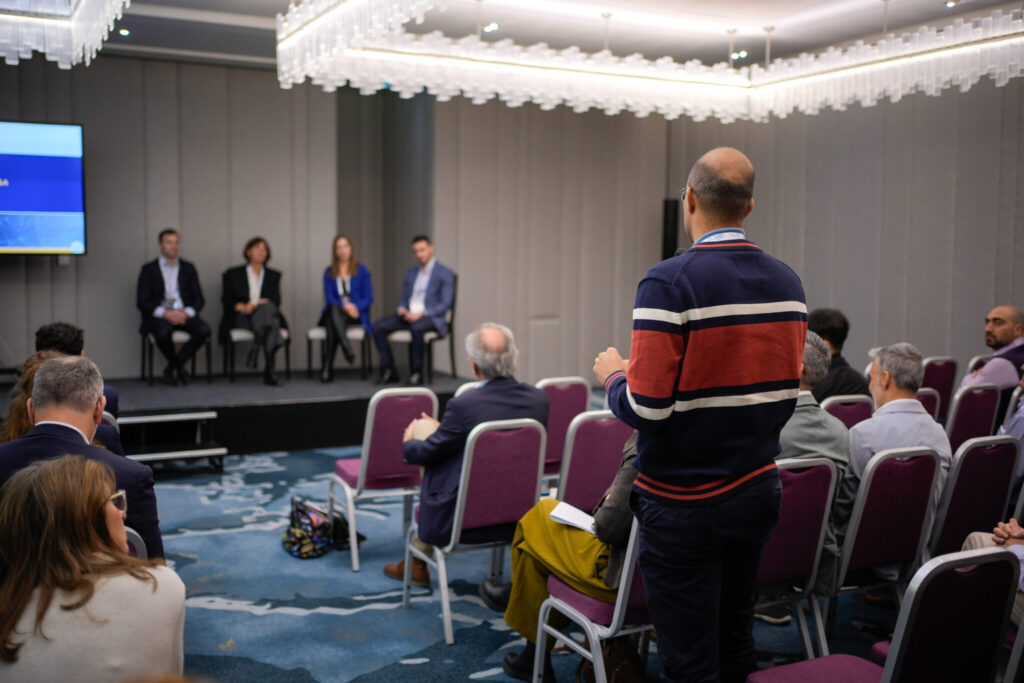
Automation is reshaping European freight systems across roads, ports, terminals, and intermodal hubs. The session “The Rise of Automation in Logistics” at the ALICE Logistics Innovation Summit 2025 explored how Europe can move from isolated pilots toward coordinated, large-scale deployment of automated logistics operations across borders and modes.
Hosted by Angjelo Andoni, ALICE Deputy Programme Manager, the session brought together speakers representing the European Commission, leading logistics operators, and major ports: Lee Bugeja-Bartolo, Pia Wijk (Einride), Mads Rasmussen (DFDS), and Karen Van Brussel (Port of Antwerp-Bruges). It was linked to a wide ecosystem of EU-funded automation projects: MODI, CCAMbassador, AUTOSUP, AutoMoTIF, SEAMLESS, FOREMAST, MultiRELOAD, and URBANE.
Angjelo Andoni opened the session by outlining ALICE’s “automation storyline,” showing how automation now spans all five ALICE Thematic Groups. He highlighted how road-focused initiatives like MODI and CCAMbassador are converging with automation in terminals and ports through AUTOSUP, AutoMoTIF, SEAMLESS, FOREMAST, and MultiRELOAD, forming the backbone for future Large-Scale Demonstrations (LSDs) under CCAM.
Lee Bugeja-Bartolo (DG MOVE) presented the European Commission’s plans for Large-Scale Cross-Border Testbeds for Autonomous Vehicles. These testbeds will serve as long-term environments equipped with regulatory sandboxes, enabling automated freight services to be tested under real conditions while accelerating regulatory alignment between Member States. He noted a strong interest in freight automation from several countries, positioning logistics as a priority use case.
A live SLIDO poll revealed the main obstacles slowing deployment: a lack of interoperability and harmonised standards, complex permitting processes, gaps in data-sharing and evaluation frameworks, concerns about technology reliability, unclear business models, and the need for greater societal and workforce readiness. These themes framed the panel discussion.
Pia Wijk (Einride) stressed that vehicle automation cannot progress without parallel digitalisation of logistics processes, including planning workflows, yard operations, and driver hand-offs. Mads Rasmussen (DFDS) emphasised the need for multi-OEM, interoperable solutions that link road corridors with hubs and terminals, highlighting persistent challenges with site readiness and digital infrastructure. Karen Van Brussel (Port of Antwerp-Bruges) showcased progress in port automation, including autonomous vessel and drone applications, and underlined the importance of synchronising road and port automation rather than developing them in silos. Returning to the regulatory dimension, Lee Bugeja-Bartolo clarified that the Commission’s testbeds represent a transition step toward deployment, not another round of short-lived pilots, and noted the complementary role of CCAM Large-Scale Demonstrations and potential IPCEI work for industrial scale-up.
All speakers agreed that automation is advancing – but not yet at the required scale. Fragmented permitting, inconsistent site readiness, limited interoperability, and the lack of reusable evidence continue to slow progress. Achieving deployment across European corridors and hubs will require coordinated digitalisation, harmonised regulation, viable business models with 24/7 utilisation, and early engagement with workers and communities to build acceptance.
Projects such as MODI and CCAMbassador are already preparing the regulatory, operational, and stakeholder foundations for cross-border automated freight. Meanwhile, AUTOSUP, AutoMoTIF, SEAMLESS, FOREMAST, MultiRELOAD, and URBANE are advancing automation across ports, terminals, and last-mile environments, ensuring that future large-scale demonstrations can deliver end-to-end automated logistics systems.
Read the full session report (restricted access) on the ALICE Knowledge Platform and download the short PDF version here https://www.etp-logistics.eu/wp-content/uploads/2025/10/3B_Rise-of-Automation_COM.pdf