
Monday, October 12th, 2026
During Connecting Europe Days 2026, transport and logistics stakeholders discussed how CountEmissions EU can support more consistent greenhouse gas emissions accounting across the sector, and how this information can be turned into practical emissions-reduction decisions.
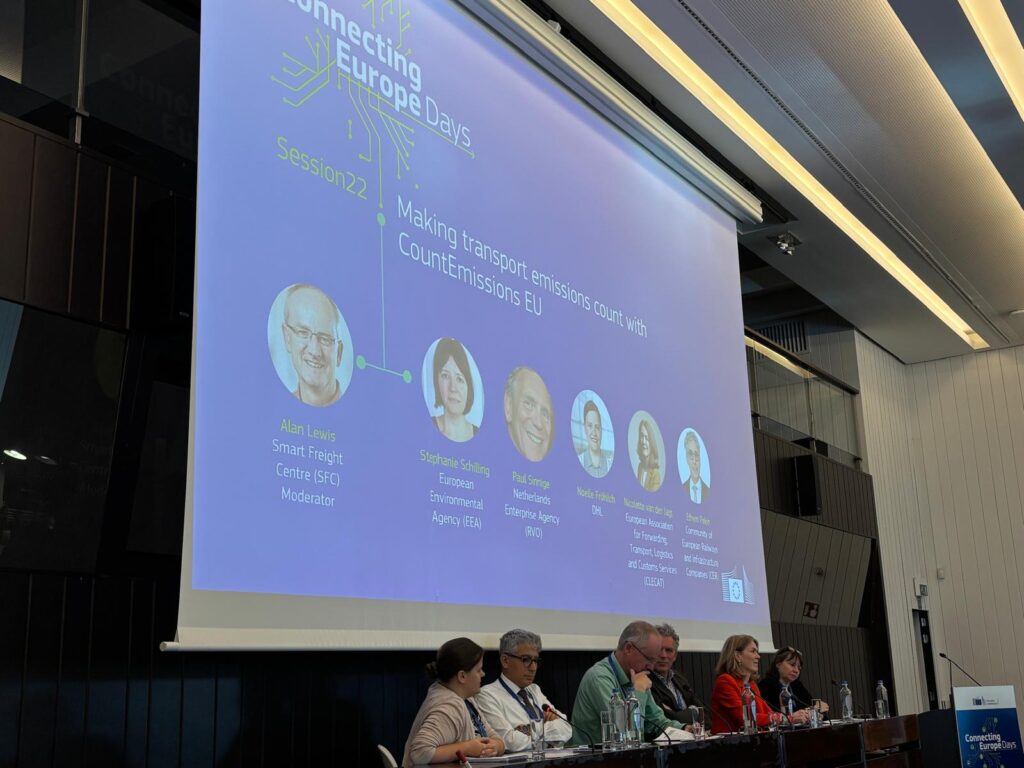
The session, held on 30 September, brought together representatives from the European Environment Agency (EEA), the Netherlands Enterprise Agency (RVO), DHL, CLECAT and the Community of European Railways and Infrastructure Companies (CER), moderated by Smart Freight Centre.
A key message was that emissions accounting is not the end goal. Its value lies in providing a common baseline that allows companies to understand where emissions occur, compare transport services, and identify where reductions can start.
This is particularly important for customers working with several transport providers. A harmonized methodology can improve comparability and support more informed purchasing and operational decisions.
ALICE has previously examined the regulatory framework and its implications for the sector in the article “CountEmissionsEU: Implications of Regulation (EU) 2026/1030 for Transport and Logistics”. The discussion at Connecting Europe Days built on this regulatory context by focusing on the practical conditions needed for consistent emissions accounting and reporting.
There are significant differences in preparedness across logistics companies. Larger organizations are generally more advanced, while many SMEs lack dedicated sustainability expertise and depend on external calculation tools.
At the same time, emissions information is becoming increasingly relevant in commercial relationships. Some customers already request Scope 3 data, include emissions criteria in tenders, or use environmental information in procurement.
Primary data, such as actual fuel consumption, energy use and transport activity, was identified as the preferred basis for calculation. However, complete primary data is not yet available across many subcontracted and complex transport chains.
Interoperability is another major challenge. Even when companies use the same methodology, different IT systems can make data exchange difficult. Standardized digital reporting formats and better system connectivity will therefore be important for scaling emissions reporting efficiently.
Participants identified standardized reporting templates and centralized emission-factor and emission-intensity databases as important implementation priorities.
Accessible guidance, calculation tools and training will also be needed, particularly for SMEs and companies that are only beginning to work with transport emissions accounting.
The EEA also highlighted opportunities to connect future calculations with real-world vehicle data, while recognizing that further work is needed to allocate this information correctly to individual trips and shipments.
These implementation challenges are also relevant to ALICE’s involvement in the CLEVER project, which addresses emissions measurement and reporting in logistics. The project provides a connection between the development of harmonised approaches and the practical needs of logistics stakeholders seeking to improve the quality, consistency and usability of emissions information.
The discussion at Connecting Europe Days showed that CountEmissions EU has the potential to provide a common language for transport emissions, but successful implementation will depend on more than methodology alone.
Credible data, interoperable systems, accessible guidance and practical support will be needed to turn emissions information into better logistics decisions.
These priorities are closely aligned with ALICE’s Thematic Group 1 activities on GHG Emissions Measurement and Reporting, which support harmonised approaches to emissions accounting and the exchange of knowledge and practical experience across the logistics sector. Through this work and related research and innovation activities, ALICE contributes to improving the availability and usability of emissions data to support more informed decarbonisation decisions.