
The ALICE Intralogistics Community is a member-driven ALICE Community, officially launched in January 2026, focused on the systemic role of intralogistics in Europe’s logistics and supply chains.
The Community was created to move beyond treating intralogistics as a standalone topic and instead address it as an integral part of end-to-end logistics, closely connected with transport operations, supply chains, energy systems and digital infrastructure.
Co-led with engaged ALICE members, notably LIMOWA, and supported by the ALICE Secretariat, the Community functions as a collaborative space, where members jointly explore challenges, share practices and develop concrete actions, solutions and business cases.
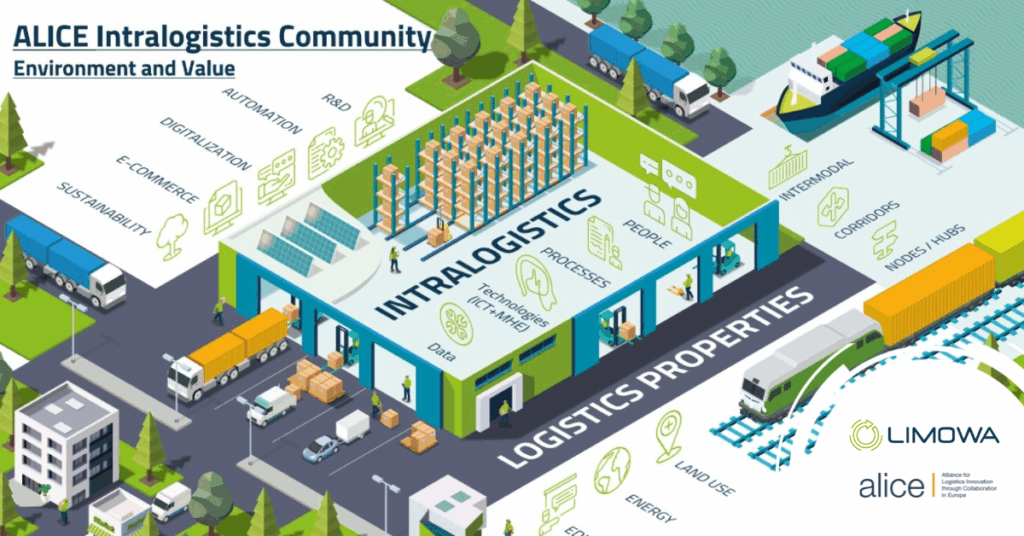
Source: picture developed by LIMOWA and adopted by ALICE Intralogistics Community.
Intralogistics is the link between transport, logistics and supply chains. Supply chain performance is strongly related to transportation and the connection with intralogistics whether in hubs, terminals, warehouses or manufacturing sites. Efficiency and seamless operations relies on predictable transport flows and handling operations in intralogistics facilities. When these domains are disconnected, inefficiencies, delays and coordination issues emerge. Notably, with the appearance of AI, Automation, Energy transition, these domains are increasingly interrelated and interdependencies are core for proper management.
ALICE’s ambition to achieve a 30% improvement in end-to-end logistics performance by 2030 cannot be realised without explicitly addressing intralogistics and its interfaces with transport and supply chain operations.
The Intralogistics Community directly supports ALICE objectives towards efficiency and decarbonization. Technology and innovation areas such as Physical Internet, Synchromodality, digitalisation (AI, data collection and exchange, etc) and automation (vehicles and robots), and the transition towards zero-emission logistics by 2050 are deeply integrated into this application domain that can provide answers and solutions for problems and opportunities beyond intralogistics. In this context, intralogistics is positioned between transport operations and a natural and needed extension of existing ALICE activities.
Within the Community, intralogistics covers internal material flow, storage and handling, inventory management, picking and packing, internal transport, and warehouse automation and control systems and the interconnection with the rest of the functions of supply chains.
The scope explicitly goes beyond traditional warehousing and also includes port operations, airport ground handling, production and assembly logistics, other controlled operational environments, and the interfaces between logistics facilities and transport corridors.
The Community addresses key challenges such as:
To tackle these challenges, the Community prioritises:
Participation in the Community offers:
The Community operates through:
Regular calls are launched for use cases, proof-of-concepts and technical visits.
Members can contribute as:
Active engagement is central to the Community’s success. Based on 42 questionnaire responses collected through the ALICE Innovation Summit and the ALICE Intralogistics Community – Member Interest Questionnaire that will continue to be open to gather feedback and collect members interest in the community.
The Community builds on discussions held at the ALICE Brokerage Event, Transport Logistic Munich, and the ALICE Logistics Innovation Summit session “Beyond Boundaries: Building Europe’s Smart and Collaborative Intralogistics Community”.
It was formally launched in January 2026 with an online Kick-Off Meeting, bringing together 25-30 participants and building on interest from more than 40 ALICE members. The full workshop report is available exclusively to ALICE members via the Knowledge Platform.
Next steps include mapping member needs and contributions, refining the 2026 work plan, collecting use cases and launching concrete collaborative activities, while strengthening links with other ALICE communities, including Ports & Hubs.
The Community is supported by the ALICE Secretariat and co-led with engaged members, including LIMOWA.
Contacts: