
Friday, September 18th, 2026
As cities work to create cleaner, healthier and more liveable urban environments, access to space is becoming a critical issue for urban logistics. Freight competes for increasingly scarce and expensive land and kerb space, while cities continue to depend on efficient deliveries and services to support residents, businesses and economic activity.
The webinar Strengthening Space for Freight: How cities and businesses can protect, preserve, and integrate land for urban logistics, held on 2 September 2026, brought together cities, logistics stakeholders and solution providers to explore how urban space can be better planned, protected, shared and managed for freight. Organised by C40 Cities and ALICE as part of the ALICE Multifunctional Urban Space Community and the NEXTLOGIC project, the session presented practical approaches from the City of Paris, City of Oslo, Weelo and Parkunload.
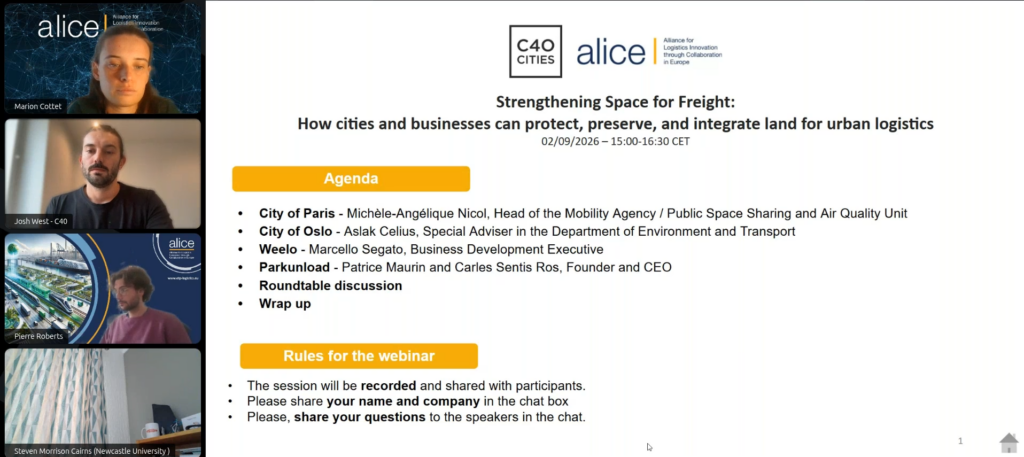
Opening the webinar, Joshua West (C40 Cities) framed the challenge around the growing competition for urban space and the need to ensure that freight is integrated into cities’ wider sustainability and mobility objectives. The objective was not simply to discuss how to create more space for logistics, but how cities and businesses can coordinate actions to preserve strategically important locations, make existing space more multifunctional and support the transition towards efficient and zero-emission urban freight.
Michèle-Angélique Nicol, Head of the Mobility Agency / Public Space Sharing and Air Quality Unit at the City of Paris, presented how Paris is embedding logistics directly into urban planning. The city handles around 1.1 million goods movements every week, with more than 90% of goods transport taking place by road. Despite this dependence on freight, logistics space within Paris has become increasingly scarce, making the protection of strategically located facilities an important element of the city’s logistics strategy.
One of the approaches presented was Paris’s use of integrating urban logistics warehouses within the city’s urban development plan, as well as the implementation of Logistics Location Perimeters, which identify plots where future development must take logistics needs into account. 116 plots are now covered by this mechanism. Paris is also developing the O+ logistics programming tool with Université Gustave Eiffel, allowing the freight movements generated by new housing, retail and office developments to be anticipated during the planning process. Together, these approaches demonstrate how cities can move from responding to logistics demand after development has taken place towards actively planning for it in advance. For more information on logistics in Paris, consult Paris’ Urban Logistics Strategy and Progress Report.
Aslak Celius, Special Adviser in the Department of Environment and Transport at the City of Oslo, explained how the city’s draft Green Mobility Plan is beginning to integrate urban logistics more systematically into mobility and street planning. Oslo expects lorry traffic to increase by around 16% and van traffic by 10% by 2036, an increase which brings with it higher emissions and air/noise pollution, an increase in the need for traffic safety, and competing usage of public space. This reinforces the need to address freight as part of the city’s wider mobility strategy.
Oslo is considering making urban logistics an explicit part of its planning process by defining it as a separate zoning purpose in the city’s planning and building act, rather than having it considered as either part of the road or parking zoning. Oslo is also exploring multifunctional and dynamic use of streets, where certain spaces can be used for logistics purposes at certain times of the day, while being used for other usages at other times. This approach demonstrates that urban space scarcity does not always need to be addressed by creating more space: cities can also improve how existing space is used.
Marcello Segato, Business Development Executive at Weelo demonstrated the importance of proximity for efficient zero-emission last-mile operations. Drawing on experience from Milan, in which using cargo-bikes reduced emissions and improved average delivery time by 23% compared with vans when deliveries remained within a compact operating area, Weelo presented three of their micro-hub concepts:
The proposed facilities can be used by multiple logistics operators, while their configuration can be adapted according to local demand. The example illustrates how multifunctional infrastructure can make scarce urban space work for both logistics and other mobility needs.
Carles Sentis Ros, Founder and CEO of Parkunload, presented Parkunload, a platform developed to manage loading and unloading zones as well as other types of free parking zones and time-limited zones in cities. This platform enables cities to manage parking digitally, adapting access conditions according to vehicle type, user category, time and other criteria.
Parkunload’s digital services address challenges including overstaying, low turnover, double parking and limited information about loading-zone use by replacing the European parking disc with their mobile app. This simplifies the enforcement of parking rules by centralising booking of parking spaces/loading zones for users in one service. At the same time, they provide cities with real-time and historical data on how kerb space is being used, allowing cities to develop policies and legislation for better multifunctional use of parking spaces and infrastructure. Parkunload reported deployment across more than 30 cities, with over 400,000 users and 10 million parking sessions.
The roundtable discussion, moderated by Marion Cottet (ALICE), highlighted that these approaches address different but interconnected parts of the same challenge. Protecting land through planning, creating micro-hubs, managing loading areas dynamically and enabling zero-emission deliveries need to be considered together rather than as isolated measures.
Participants also highlighted the importance of public-private coordination and harmonisation. Cities need operational input from logistics companies when designing freight policies and infrastructure, while businesses depend on cities to provide appropriate planning frameworks and access to strategically located space. At the same time, highly fragmented rules and systems between neighbouring municipalities can create additional complexity for operators working across several cities.
The webinar demonstrated that strengthening space for freight does not necessarily mean permanently dedicating more urban land to logistics. It can also mean protecting strategically important locations, anticipating freight demand through planning, integrating multiple functions into the same facilities and using digital tools to manage space more dynamically.
Overall, the cases from Paris, Oslo, Weelo and Parkunload point towards a broader shift from simply allocating space for freight to actively managing urban space as a multifunctional resource. Through the ALICE Multifunctional Urban Space Community and related work within NEXTLOGIC, ALICE will continue bringing together cities, authorities, businesses and solution providers to exchange practical use cases and explore how urban space can support more efficient and sustainable logistics.
Read the full report to explore the city approaches, business solutions and key lessons from the webinar in more detail.