
Wednesday, June 3rd, 2026
How can Europe move from fragmented logistics systems towards more collaborative, efficient and resilient supply chains? This question was at the centre of the roundtable session “Global, European and country-led Physical Internet research & innovation programmes including last mile and multimodality” at TRA 2026.
Bringing together representatives from industry, research organisations and innovation initiatives, the session explored how the Physical Internet (PI) concept is evolving from a long-term vision into practical implementation across urban logistics, multimodal transport and global supply chains. Discussions focused on collaboration models, data sharing, standardisation, interoperability and governance as key enablers for scaling logistics cooperation beyond isolated pilot projects.
Moderated by Sergio Barbarino from FIT Consulting and reported by Yanying Li from ALICE, the session highlighted that the Physical Internet is increasingly being recognised globally as a strategic framework for addressing capacity constraints, decarbonisation, digitalisation and logistics inefficiencies.
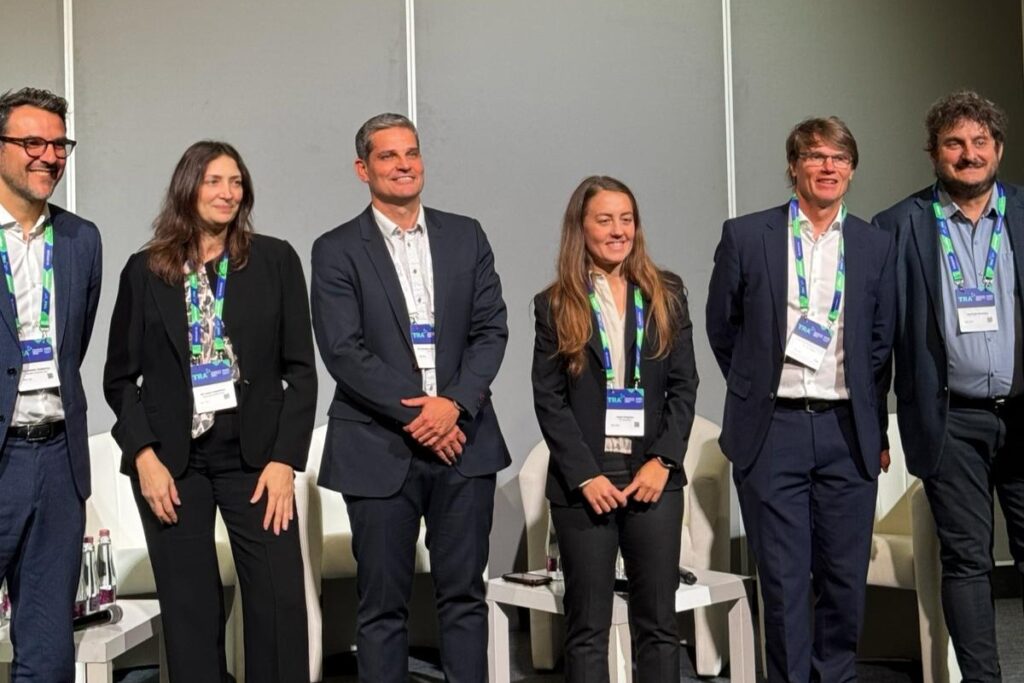
A common conclusion emerged throughout the discussion: Europe already has many successful examples of collaborative logistics and digital innovation. The next challenge is scaling these solutions through interoperability, governance and practical implementation frameworks.
Opening the session, Fernando Liesa (ALICE) presented an overview of the global evolution of the Physical Internet concept and its growing strategic relevance across different regions.
According to Fernando Liesa, supply chains and freight transport remain highly fragmented, creating inefficiencies, underused assets and difficulties in matching logistics demand with available resources. The Physical Internet aims to address these structural inefficiencies by enabling scalable collaboration through shared logistics networks, standardisation and trusted digitalisation.
The presentation highlighted the rapid international expansion of Physical Internet initiatives over the last decade. Beyond Europe, major developments are now taking place in China, Japan, Korea and other regions, where governments and industry stakeholders increasingly see the Physical Internet as a strategic response to labour shortages, rising logistics costs, decarbonisation and automation challenges.
Fernando Liesa explained that China is strongly investing in Physical Internet concepts through a top-down governmental approach, including the launch of the China Physical Internet Alliance and national initiatives linking logistics efficiency, automation and artificial intelligence. Japan is similarly using Physical Internet principles to address logistics labour shortages, low truck load factors and increasing freight inefficiencies through coordinated national initiatives led by multiple ministries.
In Europe, the Physical Internet has primarily evolved as a sustainability and logistics efficiency instrument. Fernando Liesa presented the ALICE Physical Internet Roadmap and its role in shaping European and international research and innovation activities. He also highlighted multiple Horizon Europe and national projects advancing Physical Internet implementation in areas including logistics nodes, urban logistics, multimodal systems, resilience and e-commerce.
Projects mentioned during the presentation included:
The discussion reinforced that Physical Internet principles are increasingly being applied to address major logistics challenges including decarbonisation, digitalisation, automation, capacity constraints and supply chain resilience.
A central message emerging from the session was that logistics collaboration is already happening in practice, although often in fragmented and limited forms.
Representing Gruber Logistics, Andrea Condotta challenged the common assumption that logistics operators are unwilling to cooperate. Using concrete operational examples from groupage and less-than-truckload (LTL) operations, he demonstrated how logistics providers already share assets, networks and infrastructure when economic conditions create mutual value.
Andrea Condotta explained that partnerships between logistics operators frequently allow companies to extend distribution networks into new countries without requiring major investments in warehouses or infrastructure. In these cases, companies can simultaneously act as both customers and service providers within reciprocal cooperation agreements.
However, he stressed that these forms of cooperation remain difficult to scale due to limited digitalisation, fragmented governance and lack of standardised collaboration frameworks. Much of the operational coordination still depends on manual communication and bilateral agreements rather than interoperable digital ecosystems.
The discussion also highlighted that collaboration models differ significantly depending on the logistics segment. While collaboration is relatively common in groupage and shared distribution networks, full truckload operations remain highly competitive and less open to direct operational cooperation between competitors.
Andrea Condotta argued that future innovation efforts should focus less on theoretical collaboration concepts and more on supporting cooperation models that already exist in operational logistics markets. According to him, the Physical Internet will succeed not because logistics markets become “ideal”, but because innovation learns to work with the complexity and opportunistic nature of real logistics ecosystems.
Urban logistics emerged as one of the areas where Physical Internet principles are already being operationalised through concrete demonstrations and pilot projects.
Representing FIT Consulting, Paola Astegiano presented examples from projects including DISCO, SHIFT2ZERO and IKIGAI, showing how collaborative urban logistics systems can support more efficient and sustainable last-mile operations.
The presentation highlighted several major urban logistics challenges:
According to Paola Astegiano, future urban logistics systems require systemic planning approaches rather than isolated measures. This includes pooling assets such as vehicles, infrastructure and urban logistics space while combining digital tools, predictive analytics and multimodal coordination.
Concrete examples presented during the session included:
The projects demonstrated how collaborative urban logistics systems can improve asset utilisation, reduce congestion and support zero-emission last-mile operations while integrating Physical Internet principles into practical city logistics solutions.
Data sharing and interoperability were repeatedly identified as critical enablers for scaling collaborative logistics systems.
Representing INLECOM, Ioanna Fergadiotou focused on the role of logistics data spaces and trusted digital ecosystems in supporting collaborative urban logistics.
Building on experiences from the DISCO and URBANE projects, she demonstrated how operators can collaborate operationally without exchanging commercially sensitive datasets. One example presented during the session involved locker networks in Barcelona, where operators participating in separate projects used data-space connectors to share only minimal operational information such as locker locations and available capacity. This allowed both operators to optimise delivery networks and improve asset utilisation without revealing sensitive business information.
A strong message from the presentation was that the main barrier to collaboration is often not technology itself, but governance, trust and identifying the real value of data sharing. Ioanna Fergadiotou stressed that companies do not need to exchange all operational data to collaborate effectively. Instead, the challenge is identifying which limited datasets can create operational value in trusted ecosystems.
The session also highlighted that data space should evolve into practical and standardised infrastructures similar to widely adopted enterprise software systems, allowing companies to participate in collaborative ecosystems through simple and interoperable solutions.
Concluding the session, Eric Ballot (MINES Paris) addressed the role of standardisation in enabling large-scale logistics coordination.
Using the maritime container as a historical example, Eric Ballot argued that standardisation should be understood as an operational opportunity rather than a restriction. The standardisation of maritime containers dramatically reduced transshipment costs and enabled entirely new logistics systems. According to Ballot, inland logistics and urban logistics now face a similar opportunity.
He explained that logistics already contains many fragmented standards, but lacks sufficiently harmonised systems capable of supporting large-scale interoperability. The next challenge is therefore not eliminating diversity, but identifying practical coordination frameworks capable of scaling successful solutions.
Eric Ballot also presented the IKIGAI project’s work on developing operational “norms” inspired by the collaborative development processes of the Internet Engineering Task Force (IETF). Instead of imposing rigid top-down standards, the idea is to develop practical coordination frameworks based on tested pilot implementations and continuous improvement through industry feedback.
According to the discussion, successful scaling of the Physical Internet will require:
The session concluded with a broad consensus that the Physical Internet is no longer only a conceptual vision. Collaborative logistics models, digital coordination tools and operational pilots already demonstrate its practical potential. The next challenge for Europe will be accelerating implementation, strengthening governance and transforming isolated innovations into scalable logistics ecosystems capable of supporting resilience, decarbonisation and competitiveness across global supply chains.