
Tuesday, February 17th, 2026
Urban logistics is undergoing a profound transformation, driven by the need for more efficient, sustainable and collaborative systems. Within this context, the DISCO project set out to translate the ambitious vision of the Physical Internet (PI) into concrete, operational solutions that cities can actually deploy. At the heart of this effort lies a suite of methods, approaches and digital tools, known as the DISCO-X innovations, that were implemented and tested across 8 Living Labs in Europe. Rather than simply developing new technologies, DISCO focused on adapting, enhancing and validating existing tools so that they could effectively support PI principles in real urban environments.
This work followed a structured, retrospective approach: starting from the results achieved in the Living Labs, it identified which innovations truly enabled Physical Internet concepts, how they aligned with the ALICE PI Roadmap, and which specific enhancements helped bridge the gap between strategic vision and day-to-day logistics operations. The outcome is a clear picture of how PI concepts can move from theory into practice through targeted digital and organisational solutions.
The strong alignment between DISCO and ALICE has been a key success factor in ensuring that project results contribute to a broader, long-term European vision for logistics innovation. DISCO implements the PI-led digital transition processes in urban logistics and planning defined in the ALICE Roadmap to the Physical Internet. The project delivers concrete insights into how Physical Internet concepts can be applied at city level, including lessons on governance models, data sharing between public and private actors, and develops the related innovative business models. At the same time, ALICE plays a central role in amplifying and sustaining DISCO’s impact. As Exploitation Manager and a member of the Project Governing Board, ALICE supports the dissemination of results, connects DISCO with related initiatives, and helps position project outcomes within wider European and international discussions. Through its networks and expert groups, ALICE contributes to building synergies across stakeholders and to shaping policy perspectives on urban freight, land use and digital transformation. This two-way collaboration ensures that DISCO’s Living Lab experiences do not remain isolated pilots, but instead feed into a shared roadmap for scaling up Physical Internet solutions across European cities.
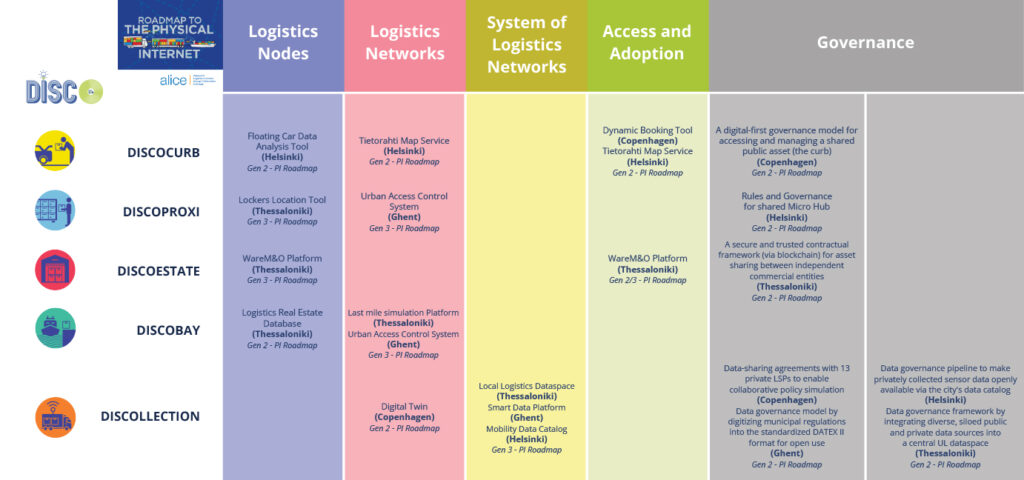
A core element of the work was the systematic mapping of DISCO tools against the ALICE Physical Internet Roadmap. This made it possible to understand where existing solutions already supported PI principles and where targeted enhancements were needed.
Together, these results show that ‘PI-readiness’ is not exclusive to new technology. Even existing legacy systems, when properly enhanced with PI ‘must-haves’ and interconnected seamlessly, can meet the rigorous standards of the ALICE roadmap, demonstrating realistically that the Physical Internet can be realized through the intelligent evolution of current assets.
DISCO demonstrates how the Physical Internet can be operationalised in cities through a pragmatic, bottom-up approach. By working with Living Labs and adapting existing tools to local contexts, the project translated PI concepts into tangible solutions that improve efficiency, sustainability and collaboration in urban logistics.
The alignment of DISCO innovations with the ALICE PI Roadmap confirms that the project contributes across all core PI building blocks – from optimising logistics nodes and networks to strengthening data interoperability, governance and adoption mechanisms. While early efforts naturally focused on physical infrastructure and operational flows, DISCO also delivered significant progress in the enabling digital and organisational layers that are essential for scaling up PI solutions.
Overall, DISCO provides cities, practitioners and policymakers with a concrete pathway to advance urban logistics in line with the Physical Internet vision – turning strategy into action and pilots into replicable models for future deployment.