
Tuesday, November 3rd, 2026
The DISCO project has developed and tested ten key exploitable results (KERs) addressing some of the main challenges of urban logistics: fragmented data, limited access to logistics space, inefficient use of infrastructure and the need for better coordination between cities and operators. These results combine digital tools and new approaches to shared capacity, complemented by policy guidance to support more efficient and sustainable urban freight operations.
The project has explored how existing logistics resources can be used more effectively, rather than relying exclusively on additional infrastructure. Its work covers data exchange, warehouse and storage capacity, curbside management, urban access, parcel delivery and logistics resilience. Alongside these solutions, DISCO has examined the governance, business and operational conditions needed for their adoption.
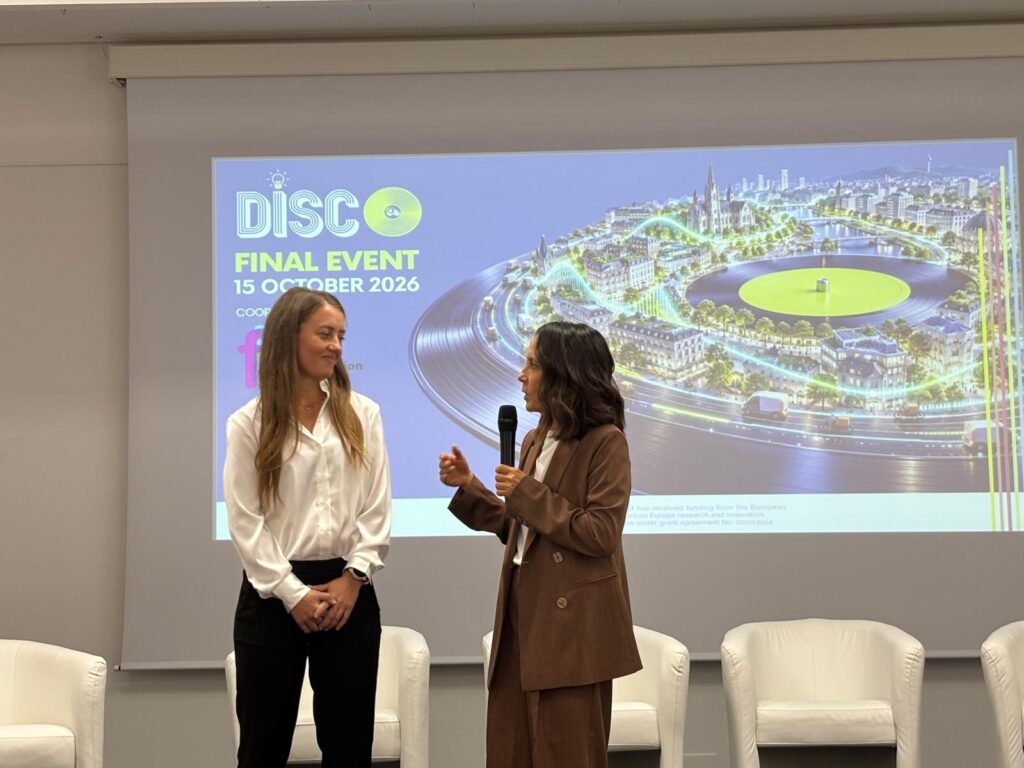
The results were presented at the DISCO Final Event on 15 October 2026 in Rome, where representatives of cities, logistics companies, research organisations and public authorities discussed their practical application and potential for wider uptake.
During the event, Andrea Condotta, ALICE President, highlighted the importance of identifying common interests between cities, logistics operators and businesses to enable investment and cooperation. He pointed to the challenges facing the logistics sector, including workforce shortages, operational pressures and the need to maintain reliable freight services, stressing the importance of making better use of existing resources. In this context, he emphasized how digitalization and the Physical Internet can support more efficient operations while contributing to cities’ sustainability objectives. He also underlined ALICE’s role in bridging research and innovation with operational practice, encouraging open discussions about remaining barriers and conflicting interests to help turn project results into solutions that can be adopted more widely.
DISCO’s main technical outputs include ten key exploitable results, covering different aspects of urban freight planning, data management and the use of logistics infrastructure.
ALICE developed innovation cards for all ten solutions to make the results more accessible to potential users and stakeholders. As Exploitation Manager, ALICE also worked with solution owners to identify target users, define value propositions, assess business models and examine ownership, access rights and reuse conditions. Where appropriate, dedicated business plans were developed to support further exploitation.
A central finding from DISCO is that cities and logistics operators can improve efficiency by making better use of infrastructure and capacity that already exist. Digital tools can help identify available warehouse space, logistics facilities and curbside resources, while collaborative arrangements can make this capacity accessible to different operators. However, turning available resources into usable logistics capacity requires more than technological solutions: it depends on the operational feasibility, economic interests and coordination needs of the stakeholders involved.
However, available space is not necessarily usable capacity. The location of a facility, its connection to existing delivery networks and the timing of its availability all determine whether sharing is operationally feasible.
During the final event session on innovation in urban logistics and the optimal use of space, moderated by Paola Astegiano, Head of Research and Innovation at FIT Consulting, Johan Lévêque, Director of Sustainable Innovation at La Poste and ALICE Vice-Chair, brought an operational perspective to the discussion. He explained that sharing logistics space requires more than identifying available facilities: their location within delivery networks, operating schedules and ability to accommodate disruptions all determine whether shared capacity can be used effectively. Drawing on La Poste’s experience, he highlighted opportunities to coordinate space and operating times across subsidiaries and combine different delivery modes, including cargo bikes.
DISCO’s work therefore connects the identification of spare capacity with the practical conditions required to use it. The project’s digital marketplace and curbside management solutions address parts of this challenge, while its broader findings highlight the importance of network organisation and cooperation between infrastructure owners, logistics operators and cities.
DISCO has also addressed how data can support better urban freight decisions. Its Urban Freight Data Space, Smart Data Platform and DISCO Meta Model Suite contribute to this work by focusing on information exchange, common approaches to data and the use of digital tools in logistics planning.
The project has highlighted that data sharing depends on more than technical compatibility. Operators need to understand why information is requested, how it will be used and what value they receive from participating. Paola Cossu, CEO of FIT Consulting and DISCO Coordinator, stressed that willingness to share data is also a cultural and organisational challenge. Clear responsibilities are particularly important when infrastructure ownership, service operation and public benefits involve different stakeholders.
These findings point to the need for common data definitions, compatible formats and clear sharing protocols, while allowing cities to accommodate their different regulatory and operational contexts. More consistent requirements could reduce complexity for logistics operators working across several cities, provided that governance arrangements also establish trust and clarify access to information.
Beyond its digital solutions, DISCO has contributed to policy discussions on the more efficient and multifunctional use of urban space. One important result is its contribution to the updated Sustainable Urban Logistics Plan (SULP) Topic Guide, particularly on optimising space and making better use of existing infrastructure.
The project also developed a Mission-Oriented Policy Package to address the conditions supporting urban logistics innovation and implementation. ALICE contributed to this work alongside partners including POLIS and Rupprecht Consult, helping involve cities, operators, researchers and policymakers in reviewing project findings. Online exchanges and an in-person workshop enabled participants to compare implementation experiences, discuss barriers and consider whether approaches developed in one city could be applied elsewhere.
Another relevant output is the joint statement “Co-Creating the Future of Urban Logistics: A Strategic Dialogue Between Cities, Parking Managers and Logistics Innovators”, issued by ALICE, POLIS and the European Parking Association. It establishes shared priorities for cooperation on urban logistics and space management.
ALICE’s role in DISCO focused on ensuring that the project’s results could reach potential users and remain relevant beyond the project. In addition to coordinating exploitation activities for the ten solutions, ALICE mapped DISCO’s tools and approaches against the ALICE Physical Internet Roadmap. This work identified how the solutions support Physical Internet principles and where further improvements are needed.
ALICE also strengthened cooperation with other European urban logistics projects, including UNCHAIN, URBANE, DECARBOMILE, GREEN-LOG and DELPHI. These exchanges helped compare experiences from different Living Labs, identify synergies and explore opportunities for continued collaboration.
Knowledge-sharing activities included the POLIS-ALICE Urban Logistics Webinar Series (listed here), covering topics such as mixed-use urban space and curbside management, as well as exchanges with EIT Urban Mobility and the European Space Agency. DISCO results were also shared through the Transport Logistic exhibition in Munich, the International Physical Internet Conference, the Transport Research Arena and the ALICE Logistics Innovation Summit. In particular, the POLIS–ALICE Urban Logistics Innovation Days provided opportunities to exchange experiences with cities, logistics operators and other European projects addressing similar challenges.
DISCO provides ALICE members with practical tools and lessons on urban freight data sharing, Physical Internet implementation, logistics capacity management and multifunctional urban space. Its results address both the technologies that can support more efficient operations and the business, governance and operational requirements that determine whether these solutions can be adopted.
The findings are particularly relevant to ALICE’s Digital Urban Freight and Multifunctional Urban Space Communities, which provide opportunities for cities, logistics operators, infrastructure managers, researchers and technology providers to continue exchanging experiences and exploring collaboration. Members can use DISCO’s innovation cards and exploitation findings to identify solutions relevant to their activities, while its policy work and SULP contributions provide guidance on the wider conditions for implementation.
DISCO’s legacy combines ten key exploitable solutions with practical experience in data sharing, capacity optimisation, stakeholder cooperation and urban logistics planning. Together, these results provide a basis for further adoption, replication and development of more interconnected and sustainable urban freight services.
More relevant resources from DISCO: