DELPHI Final Event: Building the Legacy Beyond the Project
Friday, July 10th, 2026
The DELPHI Final Event, held in Athens, Greece, on 18 June 2026, marked the conclusion of three years of collaboration to advance more coordinated, data-enabled mobility for passengers and freight. Through pilot demonstrations in Madrid, Attica, Mykonos and Cluj-Napoca, the project explored how data sharing, optimization, governance and transport network management can support more efficient and sustainable mobility systems. Check out DELPHI’s innovations here.
Throughout the project, ALICE contributed to dissemination, communication, exploitation and stakeholder engagement activities, while contributing to the development of standardization contributions, policy recommendations and activities promoting data interoperability for combined passenger and freight transport.
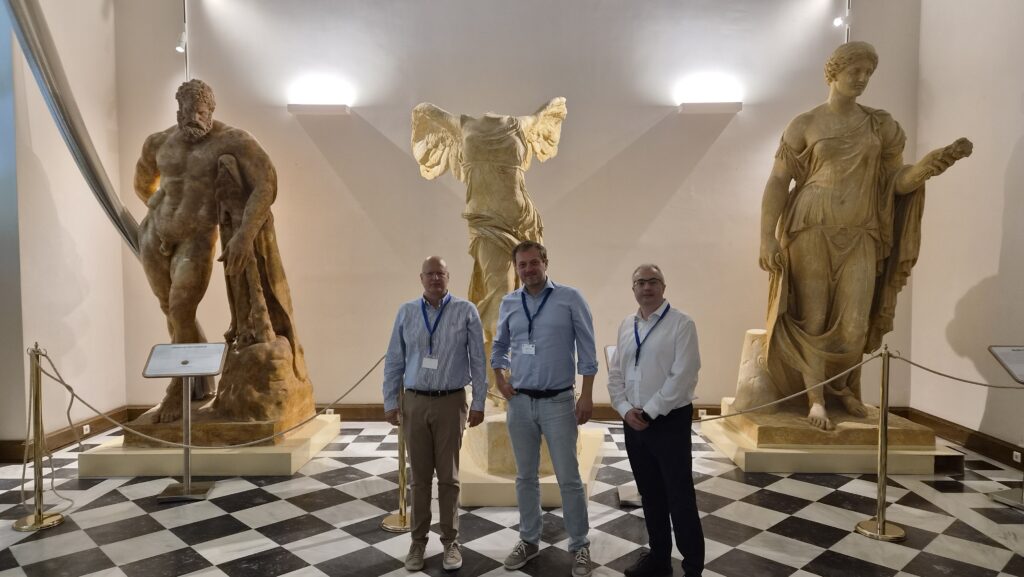
During the final event, Tomasz Dowgielewicz presented how DELPHI’s results will continue through the Digital Urban Freight Community, ensuring that the project’s knowledge, recommendations and stakeholder network remain active beyond the project’s lifetime. The event also highlighted future developments around mobility data spaces, AI-driven mobility orchestration, digital twins and continued collaboration through the Multimodal Traffic Management Cluster.
Knowledge & Results
Throughout the project, ALICE contributed to the development and dissemination of resources supporting interoperable and data-driven urban logistics. These include policy recommendations, standardization contributions, scientific publications and practical guidance that remain available to support future research and deployment.
Key resources include:
Deliverable D2.1 – State-of-the-art report in governance, relative technologies and stakeholder ecosystems in passenger and freight transport (Deliverable available here)
Deliverable D6.5 – Standardization Contributions and Policy Recommendations (Deliverable soon available here)
Deliverable D6.11 – Final DELPHI Report on Networking and Engagement Activities (Deliverable soon available here)
Throughout DELPHI, ALICE organized and contributed to a wide range of activities to engage stakeholders, promote interoperability and disseminate project results.
POLIS-ALICE Joint Guide for advancing towards zero-emission urban logistics by 2030
One of DELPHI’s most important outcomes is the Digital Urban Freight Community, established and coordinated by ALICE to ensure that collaboration continues beyond the project.
Since its launch, the community has brought together cities, industry, researchers and technology providers through a survey, workshops and knowledge exchange activities. These interactions helped identify and validate the main interoperability challenges affecting urban logistics while producing practical recommendations for improving data sharing and digitalization.
Going forward, the community will continue supporting discussions on data interoperability, mobility data spaces, practical use cases, standards and policy recommendations, ensuring that DELPHI’s results remain accessible and continue to benefit the wider urban logistics ecosystem.