Tuesday, June 9th, 2026
At IPIC 2026 in Bordeaux, the session “Interoperability Foundations” explored one of the key challenges for the realization of the Physical Internet: enabling organisations, platforms and logistics systems to exchange information and coordinate operations efficiently across organisational and technological boundaries.
Moderated by Eva Petitdemange, the session brought together researchers working on semantic interoperability, federated data exchange, AI-enabled translation mechanisms and governance frameworks designed to support large-scale collaboration while preserving organisational autonomy.
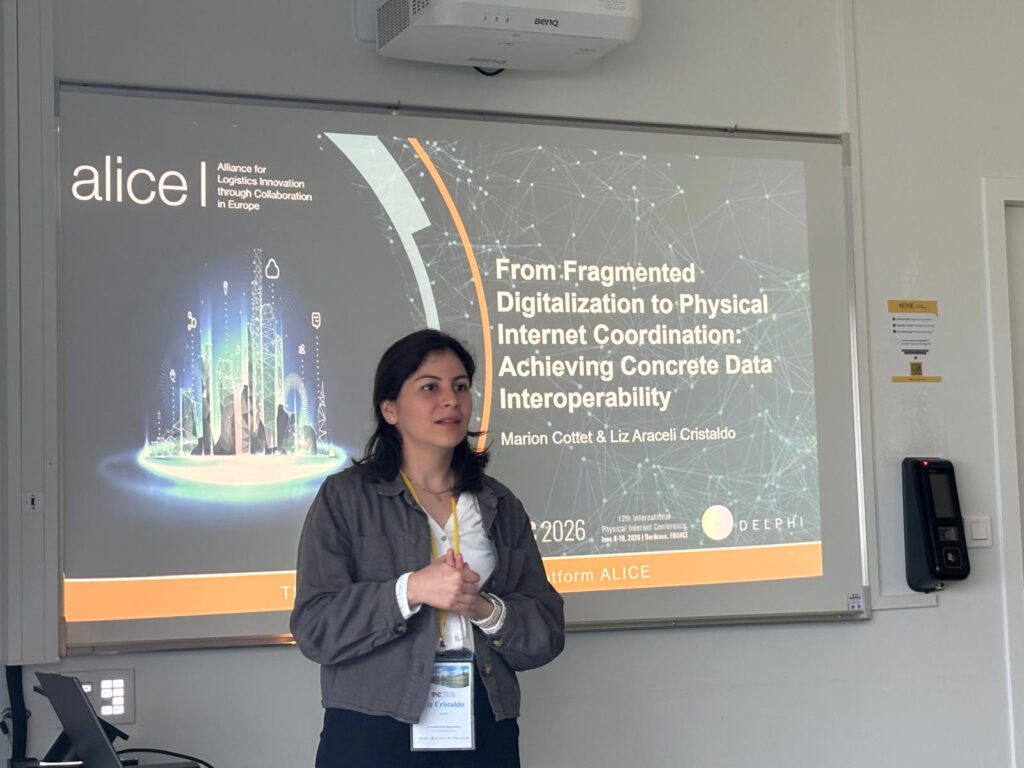
A central contribution of the session was presented by Liz Araceli Cristaldo and Marion Cottet through their paper “From Fragmented Digitalization to Physical Internet Coordination: Achieving Concrete Data Interoperability.”
Developed in the context of the DELPHI project, the work examined how growing digitalisation in logistics and mobility is generating increasing volumes of data, while fragmentation continues to limit effective data sharing and coordinated decision-making.
The researchers analysed the current European interoperability landscape, reviewing existing initiatives, standards, data spaces and governance approaches. Their work identified several recurring challenges that continue to hinder interoperability implementation across logistics ecosystems, including semantic inconsistencies between systems, governance complexities, limited incentives for data sharing, insufficient implementation guidance and varying levels of stakeholder readiness.
To validate these findings, the authors conducted a stakeholder survey involving actors from urban mobility and logistics ecosystems. The results confirmed that interoperability challenges are not purely technical but also organisational and governance-related, requiring coordinated action across multiple dimensions.
The DELPHI research emphasised the importance of developing practical implementation pathways that help stakeholders move from fragmented digitalisation towards coordinated Physical Internet operations. Recommendations included strengthening governance frameworks, supporting semantic interoperability, improving implementation guidance and fostering trust-based data sharing environments.
The presentation highlighted that achieving interoperability requires more than connecting systems – it requires aligning actors, processes and governance structures to enable meaningful collaboration across logistics networks.
This paper was written thanks to the collaborative work carried out within ALICE’s Digital Urban Freight Community, where cities, logistics stakeholders, researchers and technology providers are working together to advance interoperable digital solutions for urban freight. By connecting research with practical implementation, the Community provides a forum to further develop approaches to semantic interoperability, data governance and trusted data sharing discussed during the session.
The session opened with a presentation by Leonardo Daou, Eva Petitdemange, Gregory Zacharewicz, Séverine Durieux and Nicolas Daclin on “Enabling the Physical Internet through AI-Driven Federated Interoperability.”
The authors proposed a federated approach to interoperability that allows organisations to maintain their own systems while using AI-supported ontology matching techniques to dynamically translate concepts and meanings between heterogeneous data models.
Their work explored how artificial intelligence can support semantic alignment across logistics ecosystems while reducing the costs traditionally associated with system integration and standardisation efforts.
In the second presentation, Gero Niemann and Rod Franklin introduced “Dynamic Semantic Interoperability for the Physical Internet Using LLM-Based Translation Agents.”
The research addressed one of the most persistent barriers to collaboration: the difficulty of understanding data exchanged between organisations that use different structures, terminologies and business models.
The authors proposed an interoperability layer powered by large language models capable of translating between heterogeneous logistics data models, enabling faster onboarding of new partners and reducing integration complexity. The work demonstrated how AI could contribute to more flexible and adaptive interoperability mechanisms while maintaining reliability through a combination of deterministic mappings and machine intelligence.
The final presentation, delivered by Philippe Michiels, Julián Rojas and Birger Schrevens, focused on “Policy-based and Process-Aware Interoperability in the Physical Internet.”
The authors argued that interoperability should not be limited to data exchange but should also support coordination of operational processes and services across organisations.
Using practical logistics examples, they demonstrated how federated and event-driven architectures can enable organisations to coordinate activities while maintaining control over their own systems and data. Their proposed approach introduces mechanisms for service discovery, negotiation and process execution that support collaboration without requiring centralised control.
A key message was that stakeholders are often more willing to collaborate around shared processes than around direct data sharing, making process interoperability an important complement to data interoperability initiatives.
The session demonstrated that interoperability remains a cornerstone of Physical Internet implementation. Across the presentations, researchers highlighted the need to combine technical solutions with governance mechanisms, semantic alignment and trusted collaboration frameworks.
The DELPHI contribution particularly underlined the importance of moving from fragmented digitalisation efforts towards concrete interoperability practices that can support coordinated logistics operations at scale. Together with advances in AI-enabled interoperability and process-aware collaboration models, these developments contribute to creating the foundations for more connected, resilient and sustainable logistics ecosystems.