
Wednesday, September 23rd, 2026
How can cities make better use of freight data, coordinate increasingly complex urban logistics operations and redesign limited urban space while progressing towards climate neutrality? These questions were central to ALICE’s participation in the CIVITAS Forum 2026, held from 15 to 17 September in Thessaloniki, Greece.
Under the theme “Roots & Routes: Moving Forward to Competitive, Connected and Resilient Urban Mobility!”, the CIVITAS Forum brought together city representatives, policymakers, practitioners, researchers and mobility stakeholders to exchange practical experience on sustainable urban mobility.
ALICE was represented by Yanying Li and Marion Cottet, contributing to discussions on urban freight data, logistics operations and the transformation of urban space. Their participation also provided opportunities to strengthen connections with initiatives including NetZeroCities, exchange with European projects working on the next generation of sustainable urban logistics, and connect CIVITAS discussions with ongoing research and innovation activities through projects including DISCO, GreenTurn, NEXTLOGIC and GOLIA.
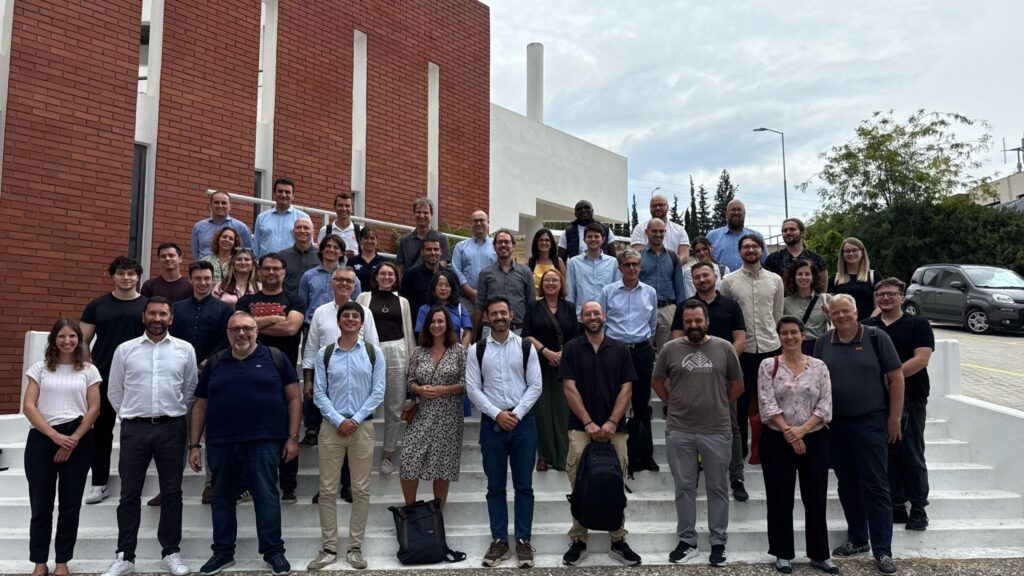
A central contribution from ALICE was the panel discussion “Urban Freight Data Connectivity and System Operations: From Data Sharing to Measurable Outcomes”, moderated by Marion Cottet, Urban Logistics Lead at ALICE.
Cities increasingly recognise that better freight data can support curbside management, congestion reduction, more efficient last-mile operations and climate objectives. However, the challenge is moving from having fragmented datasets across public and private organisations towards information that authorities and logistics stakeholders can use for operational decisions.
The session addressed this gap through practical experiences from Munich, Madrid, Thessaloniki and Vitoria-Gasteiz. Together with Marion Cottet, the panel brought together Annika Paul from the City of Munich, Sergio Fernandez Balaguer from EMT Madrid, Paola Astegiano from FIT Consulting, Iñigo Bilbao Ubillos from Mobility Lab Vitoria-Gasteiz and Vasileios Giannoudis from CERTH.
The discussion explored how freight data is being used in practice, from monitoring and managing loading areas and urban space to planning shared logistics infrastructure and building trusted data-sharing environments to support city decision-making and logistics operations. Rather than considering data sharing as an objective in itself, the session highlighted the importance of starting from the operational decisions cities and logistics stakeholders want to improve, and then identifying the data needed to support them.
The examples also showed that useful freight data does not necessarily need to be complex. Information on the occupancy and use of urban space, vehicle movements or delivery activity can already support concrete decisions on planning, curbside management and operations. Technical solutions, however, are only part of the process. Interoperability, trusted governance, regulatory frameworks and cooperation between public and private stakeholders are critical to turn data-sharing pilots into operational solutions that can be sustained and scaled. The discussion therefore explored what has already been implemented, the barriers encountered, and what is needed to move from experimentation towards lasting operational value and measurable outcomes.
The Forum also provided an opportunity to connect discussions with implementation on the ground. ALICE participated in a visit to ACS facilities in Thessaloniki linked to the DISCO project, bringing the exchange on sustainable urban logistics into a real operational environment.
In conjunction with the CIVITAS Forum, the Shift2Zero project also held its General Assembly at the premises of CERTH, an ALICE member, with Yanying Li representing ALICE in the meeting. The General Assembly provided an opportunity for project partners to review progress and coordinate the next steps towards developing and demonstrating innovative solutions for zero-emission freight transport.
The programme also included a site visit to the warehouse of DIAKINISIS in Thessaloniki, one of the region’s major logistics service providers and an ALICE member. The visit provided participants with direct insight into logistics operations and an operational setting in which the challenges and opportunities addressed through European research and innovation can be considered in practice.
These activities complemented the wider presence of European urban logistics projects at CIVITAS, including DISCO, GreenTurn, NEXTLOGIC and GOLIA, creating opportunities to exchange experience across initiatives addressing different elements of urban freight transformation.
ALICE also met with NetZeroCities, strengthening the connection between logistics innovation and the wider transition towards climate-neutral cities. Freight and logistics interact directly with urban space, infrastructure, energy, mobility planning and local climate objectives, making closer links between logistics stakeholders and city-transition initiatives increasingly important.
ALICE also took part in the NEXTLOGIC workshop “Co-designing climate-neutral & livable urban spaces: addressing urban redesign challenges”.
The interactive session brought together the newly launched Horizon Europe projects Urban-Flow, CORESpaces and NEXTLOGIC, which are working on different aspects of urban space transformation. Participants used a design-thinking approach to examine real-world urban redesign scenarios and identify relevant stakeholders, their needs, potential conflicts and acceptable trade-offs.
The workshop addressed a fundamental challenge facing European cities: urban space is limited, while demands from mobility, logistics, the energy transition and liveability continue to increase. Decisions about how streets and other public spaces are used therefore cannot be addressed through isolated interventions.
Through role-based co-creation exercises, participants examined urban redesign as a question not only of infrastructure or technology but also of coordination, governance and negotiation between actors with different needs. The exercise reflected a broader shift towards integrated approaches in which logistics is considered alongside other urban functions when planning the use of public space.
ALICE’s participation at CIVITAS Forum 2026 highlighted a common thread across these activities: achieving more sustainable urban logistics requires stronger connections between data, operations, urban planning and collaboration.
Better freight data can support decision-making, but only when cities and private operators establish workable arrangements for accessing and using it. New logistics concepts can reduce pressure on urban space, but their implementation needs to reflect local conditions and competing uses. Technologies can enable new operational models, but governance and cooperation determine how effectively they become part of the wider urban system.
The exchanges in Thessaloniki also reinforced the importance of connecting European research and innovation projects with cities and operational environments. Through the participation of projects such as DISCO, GreenTurn, NEXTLOGIC and GOLIA, discussions at CIVITAS could link emerging approaches with practical urban challenges and create opportunities for knowledge transfer across projects and cities.
For ALICE, these connections are essential to ensuring that logistics remains an integral part of Europe’s transition towards competitive, connected, resilient and climate-neutral cities.