
Thursday, June 25th, 2026
The webinar “End-to-End Trustworthiness in Autonomous Waterborne Logistics – Insights from SEAMLESS”, held on 15 June 2026, brought together experts from the maritime, logistics, cybersecurity and research communities to discuss the challenges and opportunities associated with autonomous waterborne freight transport. Organised within the Horizon Europe SEAMLESS project, the session explored the evolving cyber threat landscape affecting autonomous maritime systems and presented approaches to ensure secure, resilient and trustworthy autonomous logistics services.
As autonomous vessels, remote operation centres and digital logistics platforms become increasingly interconnected, cybersecurity is emerging as a fundamental enabler of future waterborne freight transport. The webinar highlighted that trustworthiness must extend beyond individual vessels and include the wider ecosystem of ports, communications networks, infrastructure operators and logistics service providers.
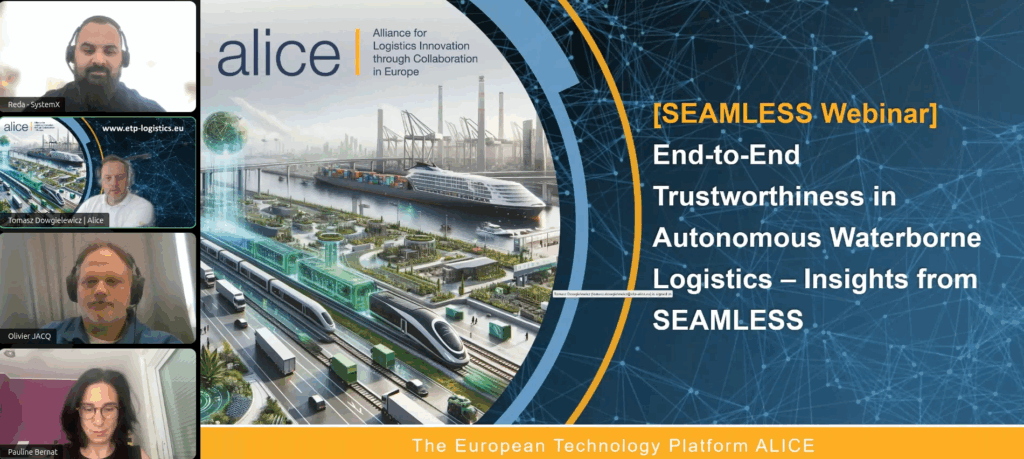
The session was opened by Tomasz Dowgielewicz (ALICE), who introduced the SEAMLESS project and its ambition to develop autonomous and economically viable waterborne freight transport services. He explained that the project combines technological building blocks with enabling activities covering regulation, safety assessment, business models and impact evaluation. Through demonstrations in inland waterways and short-sea shipping, SEAMLESS aims to contribute to the development of safe, resilient and sustainable autonomous transport services in Europe.
Olivier Jacq (Institut de Recherche de l’Ecole Navale) provided a keynote presentation on the cyber threat landscape affecting maritime systems. Drawing on a database of approximately 1,500 publicly reported maritime cybersecurity incidents, he demonstrated that cyber threats are already a daily operational reality for ports, logistics operators, shipping companies and critical infrastructure providers. Recent incidents involving ransomware, distributed denial-of-service attacks and cyber intrusions illustrate the growing exposure of maritime operations to digital threats.
Particular attention was given to the vulnerabilities associated with Global Navigation Satellite Systems (GNSS), which play a critical role in autonomous navigation. Examples from the Eastern Mediterranean and Baltic Sea regions demonstrated how interference, jamming and spoofing can disrupt vessel positioning. Olivier highlighted incidents where vessels appeared to be located at airports or in entirely different locations due to manipulated navigation signals. While human crews can sometimes identify and correct such anomalies, autonomous systems increasingly depend on digital inputs and therefore require additional safeguards to ensure safe navigation.
The presentation also highlighted the growing dependence of autonomous maritime systems on communications infrastructure. Autonomous and remotely operated vessels rely on continuous connectivity between vessels, ports and remote operation centres, making communications systems operationally critical. Examples such as the KA-SAT cyberattack and coordinated disruptions affecting satellite communication systems illustrated how communications infrastructure can become a strategic target with potentially significant consequences for transport operations.
Olivier further emphasised that autonomous maritime transport depends on a broad ecosystem of interconnected technologies and stakeholders. Navigation systems, ship-to-shore communications, remote operation centres, port community systems, logistics platforms and third-party data services all form part of a wider dependency chain. Cyber incidents affecting any of these elements can create cascading consequences across the logistics network. As autonomy increases, many traditional human checks are removed or relocated, changing the nature of cyber risk and increasing the importance of resilient system design.
The second presentation, delivered by Reda Yaich (IRT SystemX), focused on the SEAMLESS approach to cybersecurity, trust and resilience. He explained that while cybersecurity remains essential, it is no longer sufficient on its own to address the challenges associated with autonomous and interconnected logistics ecosystems. According to Reda, the future of autonomous maritime logistics depends on building resilient ecosystems capable of maintaining operational continuity even when disruptions occur.
A central theme of the presentation was the evolution from reliability and robustness towards resilience. Traditional engineering approaches focused on preventing failures, while cybersecurity introduced mechanisms to resist known threats and vulnerabilities. However, autonomous logistics systems increasingly operate in environments characterised by evolving threats, complex dependencies and uncertainty. Resilience therefore becomes essential to ensure continuity of operations and preserve trust despite disruptions.
Reda also highlighted that trust in autonomous maritime logistics extends far beyond the vessel itself. Autonomous operations depend on a network of stakeholders including technology providers, communications operators, ports, authorities, remote operation centres and logistics service providers. Because these actors are interconnected and interdependent, trust must be considered at ecosystem level.
To support this approach, the SEAMLESS project applies the EBIOS RM methodology developed by the French National Cybersecurity Agency (ANSSI). The methodology enables organisations to analyse ecosystem dependencies, identify critical stakeholders, assess realistic attack scenarios and understand how trust can be compromised across complex operational environments. This ecosystem-level perspective helps identify vulnerabilities that may not be visible when focusing solely on individual systems or organisations.
The webinar also explored how cyber threats evolve from opportunistic attacks such as phishing and ransomware towards more complex scenarios involving supplier compromises, software manipulation and coordinated attacks across multiple organisations. Such threats demonstrate the importance of understanding ecosystem dependencies and developing resilience measures that extend beyond organisational boundaries.
The session concluded with a discussion on the importance of security-by-design, resilience and trustworthiness as enabling factors for autonomous maritime logistics. Participants reflected on the implications of GNSS interference, digital dependencies and ecosystem-wide risks, highlighting the need for continued collaboration between technology developers, operators, infrastructure providers and policymakers.
Overall, the webinar demonstrated that the future of autonomous maritime logistics depends not only on advances in automation technologies but also on the ability to create trusted, resilient and secure logistics ecosystems. Through its combination of technological innovation, risk assessment and ecosystem-level resilience approaches, the SEAMLESS project is helping to lay the foundations for safe and economically viable autonomous waterborne freight services in Europe.
Read the full report to explore the use cases, insights and lessons in detail.