
Monday, March 2nd, 2026
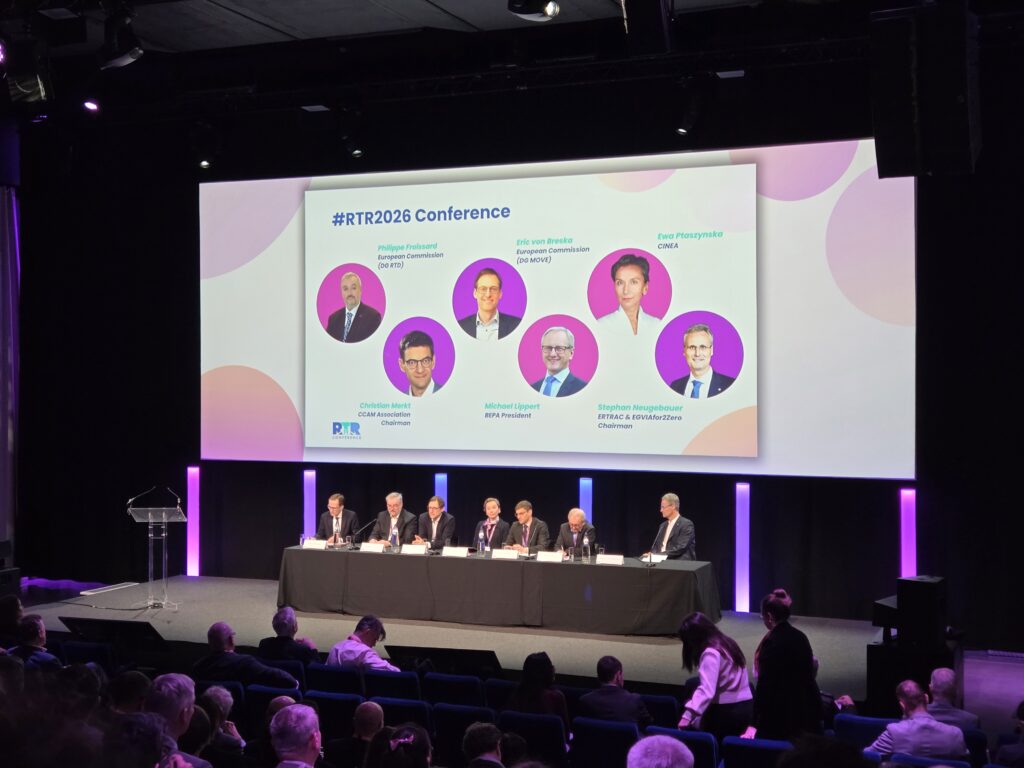
From 10 to 12 February 2026, the 9th edition of the RTR Conference brought together more than 500 participants in Brussels to showcase the results of EU-funded road transport research and discuss the next steps towards greener, safer and smarter mobility. With 95 projects presented across 32 sessions and 10 thematic areas, the conference offered a comprehensive view of how Horizon Europe is shaping the future of road transport.
ALICE played an active role in the Logistics (LOG) thematic area, contributing to three key sessions addressing last-mile decarbonisation, future-proof freight transport and zero-emission e-commerce.
On 10 February, ALICE co-moderated the session New delivery methods and business/operating models to green the last mile, together with DG MOVE. The session, held in the Aquarium room, featured the Horizon Europe projects URBANE, DECARBOMILE and GREEN-LOG.
The session was moderated by Isabelle Vandoorne (EC DG MOVE) and Dr. Yanying Li (ALICE), who guided the discussion on how innovative delivery models, digital tools and multi-actor collaboration can accelerate the decarbonisation of urban logistics.
The discussion highlighted how the transition to sustainable urban logistics is not only about deploying zero-emission vehicles, but about rethinking operating models, data use and collaboration frameworks.
Across presentations and Q&A, a clear message emerged: decarbonising the last mile requires coordinated action between cities, logistics operators and technology providers. New business models, shared infrastructures and transparent data exchange are essential to make zero-emission solutions viable at scale.
On 11 February, ALICE co-moderated the session Future proof freight transport: autonomous multimodal supply chain, freight flow integration and low energy operations, together with DG MOVE.
The session was moderated by Paola Chiarini (EC DG MOVE) and Giuseppe Luppino (ALICE) and focused on how automation and multimodal freight integration can deliver tangible environmental and operational benefits.
Four Horizon Europe projects – AUTOSUP (Ilias Gkotsis), AutoMoTIF (Angelos Amditis), ADMIRAL (Ville Hinkka) and TRACE (Stathes Hadjiefthymiades) – converged on a shared conclusion: technology alone is not enough. Real deployment depends on interoperability, governance and collaboration.
Speakers stressed that the focus should not be on generating “more data”, but on ensuring usable and trusted data with shared formats, consistent definitions and clear accountability. Without governance clarity, automation risks creating new silos instead of removing them.
The session underlined the importance of simulation tools, digital twins and decision-support systems to test scenarios, reduce investment risk and support operational decisions. At the same time, legacy systems, fragmented cross-border procedures and cybersecurity risks continue to slow down scale-up.
The closing takeaway was clear: collaboration is not a slogan – it is a prerequisite for interoperability and scalable deployment.
In addition, Session 29 on Multimodal Freight and Resilient Infrastructure featured the Horizon Europe projects SARIL and REMUNET, as well as the liaised project FOR FREIGHT. The session further underlined the importance of resilient infrastructure, multimodal integration and coordinated investment strategies to strengthen Europe’s freight transport system.
Session 8 on Smart enforcement for resilient, sustainable and more efficient transport operations also featured the Horizon Europe project DELPHI. The discussion highlighted how digital tools and smarter enforcement mechanisms can support compliance, operational efficiency and resilience across European transport networks.
In addition, the Horizon Europe project MODI was represented in Session 22 on CCAM demonstrations, contributing to discussions on the real-world deployment of connected, cooperative and automated mobility solutions in freight transport.
Later that day, ALICE also co-moderated the session User-Centric Innovations for Zero Emission E-Commerce, exploring how co-design, transparency and supply chain collaboration can accelerate the transition towards sustainable delivery and return systems.
The session was moderated by Yannick Bousse (CINEA) together with Marion Cottet (ALICE).
Two Horizon Europe projects were showcased:
Discussions emphasised that zero-emission e-commerce cannot rely on technology alone but must integrate behavioural insights and user-centred design. Research presented by the projects showed that while consumers are not opposed to sustainable delivery options, their awareness of environmental impacts remains limited, and price continues to be the dominant decision factor. Large-scale cross-country surveys revealed significant heterogeneity among users, requiring differentiated communication and incentive strategies rather than one-size-fits-all solutions.
A key insight was that the checkout process functions primarily as a trade-off environment rather than a moral decision point. Greener options are more likely to be selected when they remain affordable, time-efficient and clearly communicated. Choice architecture, default settings and transparent information play a decisive role. Return flows were identified as a particularly high-impact intervention area, where even small behavioural incentives can reduce emissions and operational costs.
The session also highlighted a structural challenge: retailers and logistics operators face uncertainty in communicating environmental performance due to the lack of harmonised emission calculation standards and the risk of greenwashing accusations. Strengthening methodological clarity and standardisation is therefore essential to scaling credible zero-emission e-commerce solutions.
Across the three days, Marion Cottet, Dr. Yanying Li and Giuseppe Luppino represented ALICE in logistics-focused sessions, contributing to moderation, discussion and strategic reflection on the future of European freight and urban logistics.
The RTR also provided selected projects with the opportunity to disseminate their findings through dedicated exhibition booths. This year, ALICE projects CLEVER, STREngTH_M and the AEVETO cluster were actively represented. The AEVETO cluster, bringing together the Horizon Europe projects ZEFES, MACBETH and FLEXMCS, was also highlighted, reinforcing the importance of coordinated efforts to accelerate the deployment of battery-electric long-haul operations and megawatt charging infrastructure across Europe. ALICE colleagues supported the booths throughout the conference, engaging with stakeholders, presenting results and facilitating discussions to ensure strong visibility and knowledge exchange around project outcomes.
RTR2026 confirmed that Europe’s road transport research ecosystem is delivering concrete results. However, scaling remains the central challenge. Interoperability, business model innovation, governance alignment and stakeholder collaboration will determine whether research outcomes translate into systemic transformation.
For ALICE and its members, the conference reinforced a clear priority: bridging the gap between innovation and deployment. By supporting knowledge exchange, aligning research with operational realities and fostering cross-sector collaboration, ALICE continues to work towards zero-emission, resilient and competitive logistics systems across Europe.
RTR2026 once again demonstrated that the tools and technologies are emerging. The next step is implementation at scale – turning pilot successes into mainstream practice and accelerating Europe’s transition towards sustainable freight transport.