
Friday, February 13th, 2026
The first IPIC 2026 webinar of the year, organised by ALICE on 30 January 2026, brought together researchers, practitioners and policy stakeholders to explore how Physical Internet (PI) principles can be applied to last-mile logistics. With close to 100 participants, the webinar highlighted how systemic, data-driven and collaborative approaches are reshaping urban freight operations, moving beyond pilots towards scalable implementation.
The webinar opened with a welcome and contextual introduction by Pablo Segura, Project Manager at ALICE, who positioned last-mile logistics as a critical leverage point for achieving climate-neutral and efficient freight transport. He underlined ALICE’s long-standing commitment to the Physical Internet as an enabler of shared assets, interoperability and zero-emission logistics networks. Within this framework, three Horizon Europe projects were presented as concrete examples of how PI concepts are already being operationalised: IKIGAI, Shift2Zero, and DISCO.
The IKIGAI project was presented as a flagship initiative driving the twin transition to green and digital logistics. IKIGAI focuses on digital standardisation, collaborative and scalable logistics models, and low-emission operations. Central to the project are Physical Internet rulebooks and norms, five large-scale logistics innovations, and pilots such as smart and synchromodal urban hubs in Paris and Esplugues, as well as modular box pooling through the GS1 SMART-Box initiative. These pilots demonstrate how shared governance, standardised containers and interoperable data can reduce emissions while improving efficiency across supply chains.
Shift2Zero complements this approach by focusing on right-sized, mission-driven electric light commercial vehicles (e-LCVs). The project develops modular vehicle concepts, holistic energy management and optimised vehicle sizing, tested across multiple European pilots including Brussels, Oslo, Bologna and Thessaloniki. The message was clear: vehicle electrification delivers the highest impact when embedded in a system-level logistics redesign rather than as a standalone solution.
The DISCO project addresses the data layer of Physical Internet deployment. By enabling trusted data sharing and advanced modelling tools, DISCO supports cities and logistics operators in optimising urban freight space, planning and operations. Its meta-model suite helps translate fragmented urban logistics data into actionable decision support for both public authorities and private actors.
A core research contribution came from Walid Klibi, Full Professor at KEDGE Business School, who presented work on the strategic location of public microhubs for sustainable last-mile logistics under competition. Using advanced optimisation and game-theory models, the research examines how municipalities can act as system orchestrators by locating shared microhubs, while logistics service providers independently optimise their delivery strategies.
Case studies from New York City and Bordeaux show that relatively small public investments in shared microhubs can double the share of zero-emission deliveries, reaching up to 30% of last-mile operations when combined with cargo bikes and light electric vehicles. Importantly, the research highlights diminishing returns beyond a certain hub density, reinforcing the need for evidence-based planning rather than ad-hoc deployment.
The final technical presentation was delivered by Yann Bouchery, Full Professor at KEDGE Business School, who introduced the ConStanCe project, funded by ADEME. The project investigates the role of parcel encapsulation – using bags or modular containers – to simplify transloading between vans, microhubs and cargo bikes.
Drawing on extensive operational data from La Poste in Bordeaux and Toulouse, the analysis shows that high encapsulation rates (often above 70-80%) are strongly correlated with lower travel distances, higher operational efficiency and reduced environmental impact. While current practices rely on non-standard, soft containers, the project reveals a “natural emergence” of Physical Internet principles in last-mile logistics and provides empirical foundations for future standardisation efforts.
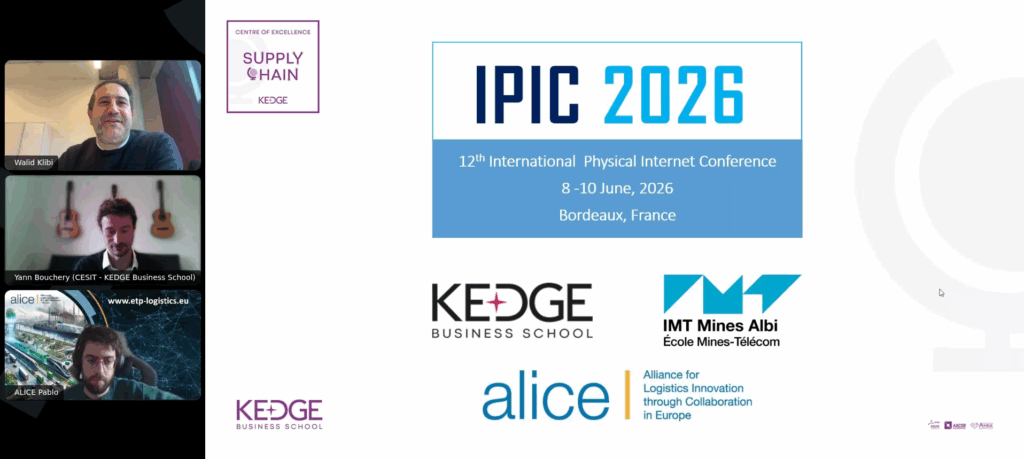
The webinar concluded with a discussion on next steps, including the upcoming IPIC 2026 conference in Bordeaux and continued knowledge exchange through ALICE’s Physical Internet community. Overall, the key takeaway was clear: Physical Internet applications for last-mile logistics are no longer theoretical. Through coordinated action between cities, researchers and industry, they are becoming practical, measurable and scalable solutions for Europe’s urban freight challenges.
The full workshop report is available exclusively to ALICE members via the Knowledge Platform.