
Friday, May 8th, 2026
A new book on sustainable urban logistics, co-edited by Ani Melkonyan-Gottschalk and Yanying Li, brings together leading research and practical insights to address the transformation of last-mile delivery systems in rapidly evolving urban environments.
The publication features 22 chapters, with contributions from several ALICE members, including Paola Cossu, Ioanna Fergadiotou, Rod Franklin, Lóri Tavasszy, Joris Beckers, Julia Amaral, José Manuel Vassallo, Natalia Sobrino, Laura Garrido
Ross O. Phillips, Delphine Pernot, Josephine Darlington, Víctor Ferran, Lorena Axinte, Edouard Ballois, Pauline Buosi, Alexandre Galzy, Cécile Gautronneau, Martin Munier-Jolain, Kevin Pereira, Sébastien Horemans and Marion Cottee, reflecting the strong engagement of the ALICE community in advancing innovation in urban logistics.
As highlighted by Fernando Liesa, logistics plays a vital role in everyday life, ensuring the timely and efficient delivery of goods. However, increasing urbanisation, the rapid growth of e-commerce, and rising consumer expectations are placing unprecedented pressure on logistics systems. At the same time, logistics contributes to congestion, environmental impacts, and competition for limited urban space, reinforcing the need for systemic transformation.
The book positions urban logistics at the intersection of sustainability, digitalisation, and circular economy principles. It explores how innovations such as data spaces, blockchain, artificial intelligence, digital twins, and the Internet of Things are reshaping logistics operations, improving efficiency, visibility, and resilience.
In parallel, it examines real-world solutions already being deployed across cities and logistics networks, including traffic and routing management systems, micro-hubs, parcel lockers, cargo bikes, and zero-emission vehicles. These approaches demonstrate how logistics systems can reduce emissions, improve reliability, and better integrate with urban environments.
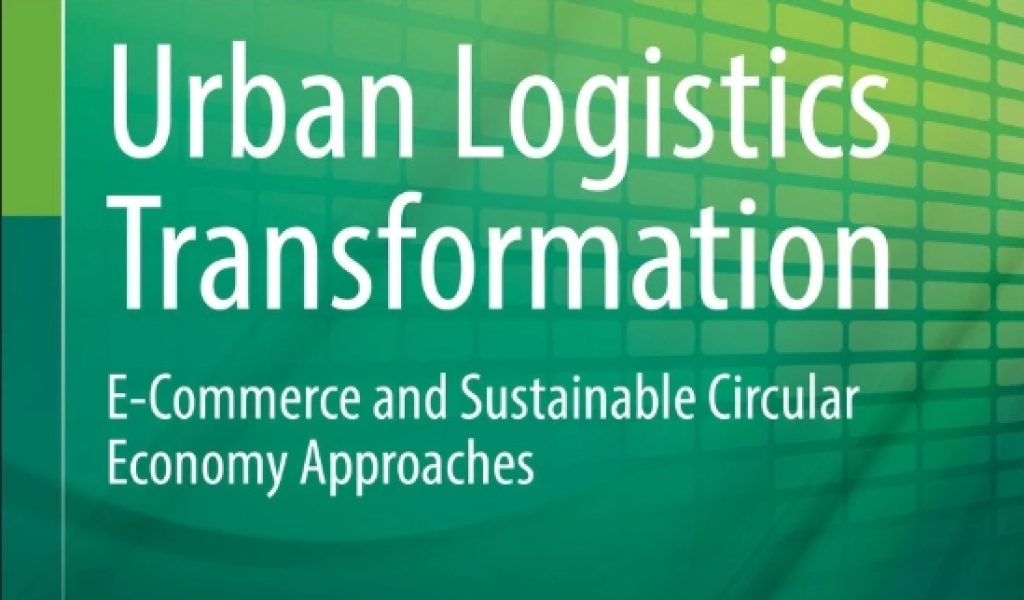
A key contribution of the book is its focus on bridging the gap between research and practice. While many innovations have been developed through research and innovation projects, their results are often fragmented. This publication consolidates state-of-the-art knowledge, offering practical solutions, case studies, and policy perspectives to support more efficient and sustainable last-mile logistics.
The book also addresses the growing importance of circularity in logistics, highlighting approaches such as reusable packaging, extended producer responsibility schemes, and the integration of forward and reverse flows. These elements are essential for reducing resource consumption and aligning logistics systems with broader climate and sustainability goals.
By combining technological, business, and policy perspectives, the book provides a comprehensive roadmap for transforming urban logistics systems. It highlights the importance of collaboration between public authorities and private sector actors, as well as the need to better integrate infrastructure, regulatory frameworks, and digital solutions.
Overall, the publication offers a forward-looking vision of urban logistics as a resilient, efficient, and seamlessly integrated part of urban life, contributing to more sustainable and liveable cities.
More information about the book here: https://link.springer.com/book/10.1007/978-3-032-08387-6