
Thursday, June 4th, 2026
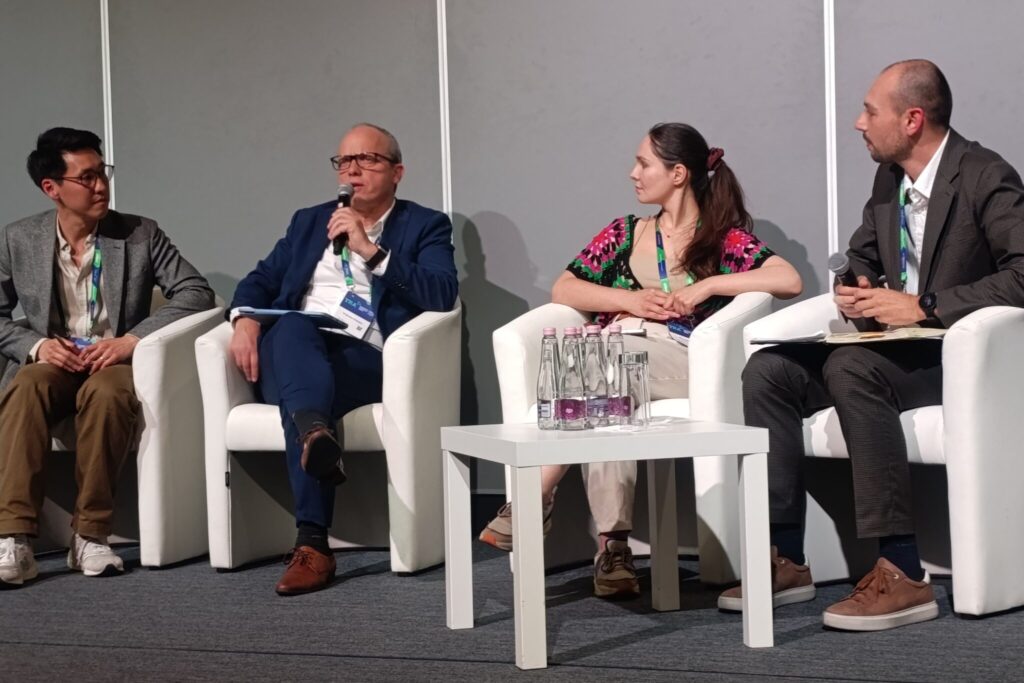
How can Europe make e-commerce logistics more sustainable while maintaining operational efficiency, affordability and consumer convenience? This question was at the centre of Session 2 “Sustainable e-commerce: zero emission delivery, consumer engagement, and circularity” at TRA 2026, bringing together logistics operators, researchers, city stakeholders and innovation projects to discuss the future of sustainable urban e-commerce systems.
Moderated by Raffaele Vergnani from POLIS, the session explored how zero-emission deliveries, circular packaging systems, consumer behaviour and urban logistics planning can contribute to reducing emissions, waste and inefficiencies across the e-commerce value chain. The session also highlighted the increasing importance of collaboration between retailers, logistics operators, public authorities and consumers to scale sustainable delivery solutions.
A common message emerged throughout the discussion: sustainable e-commerce is not only a technological challenge. Operational efficiency, economic viability and consumer behaviour are equally critical for large-scale deployment.
Representing Pick & Smile, Sébastien Horemans presented the company’s approach to developing agnostic pickup networks where consumers can collect parcels from multiple carriers in a single location.
According to Horemans, one of the major challenges of current parcel locker systems is fragmentation. Many locker networks are dedicated to a single operator, creating additional traffic and inefficiencies when consumers need to travel to multiple collection points. In contrast, shared and operator-neutral pickup systems allow consumers to collect parcels from different retailers and logistics providers in one place, reducing unnecessary trips and improving consolidation efficiency.
The presentation highlighted that operational efficiency remains essential for sustainable logistics deployment. Consumers are generally unwilling to pay significantly more for environmentally friendly delivery options, meaning that sustainable solutions must also reduce costs and improve convenience. Pick & Smile demonstrated how shared pickup networks can lower delivery costs, reduce heavy-duty vehicle movements and support low-emission last-mile operations through cargo-bike deliveries and urban micro-hubs.
The company also presented pilots developed within the GREENTURN project, including groceries deliveries using cargo bikes in Lyon and experiments with reusable packaging systems for e-commerce returns. The discussion reinforced the role of urban micro-hubs not only as parcel collection points, but also as multifunctional local logistics nodes supporting low-emission deliveries, local commerce and urban consolidation.
Consumer behaviour emerged as another central topic throughout the session.
Representing Interface Transport and the DECARBOMILE project, Pauline Buosi presented research on out-of-home delivery systems and the role of local authorities in managing the rapid expansion of e-commerce logistics.
Using the example of the Valence Romans Mobilités territory in France, the presentation showed how municipalities are increasingly trying to understand and coordinate the growth of pickup points, parcel lockers and urban logistics infrastructure. Between 2023 and 2025, the number of out-of-home delivery points in the territory increased significantly, while traditional local-shop pickup points declined and parcel locker deployment accelerated rapidly.
A key message from the presentation was that no delivery option is “intrinsically virtuous”. The environmental performance of delivery systems depends heavily on consumer behaviour, particularly the transport mode used to collect parcels. Consolidated pickup points only reduce emissions if consumers can access them by walking, cycling or integrating parcel collection into existing daily trips rather than making dedicated car journeys.
The discussion also highlighted the increasingly important role of public authorities in urban logistics governance. Cities and regions can support sustainable delivery systems by mapping logistics infrastructure, coordinating stakeholders, integrating logistics into urban planning strategies and ensuring that pickup points are located near commuter routes, multimodal hubs and areas already visited by consumers.
The session also explored the environmental impact of e-commerce packaging and the growing importance of circular packaging systems.
Representing Lindholmen Science Park, Jack Lu presented research comparing the environmental impact of physical retail and e-commerce across different products, delivery channels and geographical contexts.
The studies demonstrated that the sustainability performance of e-commerce depends heavily on product category, geography and consumer practices. While e-commerce deliveries can in some cases generate lower emissions than physical retail trips, packaging and return flows – particularly in fashion e-commerce – were identified as major contributors to emissions.
One of the key findings presented during the session was that packaging often generates more emissions than transport itself. This shifts attention towards circular packaging systems, reusable packaging models and better return management strategies.
The presentation also examined ongoing pilots testing reusable packaging systems through parcel lockers, pickup points, in-store returns and home collection. Research showed that consumers are generally supportive of reusable packaging, but only if solutions remain convenient and do not increase costs. Communication, behavioural nudging and operational simplicity were repeatedly identified as essential conditions for scaling circular systems successfully.
The session further explored how digital tools and AI-supported checkout systems could help consumers make more sustainable delivery choices. Examples included dynamic checkout systems capable of recommending delivery methods depending on geography, product type and environmental impact. Speakers also discussed how retailers could better support consumers in reducing unnecessary returns through improved sizing guidance, digitalisation and AI-supported recommendation systems.
The panel discussion reinforced that sustainable urban e-commerce requires coordinated action across the entire ecosystem, including retailers, logistics operators, consumers, cities, technology providers and public authorities.
Topics discussed throughout the session included:
A strong common conclusion emerged from the session: the transition towards more sustainable e-commerce logistics will depend not only on technological innovation, but also on creating economically viable, operationally efficient and user-friendly systems capable of changing everyday delivery and consumption practices at scale.