
Thursday, July 2nd, 2026
Autonomous shipping is no longer only a vision for the future. During the SEAMLESS Demo Day in Horten, Norway, project partners demonstrated a set of innovative technologies designed to support safe, efficient and autonomous short-sea and inland waterway transport operations. The event brought together industry leaders, researchers and policymakers to explore how digitalisation, automation and remote operations can contribute to the next generation of sustainable freight transport.
At the centre of the demonstrations were three complementary solutions that address key operational challenges across the maritime logistics chain: the Voyage and Container Optimisation Platform (VCOP), the Triple Joint Crane and ModalNET.
The Voyage and Container Optimisation Platform (VCOP) was developed to support the planning and execution of autonomous cargo transport operations.
The platform enables cargo booking, voyage planning, container stowage optimisation and cargo operation management through a shared digital environment connecting multiple stakeholders. By integrating vessel operators, terminal operators, cargo owners and remote operation centres, VCOP provides end-to-end visibility and coordination throughout the transport process.
During the demonstration, participants saw how cargo bookings can be automatically translated into optimised stowage plans while ensuring vessel stability and safe operating conditions. The platform also supports remote cargo handling operations, providing real-time updates on container movements and operational status.
A key highlight of the demonstration was the Triple Joint Crane, an innovative autonomous cargo handling concept developed by MacGregor.
Unlike conventional cranes, the Triple Joint Crane uses a unique mechanical design with multiple controlled movements and advanced sensor systems to achieve the precision required for autonomous container handling operations. Cameras, lidar systems, load cells and other sensors enable the crane to detect containers, compensate for vessel movements and perform cargo handling tasks with a high degree of accuracy.
The demonstration showed how autonomous loading and unloading operations can be executed while maintaining safety and operational efficiency. The solution is designed to support future autonomous vessel operations where remote supervision replaces many traditional onboard tasks.
While autonomous vessels and cargo handling equipment are essential building blocks, efficient logistics also requires coordination across the wider transport chain.
ModalNET addresses this challenge by providing a digital platform that integrates transport planning, shipment management and real-time operational monitoring. The system combines information from multiple logistics stakeholders, enabling end-to-end visibility of cargo movements across different transport modes.
During the demonstration, ModalNET showcased how multimodal transport routes can be planned, monitored and adjusted dynamically. The platform supports automated booking processes, disruption management and real-time tracking, helping ensure resilient and efficient logistics operations even when unexpected events occur.
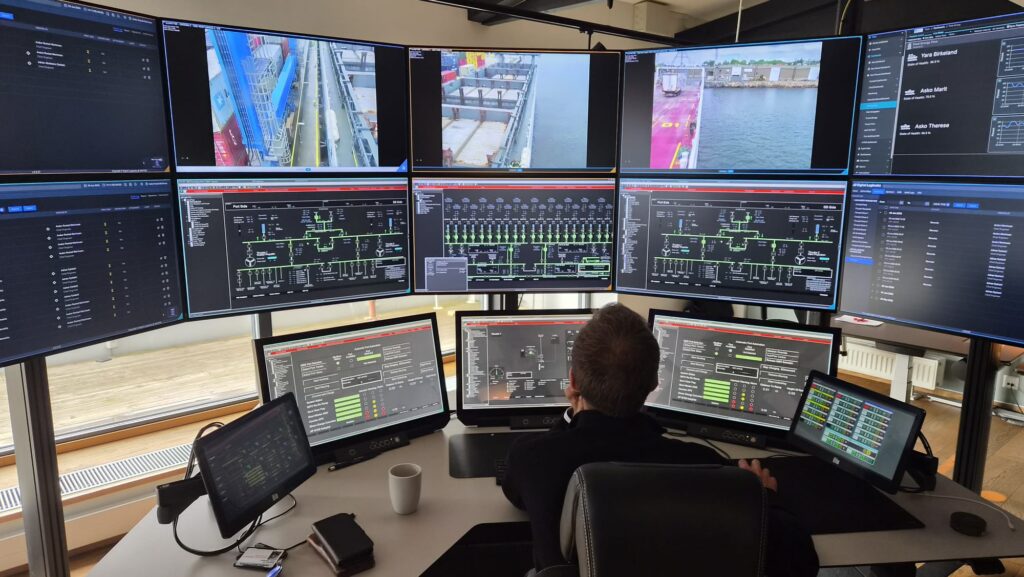
A central element of the SEAMLESS demonstrations was the Remote Operation Centre (ROC), which enables operators on shore to monitor and supervise autonomous vessel operations in real time. Rather than replacing crews entirely, the ROC provides human oversight of autonomous functions, supporting safe decision-making while reducing the need for onboard intervention.
The ROC integrates information from onboard navigation systems, vessel sensors, communication systems and logistics platforms into a single operational interface. Operators can monitor vessel status, cargo operations and environmental conditions, intervene when necessary and coordinate with ports and other stakeholders throughout the transport process.
During the demonstration, visitors observed how the Remote Operation Centre interacts with autonomous vessels and the wider digital ecosystem, illustrating the role remote supervision will play in future autonomous waterborne logistics services. The demonstration also showcased the flexibility of mobile ROC solutions, highlighting how remote operation capabilities can be deployed wherever they are needed to support autonomous transport operations. This reflects SEAMLESS’ vision of combining automation with human supervision to ensure safe, resilient and efficient freight transport.
While the demonstrations in Horten focused on autonomous short-sea shipping technologies, SEAMLESS is already preparing the next phase of validation through Demonstration Use Case 2 (DUC2), which will focus on inland waterway transport.
DUC2 will demonstrate how autonomous inland waterway services can operate along one of Europe’s busiest logistics corridors, connecting the ports of Rotterdam, Antwerp-Bruges and Duisburg. Using a commercially operated inland vessel equipped with automation technologies, the demonstration will showcase how autonomous navigation, remote operation, automated cargo handling, digital logistics planning and zero-emission propulsion solutions can work together within real freight operations.
Rather than demonstrating individual technologies in isolation, DUC2 will validate an integrated logistics ecosystem spanning ports, inland waterways and hinterland connections. The demonstration will include remote vessel supervision, automated mooring and cargo handling, multimodal transport planning, vessel stowage optimisation and battery- and hydrogen-powered operations, helping prepare autonomous inland waterway transport for future commercial deployment.
Together, VCOP, the Triple Joint Crane, ModalNET, the Remote Operation Centre and the upcoming DUC2 demonstrations illustrate how autonomous navigation, remote supervision, cargo handling and logistics coordination can be integrated into a connected operational ecosystem spanning both short-sea shipping and inland waterways.
The SEAMLESS project is developing solutions that go beyond individual technologies, focusing instead on how autonomous vessels, remote operation centres, digital planning tools and cargo handling systems can work together to support future freight transport services. Throughout the Demo Day, participants were able to visit the Remote Operation Centre, explore the demonstration vessel and observe how these technologies interact within a common operational framework.
As Europe seeks to improve the efficiency, resilience and sustainability of its freight transport system, the solutions demonstrated by SEAMLESS provide a glimpse of how autonomous and digitally connected logistics services could operate in the years ahead.