
Friday, July 10th, 2026
Europe has spent decades trying to shift freight from road to rail. Yet today, around three quarters of inland freight still travels by road, while congestion, driver shortages and transport emissions continue to grow.
What if the biggest obstacle isn’t rail itself – but the way cargo moves between trucks and trains?
This was the focus of a recent meeting between ALICE and Danish company Safe Green Logistics (SGL). During the discussion, Fernando Liesa, Secretary General of ALICE, met with SGL founder Heine Blach Jensen to explore how the company’s Container Transfer System (CTS) could help make intermodal freight transport faster, simpler and more commercially attractive.
Rather than reinventing rail transport, Safe Green Logistics has reimagined one of its biggest bottlenecks: transferring containers between road and rail.
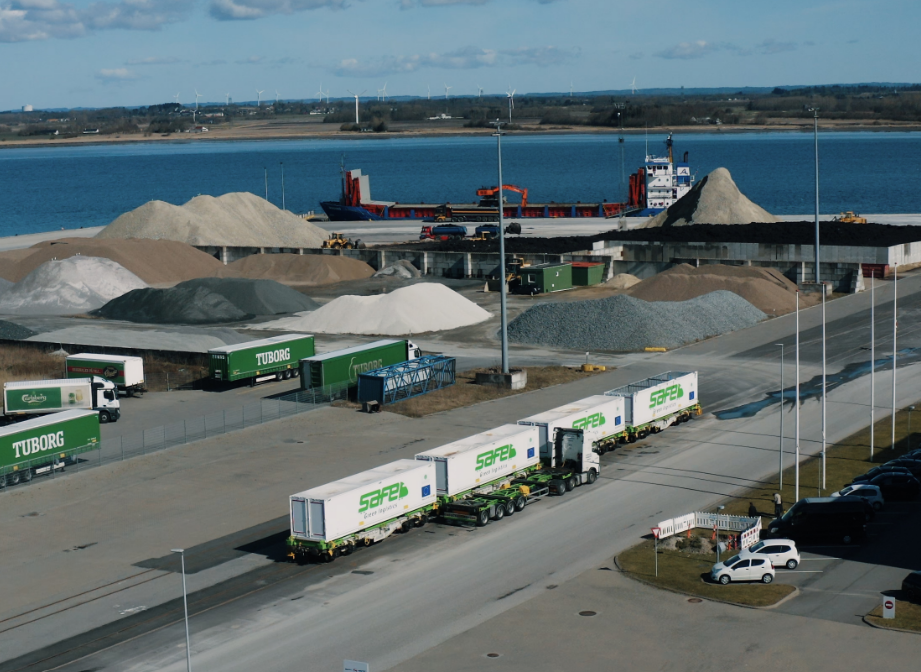
Rail remains one of the most sustainable ways to move freight over long distances, but transferring cargo between trucks and trains often requires large terminals, heavy cranes, specialised equipment and significant handling time.
These operations add cost, increase complexity and reduce flexibility, making road transport the preferred option for many logistics operators despite its higher environmental impact.
Safe Green Logistics believes that solving this single operational challenge could unlock a much greater use of rail across Europe.
The company’s innovation is the Container Transfer System (CTS), a technology that allows containers to be transferred horizontally between specially designed trucks and rail wagons.
Unlike conventional intermodal terminals, no cranes or reach stackers are required.
Once the truck is positioned alongside the train, the container slides directly from the trailer onto the rail wagon, or vice versa, in approximately 5 minutes.
Because several containers can be transferred simultaneously, an entire train can be loaded or unloaded within minutes rather than hours.
The process is highly automated, reducing handling time while simplifying terminal operations and lowering infrastructure requirements.
CTS is not simply a new piece of equipment – it is a complete logistics concept.
The system combines road and rail so that each transport mode performs the task it is best suited for.
Road vehicles handle first- and last-mile deliveries between customers and nearby transfer points, while rail carries freight over longer distances. Containers are transferred quickly between both modes using CTS before continuing their journey.
Unlike conventional intermodal hubs, CTS transfer points can be established alongside existing railway lines on relatively simple, flat surfaces. This creates opportunities for a distributed network of compact transfer locations instead of relying exclusively on large, centralised terminals.
The company has also developed dedicated rail wagons, specialised trailers and multifunctional swap bodies capable of transporting different cargo types, including refrigerated goods and walking-floor applications.
If deployed at scale, Safe Green Logistics believes the concept could address several of Europe’s most pressing freight transport challenges.
The system aims to:
Rather than replacing existing transport infrastructure, the concept builds upon it by making rail easier to access and more attractive for logistics operators.
The technology has already progressed well beyond the concept stage.
Through the Horizon 2020 Fast Track to Innovation (FTI) project M-CTS (Multifunctional Container Transfer System), Safe Green Logistics worked together with industrial partners Knapen Trailers, IDOC and Lineas to optimise the technology, develop a multifunctional swap body and validate the system under operational conditions.
The project concluded successfully in 2022, following an extension due to the COVID-19 pandemic, delivering a technology considered ready for gradual commercial uptake.
The next objective is to establish the first commercial corridor in Denmark, connecting Aalborg, Fredericia and Copenhagen. According to the company, this route would demonstrate both the operational and economic performance of the concept while removing a significant number of long-distance truck movements from Danish roads.
During discussions with ALICE, one message stood out clearly: the technology has been developed, demonstrated and validated. The next challenge is deployment.
Safe Green Logistics is now seeking strategic partners, logistics operators, infrastructure managers, freight owners and investors to establish its first commercial corridors and demonstrate the concept at operational scale.
Like many breakthrough innovations in freight transport, the remaining challenge is not proving that the technology works, but creating the partnerships and investment needed to move from successful demonstrations to widespread market adoption.
Europe has set ambitious objectives to increase the share of rail freight, reduce transport emissions and strengthen supply chain resilience. Achieving these goals will require practical innovations that remove operational barriers rather than simply expanding infrastructure.
Safe Green Logistics offers one possible answer by simplifying one of the most critical steps in intermodal transport: transferring freight between road and rail.
ALICE welcomes innovative approaches that help accelerate the transition towards a more efficient, resilient and sustainable logistics system and looks forward to following the future development of Safe Green Logistics and its Container Transfer System.
To learn more about the Container Transfer System and watch the technology in action, visit the Safe Green Logistics website and explore the demonstration videos showcasing the CTS concept and its potential for transforming intermodal freight transport.
Video material:
IBF video: https://youtu.be/GdcScq6wso4
Commercial: https://www.youtube.com/watch?v=LRef9pFq0U8
Point to point: http://safegl.eu/Video/P2P_SAFE.mp4
Drone video from Aalborg harbor: http://safegl.eu/Video/EPIC_SAFE.mp4