
Monday, October 5th, 2026
How should Europe’s road infrastructure evolve to support the next generation of heavy-duty vehicles? At Connecting Europe Days 2026, ALICE brought the logistics perspective to a discussion on how physical and digital infrastructure must develop alongside electrification, digitalisation, connectivity and automation.
On 30 September, Stefanie Van Damme, Programme Manager and Technical Expert at ALICE, participated in Session 28, “Road infrastructure support for future vehicles”. The session presented insights from the European Union Research and Innovation for the Automotive Sector (EURIAS) Expert Group and explored priority research, innovation and deployment needs at the intersection of vehicles, infrastructure, energy and digital systems.
Moderated by Andrea Gentili, Deputy Head of Unit, Clean Transport Transitions at the European Commission’s Directorate-General for Research and Innovation (DG RTD), the session brought together:
Together, the speakers addressed how road infrastructure can support future vehicles through charging and energy integration, digitalisatie, connectivity, digital infrastructure, interoperability, cybersecurity and trusted data exchange. A recurring theme was the need to move beyond individual technologies and consider how vehicles, infrastructure, logistics operations, energy systems and public authorities can work together as part of an integrated European mobility ecosystem.
Speaking from the freight and logistics perspective, Stefanie highlighted that the transition cannot be addressed by looking at vehicles or infrastructure separately. Road freight remains fundamental to European industry, while the sector simultaneously faces pressure to improve efficiency, predictability and safety and respond to challenges including driver shortages.
Electrification, digitalisation and automation can help address these challenges, but their deployment depends on an ecosystem capable of supporting them. For heavy-duty vehicles in particular, infrastructure must reflect the operational realities of freight transport.
A dense network of charging and refuelling infrastructure along European freight corridors is essential, but availability alone is not sufficient. Existing facilities are not always designed for the dimensions and manoeuvring requirements of heavy-duty vehicles, while charging power and refuelling capacity must also correspond to commercial vehicle operations. ALICE is therefore working on corridor approaches and better identification of locations suitable for heavy-duty vehicle charging and refuelling.
Stefanie also stressed that introducing electric vehicles affects much more than vehicle procurement. Logistics operators need to adapt dispatching, charging, fleet management, invoicing and other operational processes, while managing mixed fleets consisting off different vehicle and energy technologies is increasingly more complex, leading to a higher operational resource need.
Digital tools, data spaces, common interfaces and new fleet management solutions can reduce this additional complexity and workload. Better exchange of information between vehicles, infrastructure, logistics operators and energy actors, with consent of the drivers, can improve efficiency, predictability and resilience of the logistics, and helping charging point operators and electricity grids anticipate demand. At the same time, questions around commercially sensitive logistics data, trust and service quality still need to be addressed.
All this led to one of the central messages from ALICE’s contribution: electrification and digitalisation should not be treated as separate transitions. As freight operations become electrified, digital coordination becomes increasingly important for managing the additional complexity created across the logistics system.
Looking further ahead, the discussion addressed what autonomous freight vehicles will require from both physical and digital infrastructure. Automation will affect activities beyond driving itself. The non-driving tasks should also be addressed, when automation is integrated in logistics. Charging may need to become automated, while loading, unloading and other tasks currently performed or supported by drivers will also need to be reconsidered.
Large-scale deployment will therefore require accessible charging infrastructure, seamless digital integration and harmonised frameworks that allow technologies and services to operate across the European logistics ecosystem.
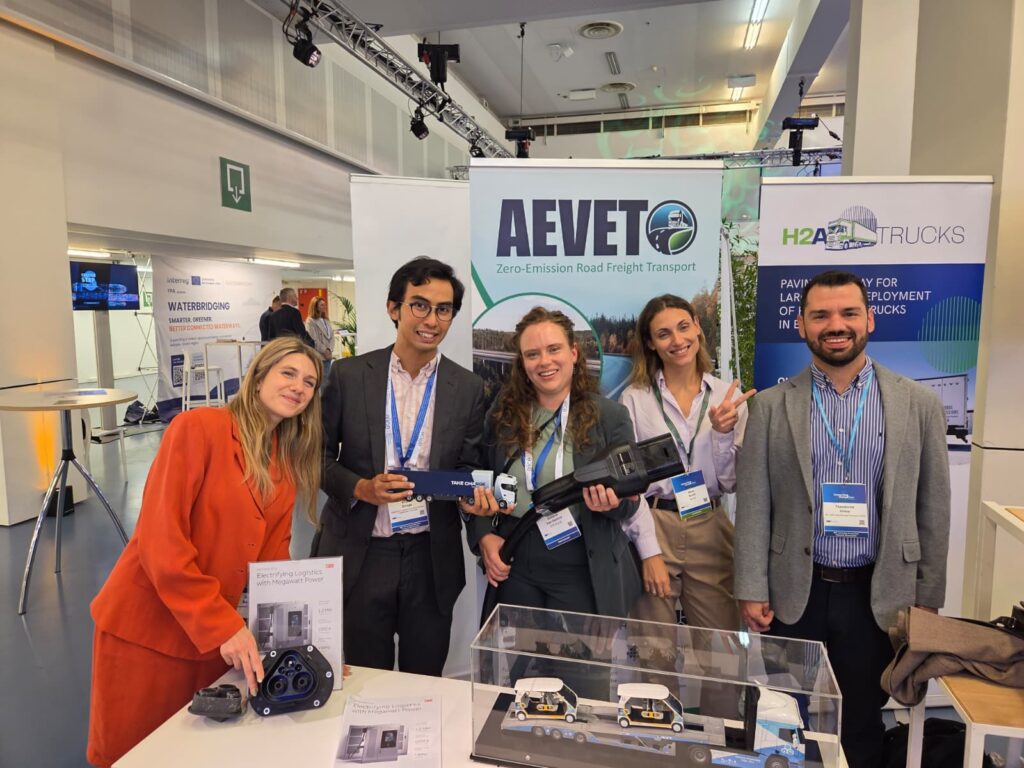
These challenges are also explored in the AEVETO White Paper, which provides further insights into the infrastructure and ecosystem requirements for automated vehicle deployment. Read the AEVETO White Paper here.
Across the wider panel, interoperability, trusted data exchange, cybersecurity and cooperation between road authorities, vehicle manufacturers, logistics operators, technology providers and public authorities emerged as recurring priorities. Participants emphasised the importance of moving beyond isolated technological solutions towards common use cases, standards and infrastructure that work across systems and borders.
Closing her contribution, Stefanie emphasised the importance of deployment. Rather than waiting for every element of the future transport ecosystem to be fully developed, logistics can already move forward with real-life electrification, digitalisation and automation use cases that are technically and economically sustainable, before progressively scaling successful solutions.
This deployment-oriented approach also reflects ALICE’s contribution to the EURIAS Expert Group. During the session, EURIAS representatives highlighted the value of having logistics represented in the group, recognising that freight operations have specific requirements that need to be considered when shaping future automotive research, innovation and deployment priorities.
For ALICE, the discussion reinforced the need to connect vehicle innovation with the infrastructure and operational environment in which new technologies must ultimately function. Building future-ready European road freight will require not only new vehicles, but coordinated progress across physical infrastructure, energy, digital systems, regulation and logistics operations.