
Friday, June 12th, 2026
At IPIC 2026 in Bordeaux, the plenary session “Physical Internet Industrial Roadmaps” explored how different global regions are approaching the implementation of the Physical Internet and how research, innovation, infrastructure and policy can support its deployment at scale.
Moderated by Sergio Barbarino, the session brought together perspectives from Europe, Asia-Pacific and Africa, highlighting that the Physical Internet is increasingly recognised as a global framework for more efficient, resilient and sustainable logistics systems. The discussion showed that implementation pathways differ significantly depending on regional governance models, challenges and priorities, infrastructure capabilities and industrial needs.
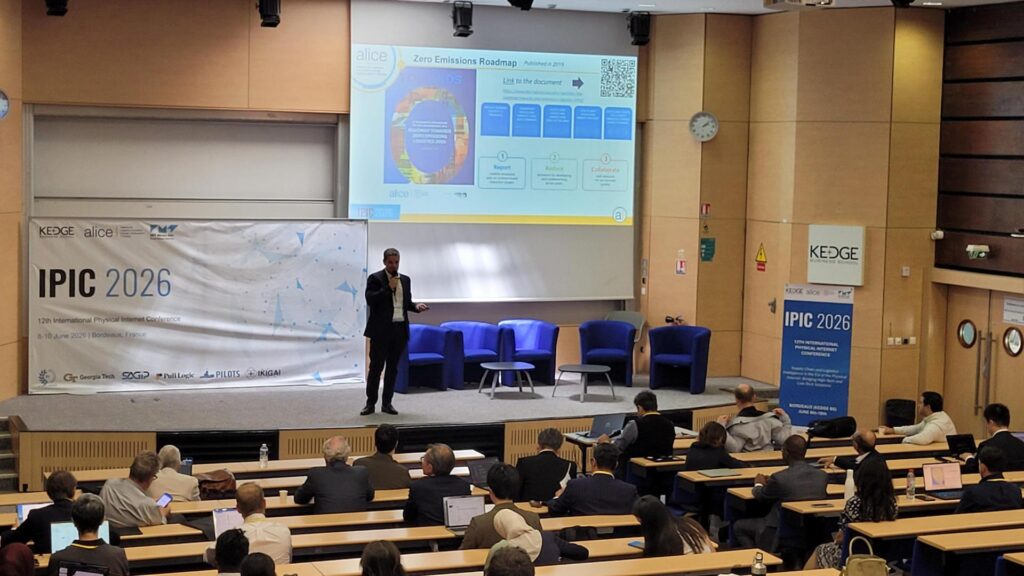
Fernando Liesa presented the European perspective, outlining the role of ALICE in supporting the transition towards more efficient, sustainable, competitive and resillient logistics systems.
He explained that ALICE has developed two main roadmaps: one focused on decarbonisation and the transition to zero-emission logistics, and another focused on the Physical Internet as a way to increase efficiency, asset utilisation and collaboration across logistics networks to decarbonize logistics while keeping competitive.
The Physical Internet is then positioned as an enabler of several European priorities, including decarbonisation, competitiveness, resilience, scarcity of resources, automation and digitalisation.
Fernando also highlighted the new shift in European policy to address the innovation gap and move beyond research and innovation alone by creating stronger links between technology development, real-world operations, policy frameworks and market uptake in line with ALICE 4 Impact Framework.
Shelton Chan presented perspectives from China and Taiwan, focusing on how AI, robotics and industrial collaboration are accelerating Physical Internet deployment in Asia.
Current supply chains are complex, fragmented and lack interoperability. Physical Internet adoption will change this paradigm to simplify complexity, achieve further efficiencies and get the full potential out of digitalization AI and automation.
Shelton explained that AI is helping make the Physical Internet more understandable and actionable for industry by providing decision-making capabilities at logistics nodes. This combination of Physical Internet principles, AI and robotics can support shared infrastructure, better forecasting, resource optimisation and stronger interconnectivity and collaboration between companies.
The presentation also highlighted developments in Taiwan, including efforts to connect government, industry, academia and research around smart manufacturing logistics, as well as initiatives in China linked to digitalised containers, distributed energy networks and battery swapping infrastructures.
Abiy Asrat Jiru presented the African perspective, arguing that Africa faces a different starting point from Europe and Asia due to fragmented infrastructure, limited rail and road connectivity, and market access challenges.
Rather than waiting for full road, rail and port infrastructure maturity, he proposed using aviation as a strategic high-speed layer for the Physical Internet. Airports could act as Physical Internet nodes, supporting time-sensitive cargo flows, export connectivity and improved integration across the continent.
The presentation referred to the Ethiopian Airlines cargo hub as an example, showing how Physical Internet principles could improve transit time, shipment reliability and reduce spoilage exposure for perishable goods.
The discussion underlined that Physical Internet implementation will not follow a single pathway. Europe is focusing on decarbonisation, scarcity or resources, competitiveness and resilience; Asia is accelerating implementation for bottom line efficiency and scalabel innovation through AI, robotics and top-down government industrial coordination; and Africa is exploring aviation-enabled logistics as a way to leapfrog infrastructure gaps.
Despite these differences, the session showed a shared ambition: to make logistics systems more interconnected, efficient and capable of responding to global and regional challenges.
For ALICE, the discussion reinforced the importance of connecting regional roadmaps, supporting innovation at scale and ensuring that Physical Internet principles are translated into practical, deployable solutions that create value for industry, society and the environment.
It was also recognised that although bottom-up initiatives in Europe are organically maturing, initiatives in other countries, primarily China and Japan, with stronger government leadership or in US, through big platforms development, are proving advancing fast. Physical Internet is a top-down choice to transform logistics industry as a whole and so far, bottom-up approaches are not delivering the speed as required.