
Thursday, July 30th, 2026
At IPIC 2026 in Bordeaux, the plenary session “Optimization in Sustainable Operations in Urban Logistics” brought together academic and industry perspectives on how cities can respond to growing logistics demands while improving efficiency, sustainability and operational performance.
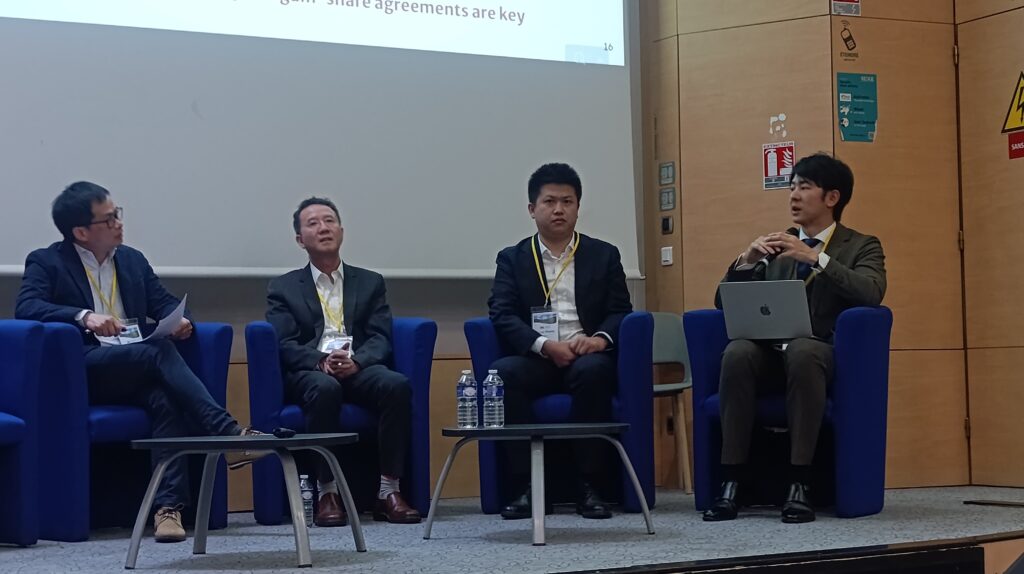
Moderated by Shenle Pan, the session featured an academic keynote by Dr. Lei Zhao (Tsinghua University) and industrial perspectives from Yixiao Huang (SF Express) and Satoki Inoue (Aidiot). The session also included a PhD 3-minute Pitch by Cécile Dupouy (KEDGE Business School).
Opening the session, Dr. Lei Zhao presented research on optimisation methods for increasingly complex urban logistics systems. He explained how Physical Internet principles align closely with operations research approaches that seek to balance decentralisation, modularisation and coordination across logistics networks.
Drawing on collaborative projects with major Chinese logistics providers, including SF Express and JD Logistics, he showed how urban delivery systems can be decomposed into manageable operational units while remaining connected through optimisation mechanisms.
Particular attention was given to:
Dr. Zhao highlighted how optimisation models can help manage increasingly complex city logistics operations while supporting faster deliveries and more efficient use of resources.
Yixiao Huang provided insights into how SF Express applies advanced optimisation techniques across one of the world’s largest urban delivery networks.
The presentation focused on the coordination of multi-shift pickup and delivery operations, where the same vehicle fleets must perform several logistics tasks throughout the day. Optimisation models are used to support planning decisions while maintaining flexibility for local operators.
A recurring theme was the importance of combining mathematical optimisation with practical operational knowledge. While algorithms provide recommendations, local couriers retain flexibility to adapt routes and decisions based on real-time conditions and knowledge of their service areas.
The discussion illustrated how Physical Internet concepts can support large-scale urban logistics operations through better coordination, resource sharing and network optimisation.
Satoki Inoue presented Aidiot’s work on logistics digital twins and the development of the Ideal Digital Twin (ADT) platform.
The platform combines:
A key message from the presentation was that digital twins should support decision-making rather than replace human expertise. In logistics environments where accountability and transparency remain critical, optimisation models and machine learning currently play a larger role than fully autonomous AI systems.
Several presentations also highlighted that digital transformation is not only about developing new optimisation tools, but also about creating trusted mechanisms for sharing logistics data across organisations while preserving data governance, interoperability and stakeholder trust.
The ADT platform is designed around standardised data formats aligned with Japanese government guidelines, creating a foundation for interoperability and future Physical Internet implementation.
One of the most concrete examples presented during the session was a collaborative logistics project involving three Japanese retail companies.
Historically, each company operated separate warehouses and delivery networks, while trucks frequently returned empty and vehicle utilisation remained low. By analysing logistics data and redesigning the network using Physical Internet principles, the companies explored shared logistics operations supported by standardised smart containers and collaborative transport models.
The results were significant:
The project, which received a Japanese Physical Internet award, demonstrated how collaboration, standardisation and shared infrastructure can generate measurable operational and environmental benefits.
The discussion also explored the growing role of artificial intelligence and large language models in logistics.
All speakers agreed that AI can significantly enhance logistics planning and decision support, particularly by improving data interpretation, explainability and user interaction with optimisation models. However, they stressed that domain expertise, operations research methods and transparent optimisation models remain essential for high-stakes logistics decisions.
Rather than replacing optimisation, large language models are increasingly being viewed as interfaces that help planners interact with complex analytical systems and better understand recommended actions.
Across the presentations, a common message emerged: achieving more sustainable urban logistics requires a combination of optimisation, standardisation, digital technologies, trusted data sharing and collaboration.
These discussions also reinforce the importance of initiatives such as ALICE’s Digital Urban Freight Community, which aims to connect cities, logistics providers, researchers and technology developers around interoperable digital solutions, common data frameworks and practical implementation of digital innovation in urban freight.
For ALICE and the Physical Internet community, these examples provide valuable evidence that the transition towards more collaborative and interconnected logistics systems is already delivering practical results in real-world operations. Physical Internet principles have also been applied to design next generation of electric light commercial vehicles (e-LCV) within the Shift2Zero project.