
Monday, July 13th, 2026
The workshop “Autonomous Inland Waterway Vessels: Market Ready or Are There Still Links Missing?”, held on 23 June 2026, brought together logistics stakeholders, inland waterway operators, ports, technology developers, researchers and shippers to discuss the opportunities and remaining barriers for deploying automated inland vessels in Europe. Organised by ALICE together with the Horizon Europe projects FOREMAST, AUTOFLEX and SEAMLESS, the workshop focused on how automation can support modal shift and sustainable logistics while addressing the practical conditions needed for commercial deployment.
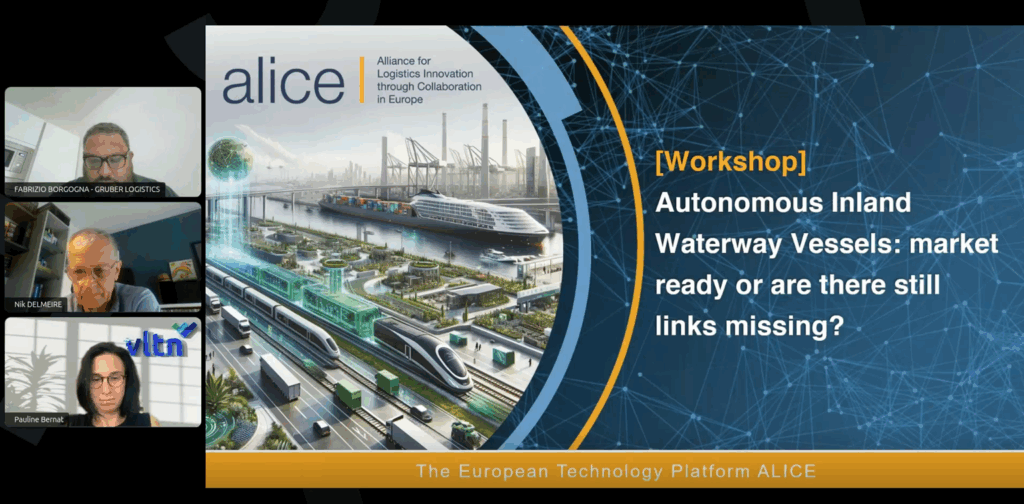
Throughout the discussions, speakers agreed that autonomous inland navigation has reached a stage where technology is no longer the primary challenge. Instead, the key questions concern infrastructure readiness, logistics integration, regulation, business viability and stakeholder collaboration. The workshop therefore examined how automated vessels can become part of competitive multimodal logistics chains rather than simply demonstrating new navigation technologies.
Nik Delmeire (ALICE) opened the workshop by explaining that inland waterways have significant potential to contribute to Europe’s transition towards more sustainable freight transport. However, unlocking this potential requires understanding where automation creates real value for logistics operators and customers. Rather than asking whether autonomous vessels are technically feasible, the discussion focused on the conditions under which they can become commercially attractive and operationally viable.
To establish a common understanding, Pauline Bernat (VLTN) introduced the different levels of vessel automation and explained that autonomous navigation should be viewed as a gradual evolution rather than a single technological breakthrough. While significant progress has been made in sensors, remote operations and digital navigation systems, successful deployment depends on a combination of technology, infrastructure, regulation, cybersecurity, business models and social acceptance. She highlighted that many enabling technologies already demonstrate high levels of maturity, but integrating them into existing logistics systems remains a significant challenge.
The workshop then presented insights from three Horizon Europe projects addressing autonomous inland navigation from complementary perspectives.
Georgia Tsiochantari (INLECOM) introduced the FOREMAST project, which is developing Small Flexible Automated Zero-emission (SFAZ) vessels designed to improve the accessibility and flexibility of inland waterway transport. Through Living Labs, digital twins and market analyses, the project is evaluating where smaller autonomous vessels can generate the greatest operational and economic value. Early findings indicate that successful deployment depends on regular freight flows, cargo consolidation and strong integration with multimodal logistics services.
Odd Erik Mørkrid (SINTEF) presented AUTOFLEX, which adopts a transport system perspective by combining autonomous vessels with temporary port terminals, mobile logistics concepts and digital planning tools. Rather than focusing solely on vessel automation, the project investigates how autonomous transport services can be integrated into wider logistics systems while minimising infrastructure investment and improving operational flexibility.
Cyril Alias (DST) presented the SEAMLESS project, which focuses on developing trustworthy autonomous waterborne logistics services. He explained that automation alone will not transform inland navigation unless it is combined with digital infrastructure, remote operation capabilities, resilient communications and effective integration into multimodal logistics chains. The project therefore addresses both technological innovation and the governance needed to support future autonomous transport services.
An interactive audience poll reinforced the workshop discussions. Participants identified clear regulation and business viability as the main barriers to deployment, while regulation, logistics integration and viable business models emerged as the key success factors. Most respondents believe autonomous inland vessels could become commercially viable within 5 to 10 years, confirming that the main challenges now lie beyond technology.
The stakeholder panel discussion brought together Fabrizio Borgogna (GRUBER Logistics), Jan-Christoph Maass (Duisport), Kristoffer Kloch (DFDS) and Cyril Alias (DST), Peter Geirnaert (Urban Waterway Logistics), moderated by Nik Delmeire (ALICE). The discussion highlighted that logistics customers ultimately prioritise reliable, flexible and cost-effective transport services rather than the degree of automation itself. Speakers agreed that autonomous vessels should be considered one element within integrated logistics chains, where ports, infrastructure managers, digital platforms and regulatory authorities all play essential roles.
Participants also discussed infrastructure requirements, investment cycles, interoperability, digital information exchange and regulatory developments. Questions from the audience addressed topics including remote operation, transport of dangerous goods, business models and the practical conditions needed to scale autonomous inland navigation beyond pilot projects. A common conclusion was that collaboration across the entire logistics ecosystem will be essential to move from successful demonstrations towards commercial deployment.
Overall, the workshop demonstrated that autonomous inland waterway vessels have significant potential to contribute to Europe’s modal shift ambitions and sustainable freight transport objectives. However, achieving widespread market adoption will require more than technological innovation. Business viability, integrated logistics solutions, supportive regulation, appropriate infrastructure and close cooperation between public and private stakeholders will determine whether autonomous inland navigation becomes a mainstream component of future European logistics.
Read the full report to explore the projects, discussions and key lessons in more detail.