
Key takeaways from the workshop: Exploring AFIR implementation challenges and grid readiness for truck charging

Monday, May 4th, 2026

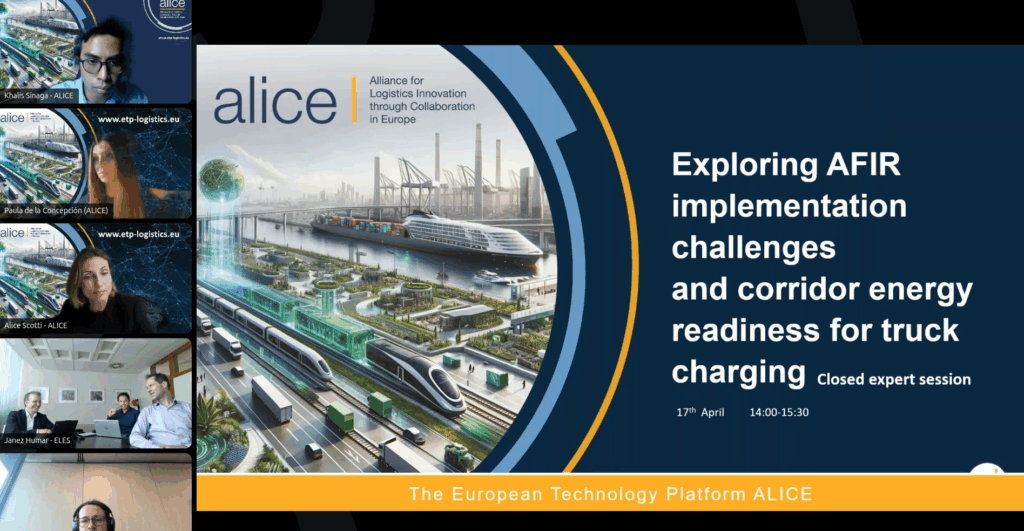
On April 17, 2026, ALICE hosted a closed expert session to address the challenges around deploying electric truck charging infrastructure under the Alternative Fuels Infrastructure Regulation (AFIR), and the readiness of Europe’s energy grid to support this transition. 

Session overview

The session gathered key ecosystem stakeholders: Charge Point Operators (Einride, Enel X), Distribution and Transmission System Operators (ELES, Stedin, Øresundskraft), a logistics real estate provider (Goodman), and a major logistics company (IKEA). The small group format aimed to facilitate open dialogue and cross-validation of concerns, especially as the European Commission’s AFIR Call for Evidence and EU Grids Package are currently under review. 
The objectives were to collect practical evidence, distinguish AFIR-specific issues from broader infrastructure concerns, and prepare recommendations for future engagement with the Commission. 

Structure and key discussion blocks

  • Opening and Introduction: Set the policy context and outlined session objectives, emphasizing competition law compliance and expected outputs. 
  • ELES Framing Presentation: Highlighted the challenge of grid readiness for high-power corridor truck charging and the risk of building infrastructure that quickly becomes inadequate if only minimum standards are met. 
  • Evidence Roundtable: Each participant identified a key issue or gap, provided an example, and discussed the main risk or impact. 
  • Root Cause Analysis: Explored whether challenges stem from AFIR, TEN-E, or implementation practices. 
  • Closing and Next Steps: Identified immediate contributions to the AFIR Call for Evidence, areas needing further study, and potential future DG engagement. 
  • Major Themes and Evident Challenges
  • Grid Access, Timing, and Capacity Risk: The greatest concern was whether grid upgrades and new connections could match the rising demand for electric trucks. Existing congestion can mean years-long waits for new capacity, and heavy-duty charging will intensify these pressures beyond what passenger vehicles have experienced. 
  • Differentiated Charging Ecosystem: Stakeholders cautioned against a “one-size-fits-all” approach focused solely on high-power corridor charging. Depot and overnight charging, public CCS, and storage solutions were highlighted as essential complementary options. Over-investment in Megawatt Charging System (MCS) sites risks higher costs, slower deployment, and grid strain. 
  • Logistics and Driver Needs: Charging infrastructure must align with freight operations, driver rest rules, route planning, and reliability requirements. Site location and amenities are critical, and operational downtime imposes significant business costs. 
  • Data, Interoperability, and Booking: Reliable operational data, interoperability, and reservation systems are needed to ensure chargers are available and functional when required by heavy-duty vehicle operators. 
  • Funding Logic and Supporting Infrastructure: Current funding models focus on visible charging assets but often overlook the cost and importance of grid connections, site readiness, and supporting services. This can leave projects technically feasible but commercially blocked. 
  • Geographic and Corridor-Specific Differences: AFIR implementation conditions vary widely across Europe. Some locations face severe grid congestion, while others have low utilization. An EU-wide framework must allow for regional evidence and site-specific planning.

Root causes identified

Through “fishbone” analysis, the following underlying issues were pinpointed: 

  • Insufficient anticipatory grid investments due to uncertain demand forecasts 
  • Planning and permitting delays from fragmented responsibilities and complex procedures 
  • Funding gaps for grid infrastructure needed to enable truck charging 
  • Misalignment between AFIR and TEN-E frameworks, causing inconsistent priorities and eligibility 
  • Poor coordination between transport and energy planning, leading to disconnected decision-making 

The distribution of costs and benefits is uneven, with grid investments delivering system-wide gains but placing financial burdens on specific actors. 

Wrap-up and next steps

The session’s main findings emphasized that: 

  • AFIR implementation success requires both charging infrastructure and local energy system readiness 
  • Better integration of AFIR and TEN-E frameworks is vital 
  • Anticipatory grid investment is crucial to avoid future bottlenecks 

Further evidence is needed on demand forecasting, infrastructure planning, and the interaction of charging solutions. An initial AFIR feedback paper was prepared and circulated to participants for further refinement. 

Conclusion and ALICE’s future actions

Electrifying heavy-duty transport demands more than deploying charging stations; it requires coordinated systemic transformation across infrastructure, regulation, planning, and cross-sector collaboration. The session helped build shared understanding and contributed concrete evidence to policy discussions. ALICE will continue gathering examples and evidence from stakeholders and experts, aiming to provide comprehensive industry input for AFIR’s public consultation in Q2 2026. Plans include exploring structured follow-up activities such as a working note, position paper, or dedicated task force within ALICE’s Electrification Community. 

Read the full report for detailed insights and stakeholder perspectives. 


Back to overview