
Tuesday, March 31st, 2026
ALICE organised an online webinar under the SEAMLESS project on Safe and Intelligent Maritime Navigation Solutions for Short-sea and Inland waterway environments, bringing together experts to explore how advanced digital technologies and control systems can enable safer and more resilient automated vessel operations.
The session was opened and moderated by Tomasz Dowgielewicz (ALICE), who introduced the objectives of the webinar and positioned it within the broader SEAMLESS project. He highlighted that SEAMLESS is working to support the development of autonomous waterborne freight transport services by combining technological building blocks with enabling work on safety, approval and deployment. The webinar formed part of a wider series addressing key challenges related to automation in maritime and inland navigation.
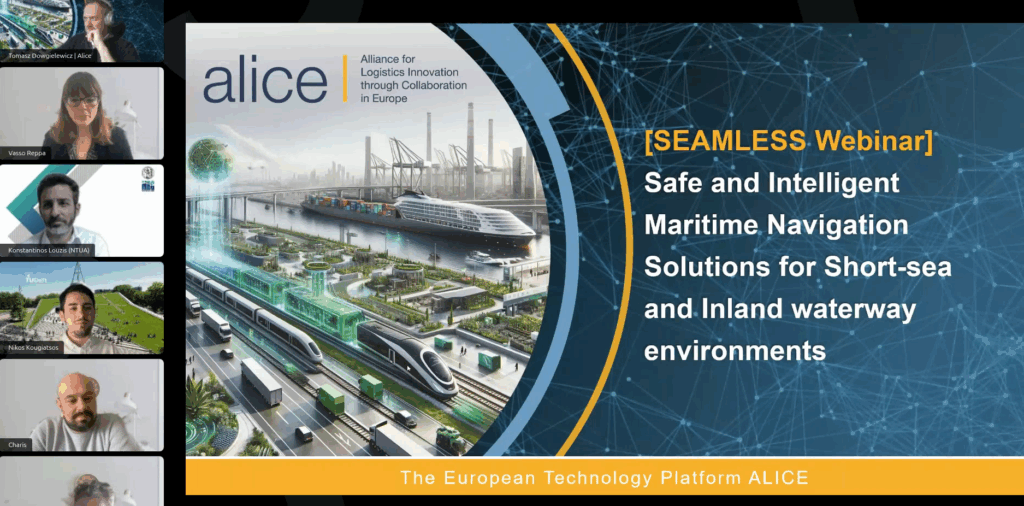
The first presentation, delivered by Nikos Kougiatsos and Vasso Reppa (TU Delft), focused on intelligent, rule-aware and fault-tolerant navigation solutions. Their work centres on the Guidance, Navigation and Control (GNC) system, which is considered the most safety-critical component of an automated vessel. They explained how future navigation systems must go beyond traditional approaches by integrating intelligence, regulatory awareness and fault tolerance into a unified framework.
A key point highlighted during the presentation is that automated vessels are expected to operate across different environments, including short-sea shipping routes and inland waterways. These environments differ significantly in terms of physical constraints, operational conditions and applicable traffic regulations. As a result, navigation systems must be capable of adapting dynamically to these variations while ensuring safe and compliant behaviour.
The speakers also emphasised the importance of incorporating rule awareness into navigation decisions. While international regulations such as COLREGS are well established for maritime operations, inland waterways rely on additional regional rules. Ensuring that automated systems can interpret and switch between these regulatory frameworks is essential for safe operation across mixed environments.
Another important aspect discussed was fault tolerance. Automated vessels rely heavily on sensors and digital systems, which makes them vulnerable to faults and uncertainties. The presentation showed how model-based approaches and monitoring mechanisms can be used to detect faults and compensate for their effects, allowing the vessel to continue operating safely even under degraded conditions. This capability is particularly important for ensuring reliability and supporting future certification processes.
The second presentation, by Konstantinos Louzis (NTUA), addressed the challenges of risk assessment and safety assurance for waterborne digital systems. He explained that modern maritime systems are increasingly becoming cyber-physical systems, combining physical components with software, connectivity and, in some cases, artificial intelligence. While these systems offer significant benefits in terms of efficiency and performance, they also introduce new types of risks and failure modes.
Traditional risk assessment methods, such as Hazard and Operability analysis (HAZOP), are widely used in industry but were originally designed for less complex, primarily hardware-based systems. As a result, they do not fully capture the complexity of digital and interconnected systems, particularly when it comes to software behaviour, cyber threats and interactions between system components.
The presentation highlighted ongoing efforts to adapt and extend these methods so they can better address the realities of modern maritime systems. This includes considering new types of hazards, integrating knowledge across system levels and linking component-level failures to system-level consequences. These developments are essential to ensure that advanced navigation systems can be properly assessed, certified and deployed.
The webinar concluded with an interactive discussion and exchange with participants. Topics included the role of regulators in driving adoption, key barriers to investment and the main risks associated with highly digital and autonomous systems. Participants highlighted concerns related to cybersecurity and the transparency of decision-making in intelligent systems, underlining the importance of trust and reliability.
Overall, the webinar demonstrated that achieving safe and intelligent maritime navigation requires a combination of advanced control technologies, digital innovation and robust safety assurance frameworks. It also reinforced the importance of collaboration between research, industry and public authorities to ensure that these solutions can move from research to real-world deployment.
The full workshop report is available exclusively to ALICE members via the Knowledge Platform.