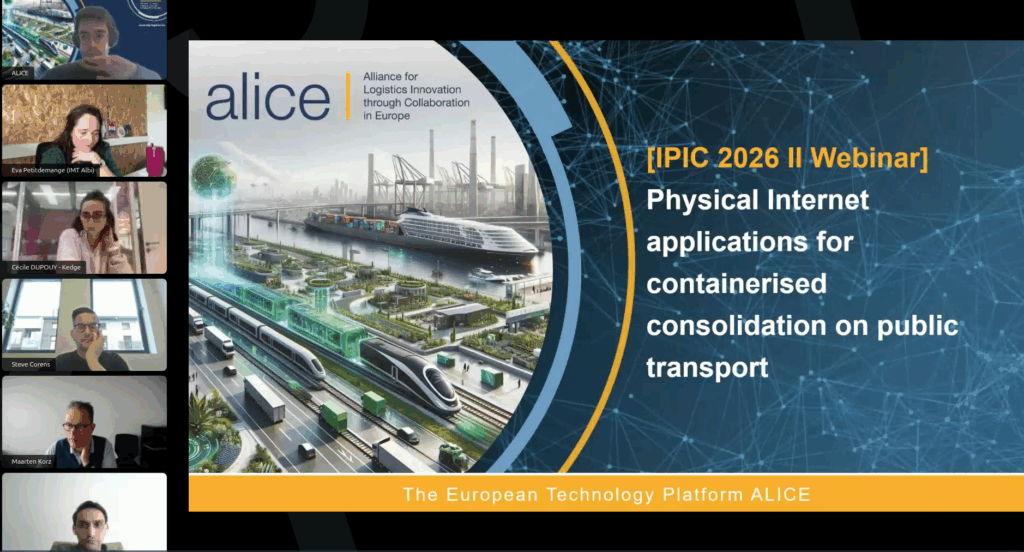
The webinar was opened and moderated by Pablo Segura (ALICE), who linked the session to the road towards the 12th International Physical Internet Conference (IPIC 2026) and introduced related European initiatives, including DISCO, Shift2Zero,IKIGAI and URBANE. He highlighted the role of the Physical Internet in enabling more collaborative, interoperable and resource-efficient logistics systems.
Cécile Dupouy (KEDGE Business School / University of Bordeaux) presented research on the use of public transport for urban parcel deliveries through containerised consolidation. Focusing on the Bordeaux case study, she demonstrated how an orchestrated multimodal system can enable public transport networks to handle a significant share of urban middle-mile deliveries. Her presentation showed how integrating freight into existing passenger transport systems can improve efficiency and better utilise available capacity.
Eva Petitdemange (IMT Mines Albi) provided a complementary perspective focused on rural transport systems. She explained the structural challenges of rural mobility, including low demand density, long distances and fragmented flows, which limit the efficiency of traditional transport services. Using the EcoTrain case in France, she illustrated how Physical Internet principles, such as mutualisation, modularity and shared governance, can support the integration of passenger and freight flows and improve the overall performance of rural mobility systems.
The presentations highlighted that while urban and rural logistics require different operational approaches, they share common inefficiencies linked to underutilised capacity and fragmented systems. In this context, the Physical Internet offers a common framework to improve system performance through better coordination, interoperability and use of existing infrastructure.
The webinar concluded with a discussion on operational and implementation aspects, including capacity constraints, coordination mechanisms and economic considerations. Participants underlined the importance of governance models, data sharing and collaboration between stakeholders to enable the deployment of integrated passenger–freight solutions.
Overall, the session confirmed that integrating freight into public transport systems represents a promising pathway towards more efficient and sustainable logistics. It also highlighted the need for continued research, experimentation and collaboration to scale these approaches in real-world conditions.
The full workshop report is available exclusively to ALICE members via the Knowledge Platform.