
Friday, February 27th, 2026
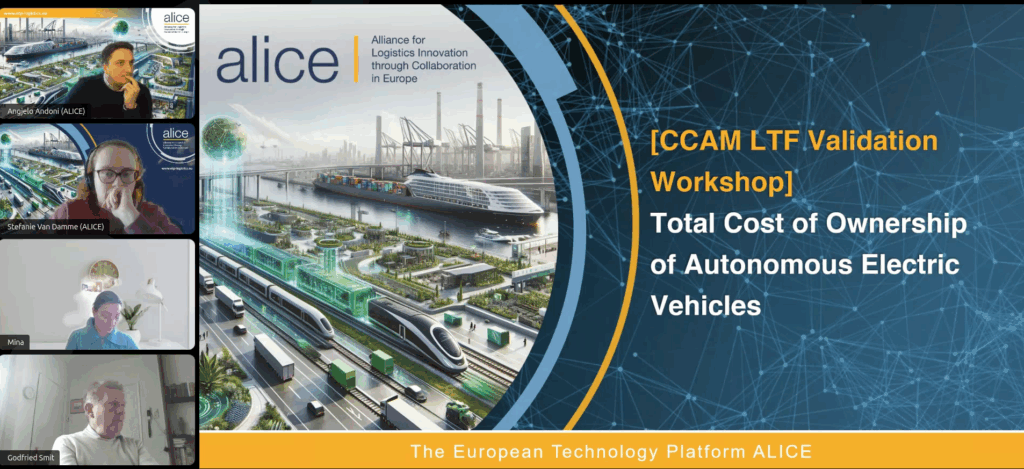
On 13 February 2026, ALICE, together with the Institute of Transport Economics (TØI), brought together industry stakeholders for a validation workshop under the CCAM Logistics Task Force to examine one of the most pressing questions surrounding autonomous freight: what will the total cost of ownership of Autonomous Electric Vehicles really look like in practice?
The session formed part of the MODI project’s ongoing business-model work and built on an earlier input collection phase, where logistics actors were invited to share operational data and assumptions through a questionnaire and a dedicated TCO tool. The workshop presented consolidated, anonymised findings and invited participants to test whether the emerging cost ranges for autonomous electric trucks are directionally plausible across drayage, middle-mile and long-haul operations.
A recurring theme throughout the discussion was uncertainty. While there is broad agreement that electrification increases upfront vehicle costs compared to diesel, automation introduces an additional layer of complexity. Stakeholder inputs suggested that capital expenditure for autonomous electric trucks is expected to rise further, while operational intensity – particularly annual mileage – could also increase. Labour costs were consistently identified as the main potential balancing factor, with expectations of significant reductions depending on how quickly and fully driving tasks can be automated.
However, not all variables showed convergence. Energy consumption, maintenance costs and insurance assumptions remain areas of debate. Participants highlighted that some impacts may differ strongly by duty cycle. In drayage, automation could extend asset productivity and value through higher utilisation. In long-haul, higher operational intensity could shorten useful life, even if partially offset by labour savings and increased mileage. These contrasting views underline why more evidence and broader input are still needed before drawing firm conclusions.
To better understand how uncertainty affects investment decisions, the workshop also demonstrated a modelling approach combining Monte Carlo analysis with sensitivity testing. Rather than producing a single TCO number, the methodology treats key inputs-distance, speed, working days, load times, driver costs, CAPEX and energy prices-as variable ranges. This produces probability-based outcomes and highlights which parameters most strongly influence the final cost per kilometre. The preliminary illustration showed that, under certain assumptions, autonomous electric vehicles could approach diesel-level TCO despite higher purchase costs, primarily due to labour reductions. Yet the results proved highly sensitive to utilisation patterns and cost assumptions, reinforcing the need for validated input data.
The interactive validation exercise further revealed an important distinction raised by participants: the difference between what is expected from the technology and what is acceptable from a business perspective. Several operators noted that while long-term projections may suggest cost reductions, adoption decisions will ultimately depend on clear criteria such as capital burden, availability, operational throughput and reliability. Without predictable utilisation and financing models, even technically promising solutions may struggle to gain traction.
The workshop did not aim to provide definitive answers. Instead, it clarified where stakeholder views align, where they diverge, and which assumptions most strongly shape TCO outcomes. By openly testing these ranges with industry actors, the CCAM Logistics Task Force is strengthening the analytical foundation of MODI’s business-model work and helping move the conversation from speculation to evidence-based evaluation.
The consolidated findings and detailed modelling approach are documented in the full report, which provides deeper insights into the assumptions, ranges and methodological choices discussed during the session.