
Wednesday, September 30th, 2026
How can Europe move from having data, regulation and promising AI applications to creating measurable value for companies and transport systems? This question was at the centre of Session “From data to impact – Data as a strategic asset for AI, competitiveness and strategic autonomy” at Connecting Europe Days 2026, where policymakers, industry, researchers and technology experts discussed the conditions needed to make Europe’s data economy work in practice.
Held on 29 September in Brussels, this session explored mobility and transport as a high-value use case for Europe’s wider ambitions on data and artificial intelligence.
The discussion was moderated by Bjoern Juretzki, Head of Unit for Data Policy and Innovation at DG CNECT, with contributions from Borys Budka, Member of the European Parliament and Chair of ITRE; Martin Vohánka, CEO and Founder of Eurowag; Prof Dr Anna Zeiter, CEO of W Social and Titular Professor of European Data Law at the University of Bern; Leona King, researcher at KU Leuven; and Vassilis Antoniades, Managing Director and Senior Partner at Boston Consulting Group.
A central topic of this session was the shift from establishing rules towards making Europe’s data framework work for businesses. Europe has spent recent years establishing the foundations for a trusted data economy and trustworthy AI. The challenge now is to convert these foundations into business assets that can be scaled.
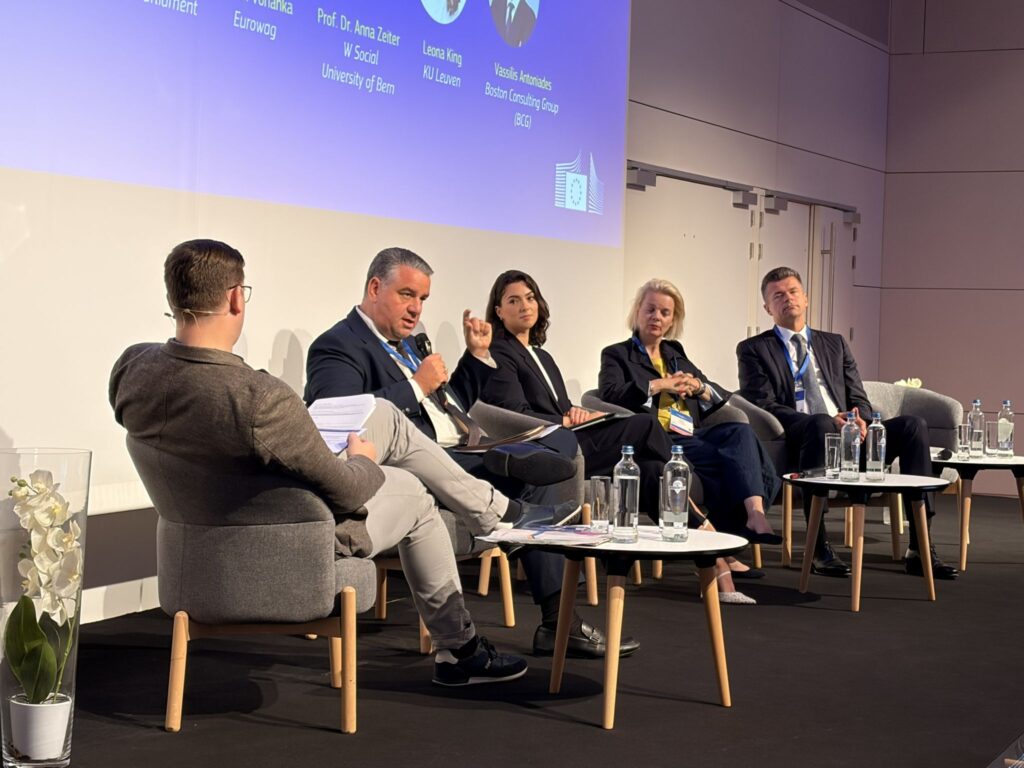
MEP Borys Budka sharpened this point by focusing on the distance between data and impact. Europe has developed an extensive framework around data and AI, but regulation alone does not create infrastructure, deploy technology or generate economic value. The discussion therefore turned towards implementation, technological capacity and the ability of European companies to build and deploy solutions at scale.
For mobility and logistics, this is particularly relevant. The sector produces large volumes of operational data, from vehicles and infrastructure to transport operations, charging, financing and supply-chain activities. The session highlighted the potential to use this data for better infrastructure management, operational savings and greater resilience.
Rather than asking only whether European data spaces exist, the discussion asked whether a mid-sized logistics company with around 40 trucks and no dedicated data scientist could actually connect to one easily and derive value from it. This distinction is important. Data infrastructure can only contribute to competitiveness if companies of different sizes can participate without prohibitive technical, administrative or legal complexity.
The panel repeatedly returned to two challenges: fragmentation and data quality.
Martin Vohánka described the practical work required to develop AI-enabled solutions in transport. His experience was that the most difficult part was not necessarily the AI itself, but gathering data from multiple sources, cleaning it, structuring it and bringing it together into a coherent system.
This is a familiar challenge across logistics. Vehicle data, transport data, financial information, infrastructure data and operational information frequently are in separate systems, follow different standards and are governed through different arrangements.
Fragmentation also exists beyond technology. The panel discussed fragmentation between countries, organisations and even divisions within individual companies. Innovation developed successfully in one part of an organisation does not automatically spread across the rest of the business or into other markets.
An audience poll reinforced the discussion: fragmentation emerged as the leading issue participants believed Europe should address to strengthen competitiveness in the digital economy, followed by data quality.
The discussion also examined what is needed for data spaces to move beyond pilot projects.
Leona King highlighted the complexity of the legal environment surrounding data. New frameworks such as the Data Act and Data Governance Act interact with existing areas of law, while different categories of data may be subject to different requirements.
Questions around verification, governance and participation therefore still need practical answers. Without these, the transition from experimental data spaces towards infrastructure that companies can rely on and build services upon may remain difficult.
Another important message was that successful AI deployment depends on people and organisations as much as algorithms.
Drawing on BCG’s experience, Vassilis Antoniades emphasised the importance of the human component in achieving impact from AI, including what he described as an organisation’s “AI fluency”: the ability of people to understand and use AI sufficiently to embed it across their work.
Education and skills returned in the concluding discussion. Panellists argued that Europe needs stronger AI literacy and earlier education so that individuals and organisations can make informed choices and use new technologies effectively.
The implication for logistics is clear: investing in platforms, algorithms and data infrastructure is only part of the challenge. Organisations also need people who understand how to use these tools, redesign processes around them and collaborate with partners across the supply chain.