
Thursday, June 11th, 2026
At IPIC 2026, the session “From Data Spaces to Process Spaces: Enabling Event-Driven Coordination in the Physical Internet” explored a critical challenge for the future of collaborative logistics: while organisations are increasingly able to exchange data, effective coordination requires more than data sharing alone. To enable the Physical Internet vision, stakeholders must also be able to share process context, events, responsibilities and operational states in a trusted and governed manner.
Moderated by Birger Schrevens (imec), the session brought together technology developers, standards organisations, logistics platforms and researchers, including contributors from the PILOTS project, to discuss how process sharing can become the missing operational layer between data exchange and real-world logistics execution. The discussion highlighted how data spaces, event-driven architectures, e-CMR and governance frameworks can work together to support scalable and interoperable logistics ecosystems.
Birger Schrevens introduced the concept of process spaces, arguing that interoperability for the Physical Internet cannot stop at exchanging data. While data spaces provide mechanisms for secure and sovereign data sharing, logistics actors also need a common understanding of the processes they are participating in.
This requires defining logistics processes in a machine-readable manner, including the actors involved, possible process states, events, responsibilities and transition rules. Rather than simply sharing information, organisations would be able to exchange logistics events linked to agreed process definitions. Such an approach would allow systems to automatically interpret events, update process states and coordinate actions across organisational boundaries.
Several of the concepts presented are currently being explored within the PILOTS project, which investigates how interoperable process-sharing mechanisms can support event-driven coordination across Physical Internet ecosystems while preserving organisational autonomy and data sovereignty.
The proposed architecture builds upon data space technologies while extending them towards event-driven coordination. Process definitions become reusable assets that enable organisations to discover services, exchange events and execute collaborative processes without requiring tightly coupled integrations. According to the speakers, this creates a foundation for scalable interoperability while preserving organisational autonomy.
Philippe Michiels (imec) further developed the process-sharing concept by explaining how open standards and process modelling technologies can support collaboration between organisations.
Drawing on business process modelling approaches, he highlighted the importance of creating shared representations of logistics processes that can be understood by both humans and machines. These process definitions can then be connected to existing enterprise systems while maintaining flexibility for each participating organisation.
A key message was that process spaces do not replace data spaces. Instead, they build upon them. Data spaces provide trusted data exchange and sovereignty mechanisms, while process spaces add operational coordination through shared events and process state management. This combination creates a framework where organisations can collaborate more effectively without surrendering control over their internal systems or data.
The practical implications of this approach were illustrated through a demonstrator presented by Arne Kerremans (Inuits) and Matteus Deloge (T-Mining).
The demonstration focused on a container weighing process in the Port of Antwerp-Bruges. The speakers showed how multiple organisations could participate in a shared logistics process while maintaining control over their own systems. Events generated by one participant automatically triggered updates and actions by others, allowing process progression to be coordinated across company boundaries.
The demonstration relied on process definitions expressed through business process modelling standards and connected through data-space technologies. Participants were able to exchange process events while retaining ownership of their data and systems. The example illustrated how process sharing can create a common operational understanding without requiring centralised control or fully shared information systems.
The presenters emphasised that organisations continue to operate their own enterprise systems, while process-sharing mechanisms provide the coordination layer that enables interoperability between them.
Stefan Gevaert (Pionira) argued that e-CMR represents a natural candidate for process-sharing architectures because it already captures key logistics interactions involving multiple actors.
The electronic consignment note is more than a digital document. It reflects a process involving consignors, carriers, drivers, receivers and other stakeholders. Many e-CMR solutions already support event notifications and workflow-related information exchange. However, most current implementations remain limited to interactions within individual platforms or communities.
The Physical Internet perspective requires extending these capabilities beyond platform boundaries. By connecting e-CMR systems through interoperable infrastructures and trust frameworks, process information could be shared across wider logistics networks. This would allow organisations to participate in common logistics processes while maintaining their preferred platforms and service providers.
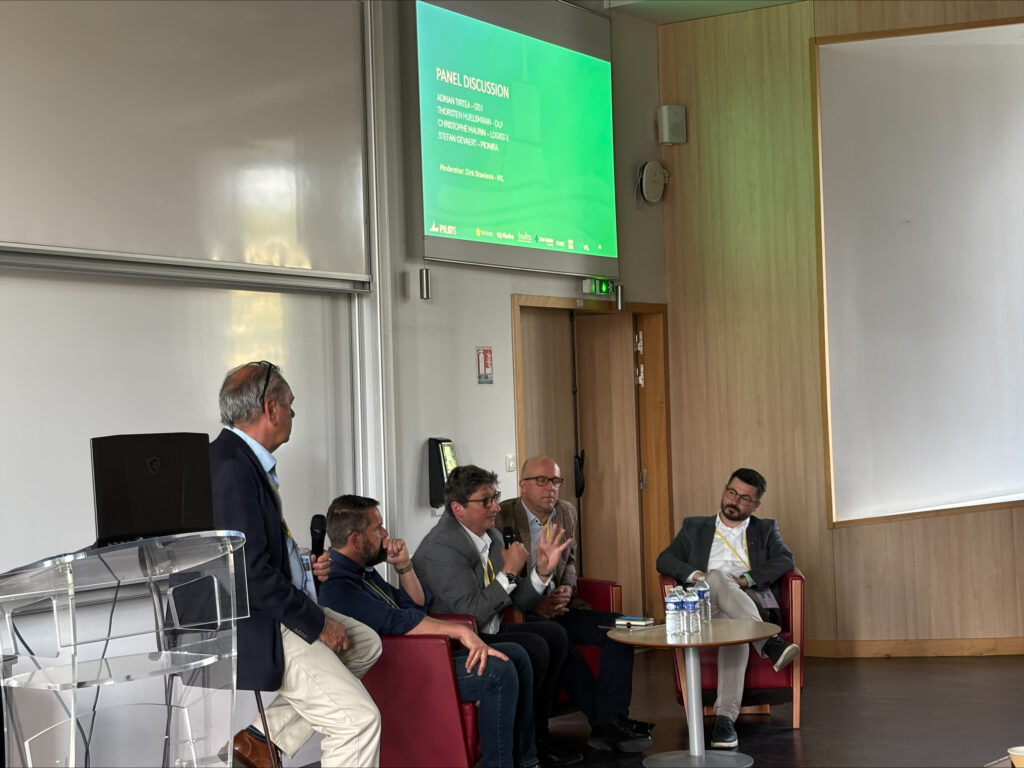
The panel discussion brought together representatives from Open Logistics Foundation, GS1 and Logist-X to examine how standards, platforms and open-source initiatives can contribute to scalable interoperability.
A recurring theme was the need to move beyond isolated digital platforms and towards federated ecosystems that allow organisations to collaborate while retaining ownership of their data and commercial relationships. Several speakers highlighted that adoption challenges are often linked less to technology than to trust, incentives and governance.
GS1 stressed the importance of common identifiers, event standards and shared business vocabularies that enable different actors to understand logistics events consistently across supply chains. The organisation also highlighted the transition from static document exchange towards dynamic and machine-readable business processes.
Representatives of the Open Logistics Foundation emphasised the role of open-source solutions in reducing duplication of effort and creating reusable interoperability components. Rather than each organisation developing the same basic capabilities independently, common building blocks can be collaboratively maintained while allowing commercial providers to innovate on top of them.
Logist-X highlighted that process sharing should not imply centralisation of data. Instead, organisations should be able to share trusted process information while preserving data sovereignty and control. The discussion reinforced the importance of common data models, semantic interoperability and governance frameworks that support collaboration without forcing organisations into closed ecosystems.
The session concluded with a presentation by Shafagh Alaei Jordehi (VUB), who focused on governance requirements for process sharing in the Physical Internet.
She argued that the challenge is no longer simply technical interoperability but operational trust. When organisations share process information, actions performed by one participant may affect others. Questions of responsibility, accountability, access rights and decision-making therefore become central.
Governance must address multiple layers simultaneously. These include identity and trust management, access control, standards and interoperability mechanisms, as well as business incentives and ecosystem coordination. Process sharing requires organisations to trust not only the exchanged data but also the broader collaborative environment in which coordination takes place.
The presentation highlighted that no single governance model will suit all logistics ecosystems. Different use cases, stakeholders and collaboration structures may require different governance arrangements. The key objective is therefore to create adaptive governance frameworks that reduce uncertainty and enable organisations to collaborate confidently across organisational boundaries.
The session demonstrated that achieving the Physical Internet requires moving beyond data exchange towards operational coordination. While data spaces provide essential foundations for trusted information sharing, process spaces offer a complementary layer that enables organisations to coordinate actions, share events and collaborate across organisational boundaries.
The discussions showed growing convergence around several key principles: preserving data sovereignty, adopting open standards, enabling event-driven coordination, leveraging reusable interoperability components and establishing governance frameworks that foster trust.
As Tomasz Dowgielewicz (ALICE) noted in the closing remarks, the Physical Internet ultimately requires more than connecting information systems. It requires connecting logistics ecosystems. Process sharing, supported by trusted governance and interoperable digital infrastructures, may become one of the key enablers of that transition.
Tomasz also pointed out that the topic of Data Spaces that serve both, eCMR, eFTI and process interoperability will be continued at the Alice Innovation Summit in November 2027.