
Tuesday, April 21st, 2026
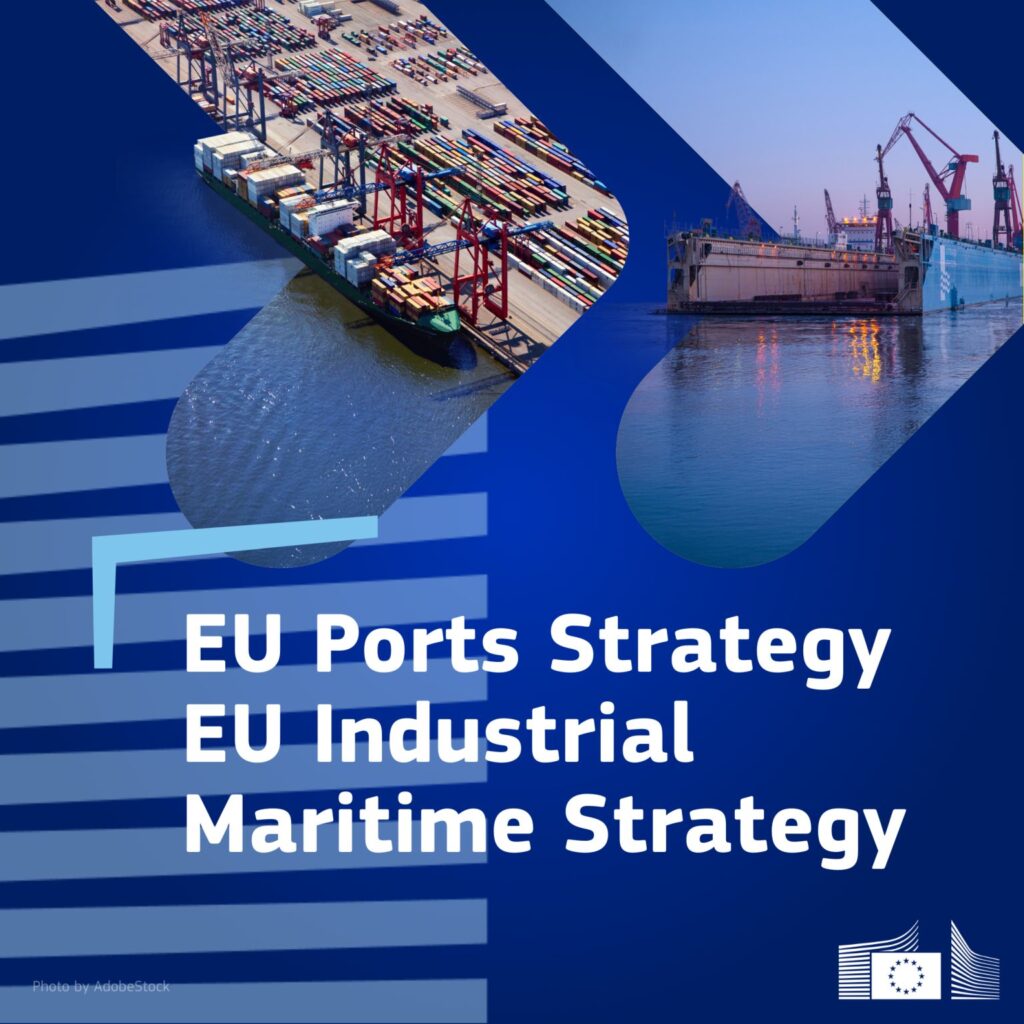
On 4 March 2026, the European Commission adopted a new EU Ports Strategy, setting out a framework to strengthen the competitiveness, resilience, security and sustainability of Europe’s ports. The strategy comes at a time when ports are expected to do much more than handle cargo: they are increasingly being asked to expand capacity, support clean energy deployment, digitalise operations, reinforce security and contribute to Europe’s economic resilience at the same time.
Ports remain a cornerstone of the European economy. According to the Commission, EU ports facilitate around 74% of the EU’s external trade, handle more than 3.4 billion tonnes of goods and nearly 395 million passengers annually, and support around 423,000 direct jobs. The strategy also underlines their wider role as gateways for trade, lifelines for islands and outermost regions, and critical infrastructures for energy supply, defence, logistics and territorial cohesion.
The scale of the system is also significant. The infographic accompanying the strategy highlights 550 TEN-T ports across Europe, including 327 maritime ports, 223 inland ports, 99 island ports and 26 ports in outermost regions.
A central message of the strategy is that ports are no longer seen only as transport interfaces. The Commission describes them as increasingly important multi-functional industrial hubs, hosting innovation, clean energy activities, logistics functions and new business opportunities. At the same time, they face growing exposure to organised crime, cyber threats, geopolitical pressure, foreign influence risks and competition from third-country ports.
For ALICE, this broader framing is particularly relevant. Ports sit at the intersection of freight transport, energy systems, logistics chains and industrial ecosystems. Their performance increasingly depends not only on maritime operations, but also on the quality of their hinterland connectivity, the efficiency of multimodal interfaces, data exchange, access to clean fuels, security arrangements and collaboration across supply chains.
The Commission structures the EU Ports Strategy around five priorities. First, it aims to strengthen competitiveness, innovation and digitalisation, including guidance on foreign investments, principles for EU funding and investments in third-country ports, stronger support for innovation uptake, and better data sharing and hinterland connectivity.
Second, it focuses on energy transition, sustainability and clean industries. Here, the strategy highlights electrification, grid access, clean fuels, port-centred energy cooperation and faster permitting for strategic projects. The Commission also plans to prioritise onshore power supply in a 2026 CEF call and link ports more strongly to industrial clusters and clean energy networks.
Third, the strategy addresses protection and security. Ports are identified as vulnerable to organised crime, drug trafficking, cyberattacks, hybrid threats and pressure on critical supply chains. Planned actions include updated security guidance, background-check frameworks for port workers, cybersecurity cooperation, third-country port assessments and an EU-wide coordinated cyber risk assessment.
Fourth, the strategy tackles access to finance and investment. The Commission points to a mix of EU, national and private funding, supported by clearer public funding principles and more technical assistance, especially for small and medium-sized ports. Since 2014, EU instruments have already supported port-related projects with around EUR 10 billion for deployment and more than EUR 200 million for research and innovation, according to the strategy.
Fifth, it addresses social cohesion, skills and quality jobs, with actions on workforce renewal, upskilling, port safety, alternative fuels handling and support for smaller ports, islands and outermost regions.
Several elements are especially relevant from a logistics perspective. The strategy explicitly acknowledges the role of hinterland connections in port competitiveness and efficiency, including better integration with rail and inland waterways and more resilient multimodal logistics chains. It also recognises the importance of digital systems and secure data exchange in managing freight flows and port operations, while warning against fragmentation and dependence on non-EU technologies in strategic infrastructures.
The emphasis on resilience, security, clean energy and coordinated investment also aligns with broader priorities for Europe’s freight and supply chain system: reducing vulnerabilities, accelerating decarbonisation and ensuring that critical nodes can continue to function under pressure.
To support implementation, the Commission will establish a high-level Maritime Industries and Ports Board, chaired by the responsible Commissioner and Executive Vice-Presidents, to follow progress on both the EU Ports Strategy and the parallel EU Industrial Maritime Strategy.
For ALICE members, the new strategy is an important policy signal. It confirms that ports are not only maritime assets, but strategic enablers of Europe’s trade, logistics, energy and resilience agenda. The challenge now will be to translate this framework into coordinated action across infrastructure, innovation, security, data and skills.
Press materials