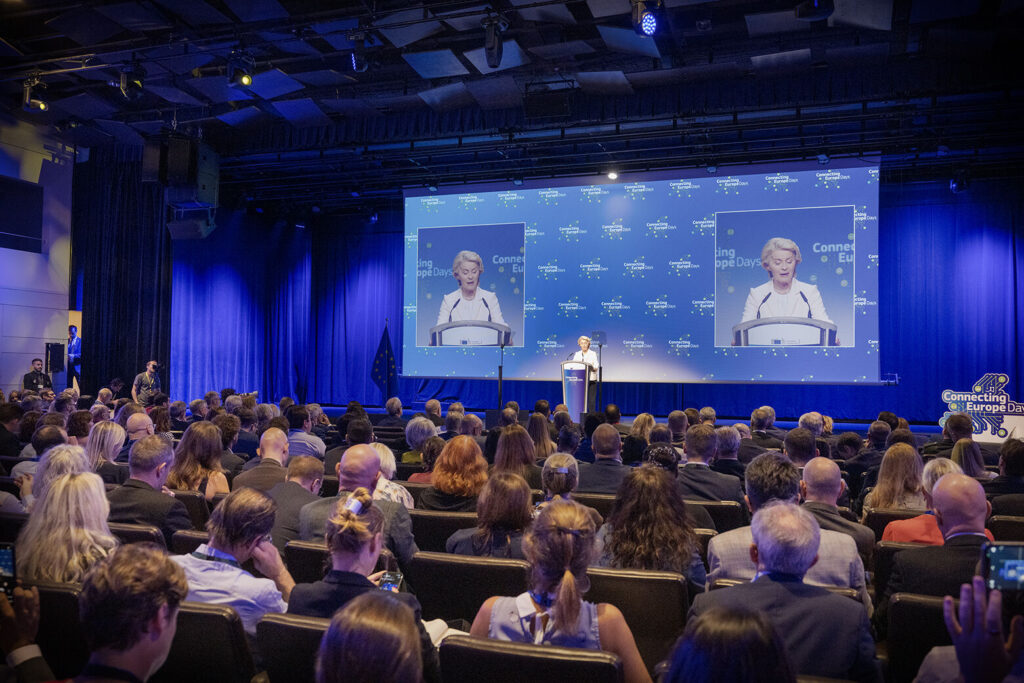
Completing the connections that make the Single Market work
A first priority was the completion of the Trans-European Transport Network (TEN-T) and, in particular, removing bottlenecks and missing links between national systems.
The Lisbon-Madrid rail connection was presented as an example of what this means in practice. The European Commission expects a direct journey of around five hours by 2030 and around three hours once the high-speed connection is completed by 2034.
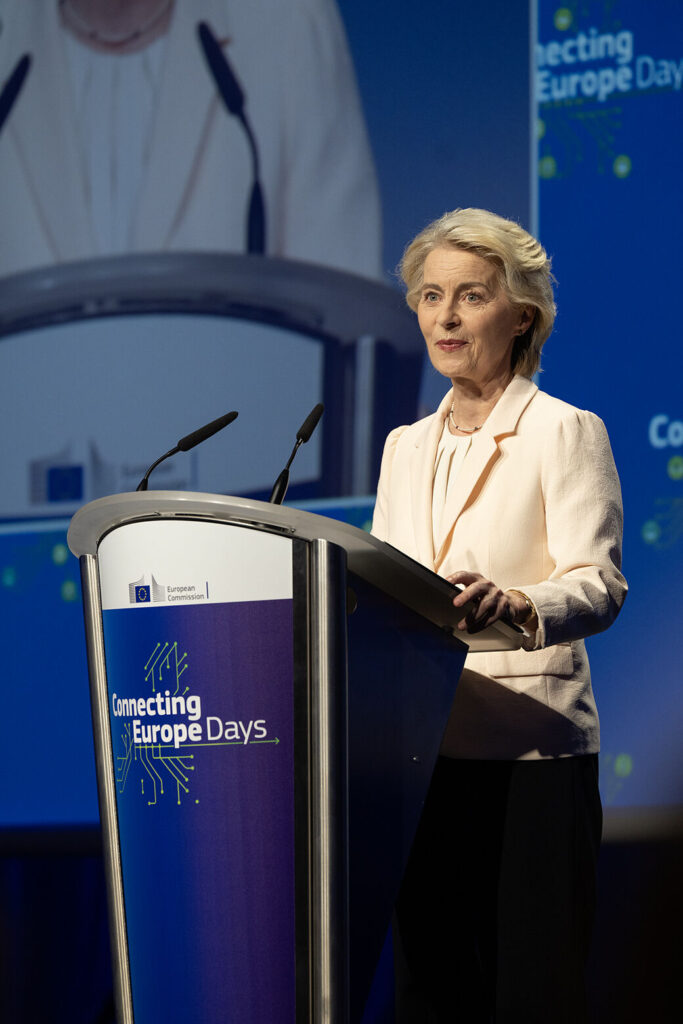
The economic dimension is significant. President von der Leyen referred to Commission estimates indicating that implementation of the revised TEN-T could contribute to a 2.4% increase in EU GDP by 2050, equivalent to €467 billion compared with the baseline scenario.
Delivering these connections requires investment. The Commission has proposed €51.5 billion for transport under the Connecting Europe Facility for 2028-2034, around twice the current transport allocation.
For the logistics sector, the message is particularly relevant: European transport corridors need to work as connected systems, linking roads, railways, inland waterways, ports, terminals and other infrastructure rather than operating as fragmented national networks.
Giving transport innovation European scale
Innovation was the second major theme. President von der Leyen highlighted electrification and automation as areas where Europe already has significant industrial capabilities, but where companies also need the right conditions to deploy solutions at scale.
Zero-emission road freight provided a concrete example. Around 26,000 zero-emission trucks are currently operating on European roads, with the number expected to approach 400,000 by 2030. Supporting this growth requires reliable cross-border charging infrastructure rather than disconnected national networks. The Commission and Member States are therefore working through the Clean Transport Corridor Initiative to develop coordinated charging corridors along TEN-T.
The same European-scale approach applies to automation. In June 2026, 18 Member States agreed to cooperate on large-scale cross-border testbeds for autonomous vehicles, including common approaches to approval and coordinated permitting. Freight and logistics are among the use cases covered by the initiative
Resilience needs to be designed into infrastructure
The Opening Ceremony also placed climate resilience firmly within the transport infrastructure agenda.
Heat affecting railways, flooding disrupting roads and tunnels, and drought affecting waterways were cited as examples of the growing exposure of European transport networks to climate risks. The message was that resilience should not be treated only as a response to disruption. It needs to be considered from the design and investment stage.
The Commission is preparing a new integrated European framework for climate resilience and risk management, with resilience by design among its guiding principles.
Europe’s future transport network needs to be multimodal, resilient, sustainable and digital, connecting railways, inland waterways, short-sea shipping, roads, ports and airports while removing technical and operational barriers between them.
Connectivity beyond today’s EU borders
Finally, the opening address linked transport infrastructure to the future geography of Europe. President von der Leyen referred to Ukraine, Moldova and the Western Balkans moving closer to the European Union and stressed the importance of developing the physical transport connections that accompany this process. Moldova’s improved links with Romania were highlighted as one example.
The broader message was clear: European integration requires physical connectivity alongside political and economic integration.
Europe is looking not simply for more infrastructure, but for a transport system that connects networks, enables innovation at European scale and remains resilient under changing economic, technological and climatic conditions.