
Monday, October 26th, 2026
Connecting Europe Days 2026 concluded on 30 September in Brussels with a Closing Ceremony bringing together European political leaders to reflect on the future of Europe’s transport network and the priorities needed to strengthen connectivity, competitiveness and resilience across the continent.
Moderated by Katrina Sichel, the closing programme featured Enrico Letta, former Prime Minister of Italy; Elissavet Vozemberg, Chair of the European Parliament’s Committee on Transport and Tourism (TRAN); and Apostolos Tzitzikostas, European Commissioner for Sustainable Transport and Tourism.
Their discussions brought several of the themes addressed throughout Connecting Europe Days back to a common challenge: Europe needs transport networks that work across borders and support not only mobility, but also the functioning of the Single Market, economic competitiveness, security and territorial cohesion.
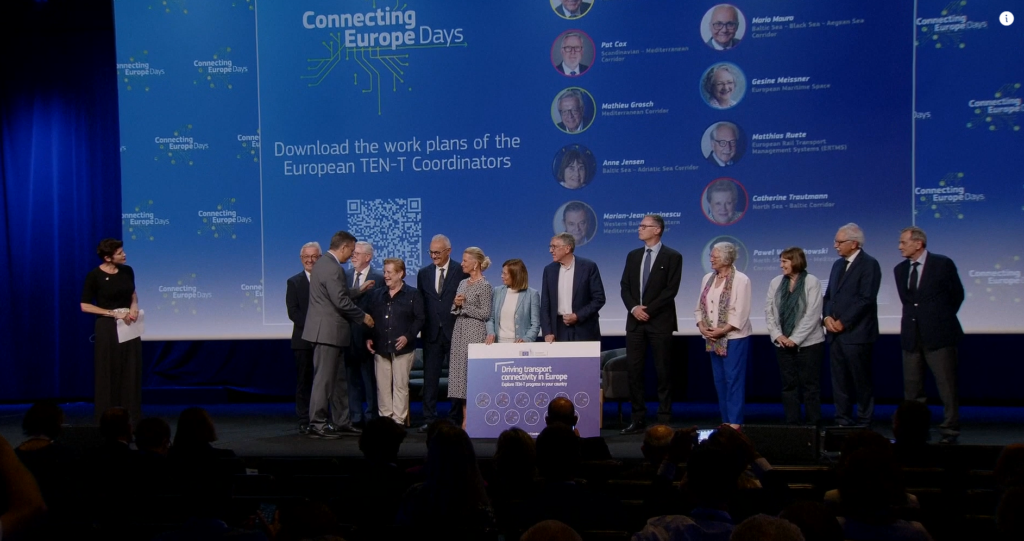
A central focus of the Closing Ceremony was the implementation of the Trans-European Transport Network (TEN-T) and the importance of completing strategic connections across Europe.
Elissavet Vozemberg highlighted the role of transport connectivity in strengthening economic, social and territorial cohesion and providing citizens and businesses across European regions with access to an efficient and interconnected transport system. She stressed the importance of timely implementation of TEN-T and sustained investment in major infrastructure projects.
The ceremony also marked the handover of the first European Coordinators’ work plans under the revised TEN-T framework, reinforcing the importance of coordination between the European institutions, Member States, regions and infrastructure stakeholders in translating European transport priorities into implementation.
The discussion underlined that completing Europe’s transport network is a shared responsibility. Cross-border projects in particular require long-term cooperation, aligned priorities, adequate financing and trust between the different countries and organisations involved.
Enrico Letta placed transport connectivity within the wider discussion on the European Single Market. He highlighted the continuing barriers created by fragmentation between national systems and used rail connectivity as a tangible example of what a more integrated Europe could deliver for citizens.
The discussion went beyond physical infrastructure. Investment and the mobilisation of private capital were highlighted as important elements in strengthening European competitiveness, alongside the need to overcome fragmentation and create the scale required for major European projects.
From this perspective, transport infrastructure is not simply a mobility issue. Efficient connections between countries and regions contribute to the movement of people and goods, the functioning of supply chains and the ability of European businesses to operate effectively across the Single Market.
Resilience and security also featured prominently in the closing discussion. Speakers reflected on how Europe’s geopolitical environment is changing the role expected of transport infrastructure.
Transport networks increasingly need to support economic competitiveness while also strengthening supply-chain resilience, security and Europe’s capacity to respond to disruption. This makes cooperation across borders, sectors and modes increasingly important.
The discussion highlighted the need to connect infrastructure development with digitalisation, clean energy, security and technological development rather than treating these areas separately.
In his closing remarks, Commissioner Apostolos Tzitzikostas reflected on the discussions held throughout Connecting Europe Days, spanning connectivity, infrastructure, innovation, sustainability, competitiveness, security and resilience.
His concluding message emphasised that the future transport system will not be shaped by a single technology, company or transport mode. It will depend on cooperation across borders, between public and private actors, across transport modes and between established industries and innovators. The growing relationship between civilian and defence infrastructure was also highlighted as part of this changing environment.
This message is particularly relevant for logistics. European freight operations depend on the interaction of infrastructure, transport services, energy systems, digital solutions and actors operating across national borders. Improving individual components is important, but their value ultimately depends on how effectively they function together as part of an integrated European network.
The Closing Ceremony therefore provided a fitting conclusion to Connecting Europe Days 2026: Europe’s transport network remains one of its most important shared assets, but its future strength will depend on sustained investment, implementation and collaboration.
For ALICE and the logistics innovation community, the discussions reinforce the importance of approaching transport infrastructure as part of a wider logistics ecosystem – connecting infrastructure development with operational needs, digitalisation, sustainability, resilience and competitiveness as Europe moves towards a more integrated transport system.