
Thursday, January 29th, 2026
On 22 January 2026, ALICE officially launched its Intralogistics Community with an online Kick-Off Meeting, bringing together around 25-30 participants and building on interest expressed by more than 40 ALICE members.
Intralogistics covers internal material flow, storage, and handling. As automation, digitalization, and AI-driven solutions continue to reshape the logistics landscape, intralogistics is increasingly recognized as a key area where innovation and collaboration can bring significant efficiency and sustainability gains.
The new Community responds to a growing recognition that intralogistics plays a strategic role in Europe’s logistics and supply chains resilience and competitiveness and must be addressed as an integrated part of end-to-end logistics operations rather than in isolation. Europe’s intralogistics market was valued at USD 16.40 billion in 2022, projected to reach USD 44.03 billion by 2030.
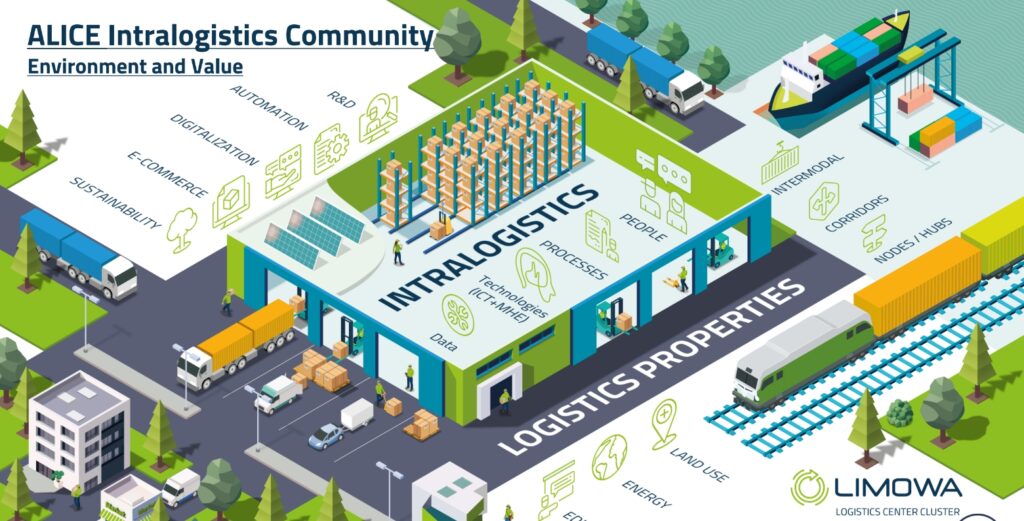
Intralogistics community will address the current gap between transport and intralogistics operations creating interoperability and digital handshake between warehouses and transport flows. The Intralogistics Community positions itself as a platform to address this interface holistically, aligning operational practices, enabling real‑time data sharing, and tackling cross‑cutting challenges such as system interoperability, automation in brownfield sites, standardization (e.g. VDA 5050), workforce transformation, and the evolving role of warehouses as energy and decarbonization hubs. The goal is shifting the landscape from siloed blame to proactive end‑to‑end collaboration facilitated by systems and technologies.
The session marked the transition from exploratory discussions in to structured collaboration and work plan for 2026 following earlier exchanges during the ALICE Brokerage Event, Transport Logistic Munich and the ALICE Summit session: Beyond Boundaries: Building Europe’s Smart and Collaborative Intralogistics Community. Participants discussed how intralogistics connects people, processes, technologies and data across warehouses, transport interfaces and supply chains, particularly in the context of automation, digitalisation and the energy transition.
The meeting opened with framing remarks from Fernando Liesa (ALICE Secretary General). Despite many initiatives addressing intralogistics technologies, or the sector itself, there has been no dedicated European forum examining its systemic role within logistics and supply chains including a broader range of stakeholders including shippers and logistics service providers, a gap the new Community aims to fill in close collaboration with engaged members such as LIMOWA that is co-leading this initiative.
Tomasz Dowgielewicz (ALICE) presented key conclusions from the intralogistics session held at the ALICE Logistics Innovation Summit. He highlighted the rapid growth of the intralogistics market, driven by automation, digitalisation and sustainability pressures, while underlining persistent challenges caused by fragmented warehouse and transport operations. He stressed that transport performance depends on warehouse readiness, and vice versa, yet the two domains often operate in silos, leading to inefficiencies and delays. Tomasz emphasised the need for better data sharing, interoperability and coordinated planning, as well as common standards such as VDA 5050 to enable scalable automation with mixed fleets of AGVs and AMRs. He also pointed to workforce challenges and the evolving role of warehouses as part of decarbonised logistics systems.
The session continued with an overview of member feedback presented by Teemu Hämäläinen (LIMOWA). Based on 42 questionnaire responses collected through the ALICE Innovation Summit and the ALICE Intralogistics Community – Member Interest Questionnaire that will continue to be open to gather feedback and collect members interest in the community. The feedback confirmed strong interest in intralogistics across a diverse membership base. Digitalisation emerged as the most frequently highlighted topic, alongside broad interest in automation, data and systems integration and the physical internet. Members expressed interest in a wide range of Community activities, including webinars, workshops, technical seminars, site visits and collaborative project development. While Horizon Europe funding was the most familiar instrument, participants also noted the importance of national and regional funding opportunities as well as industry partnerships.
During the open discussion, participants emphasised the need to define intralogistics broadly, extending beyond traditional warehousing to include port operations, airport ground handling, production logistics and other controlled operational environments. This input was acknowledged as important for refining the Community’s scope and creating strong links and connections with ALICE Ports & hubs community. The Secretariat underlined that the success of the Intralogistics Community depends on active member engagement, with value created through shared contributions, use cases and collaboration rather than passive participation.
The Kick-Off Meeting concluded with a shared understanding that intralogistics must be addressed as a systemic component of logistics and supply chain operations. The newly launched ALICE Intralogistics Community will now focus on mapping member needs and contributions, including collecting use cases, proof of concepts, technical visits that will be the base for refining the presented work plan, and initiating activities.
The full workshop report is available exclusively to ALICE members via the Knowledge Platform.