
Tuesday, October 13th, 2026
On 7 October 2026, Fernando Liesa, Secretary General of ALICE, contributed remotely to the 1st LOGISTOP Scientific-Technological Congress, held on 6-7 October in Valencia, Spain. His presentation, “Logistics Innovation for a Competitive and Resilient Europe: Digitalisation, Sustainability and Collaboration”, explored the transformations reshaping European logistics and the role of innovation in strengthening competitiveness, resilience and strategic autonomy.
Organised by LOGISTOP, the Spanish Technology Platform for Innovation in Logistics, Transport and Mobility, the congress brought together businesses, research organisations, technology providers and public institutions to explore how applied research and collaboration can address the sector’s evolving challenges.
For Fernando, participation also held personal significance. Having been involved in LOGISTOP’s early development, he reflected on the progress made over the past two decades and the importance of bringing industry, research and public authorities together to advance logistics innovation.
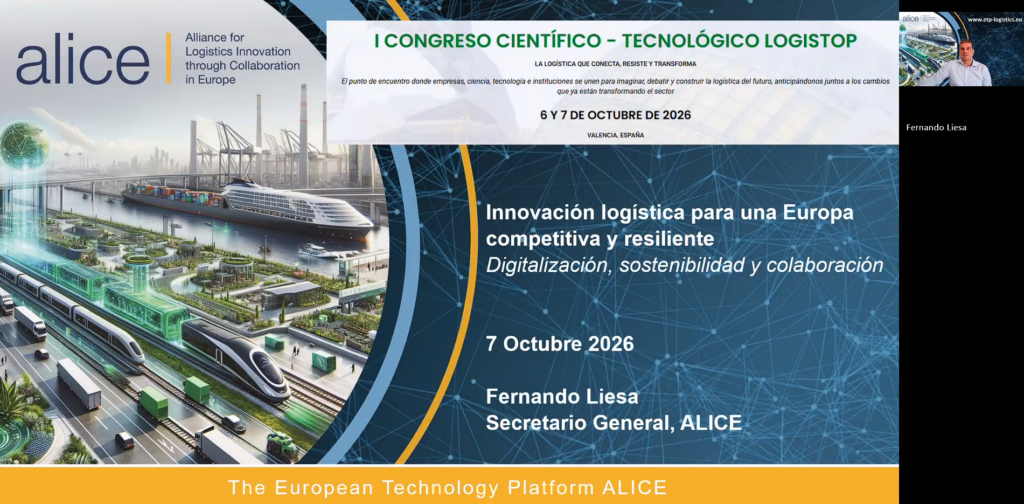
Fernando highlighted the changing European policy and economic landscape, where competitiveness, resilience, strategic autonomy and closing the innovation gap have become increasingly important priorities.
Europe has strong research capabilities, industrial expertise and technological knowledge. However, the challenge is to translate these strengths into solutions that can be implemented at sufficient speed and scale.
Logistics plays a central role in this transformation. As a foundation of European industry and trade, its efficiency and resilience directly influence the competitiveness of businesses and the wider economy.
Fernando identified four interconnected transformations shaping the future of logistics: decarbonisation and the energy transition; resource scarcity; geopolitical, economic and climate-related uncertainty; and digitalisation, artificial intelligence and automation.
These developments are changing how logistics networks must be designed and operated, requiring companies to reconsider their investment priorities, operational models and approaches to collaboration.
A key message was that decarbonisation should not be viewed solely as an environmental objective. Reducing dependence on external energy sources can also strengthen resilience, energy autonomy and long-term competitiveness.
Fernando noted that electric heavy-duty vehicles are already becoming competitive with diesel alternatives in certain European operations. However, electrification requires much more than replacing vehicles. Companies must adapt routes, charging strategies, schedules, workforce skills and coordination with customers and energy providers.
He highlighted European research and innovation projects supported by ALICE, including ZEFES, MACBETH and FLEXMCS, which are advancing zero-emission heavy-duty transport and high-power charging solutions through real-world demonstrations.
He also referred to BELOGIC, which supports operators in planning and optimising logistics operations involving electric vehicles.
These initiatives illustrate the importance of practical experience in reducing uncertainty and supporting investment decisions as companies prepare for the energy transition.
Beyond energy, Fernando emphasised the growing pressure on logistics infrastructure, transport capacity and skilled labour.
Europe faces substantial investment requirements in energy networks, transport infrastructure, rail corridors and multimodal facilities. At the same time, structural workforce shortages and increasing transport demand are placing additional pressure on logistics operations.
Responding to these challenges will require greater productivity and more effective use of existing resources.
Automation can help improve operational efficiency, but collaboration between organisations and better utilisation of transport assets and infrastructure will be equally important.
Rather than relying exclusively on additional capacity, the logistics sector must develop ways to make existing networks more flexible, accessible and productive.
Digitalisation, artificial intelligence and automation offer important opportunities to manage increasingly complex logistics operations.
Fernando referred to Spain’s introduction of mandatory electronic administrative transport documentation on 5 October 2026 as an example of the transition from paper-based processes towards structured digital information.
The significance extends beyond regulatory compliance. Making transport information available in digital formats creates opportunities for automated processes, improved visibility, more effective data exchange and AI-supported decision-making.
However, digital technologies can only deliver their full potential when organisations can exchange information efficiently and operate through interoperable systems.
Common standards and reliable data-sharing arrangements are therefore essential for scaling innovation across the logistics sector.
A central part of Fernando’s presentation focused on the Physical Internet, the long-term vision guiding ALICE’s work towards fully interconnected logistics networks.
While individual companies have achieved significant efficiency improvements within their own operations, logistics remains fragmented between organisations. This creates inefficiencies in the use of transport capacity, infrastructure and information.
The Physical Internet approach seeks to address this fragmentation through collaboration, standardisation, interoperability, automation and shared resources.
Fernando emphasised the importance of developing logistics networks where capacity can be shared more easily, data can be exchanged under agreed conditions and business collaboration can be implemented with fewer operational barriers.
He also highlighted the growing international interest in Physical Internet principles, including initiatives in China, Japan and other regions. Their development reinforces the importance of accelerating implementation in Europe.
This vision is supported by ALICE’s Roadmap to the Physical Internet and European innovation activities such as IKIGAI, which explore how collaborative and interconnected logistics systems can progress towards practical implementation.
Fernando concluded by emphasising that the future of logistics cannot be built by a single company, technology or organisation.
The transition requires coordinated efforts across industry, research, technology providers and public authorities, supported by innovation ecosystems capable of connecting knowledge with investment and implementation.
He encouraged participants to continue engaging with LOGISTOP and ALICE, recognising their complementary roles in connecting Spanish and European logistics innovation communities.
The central message was clear: Europe’s future competitiveness and resilience will depend not only on developing new technologies, but on its ability to collaborate, invest and deploy innovation at scale.
By strengthening cooperation across organisations and borders, the logistics sector can turn today’s technological and operational challenges into opportunities for greater efficiency, sustainability and resilience.