
Thursday, October 22nd, 2026
On 29 September 2026, ALICE contributed to the Space-to-Sea Solutions event in Naples, Italy, organised by the European Space Agency (ESA) in collaboration with the Italian Space Agency (ASI). The event brought together more than 200 representatives from port authorities, coastguards, industry, public institutions and research organisations to explore how space technologies can support maritime operations, port innovation and the blue economy.
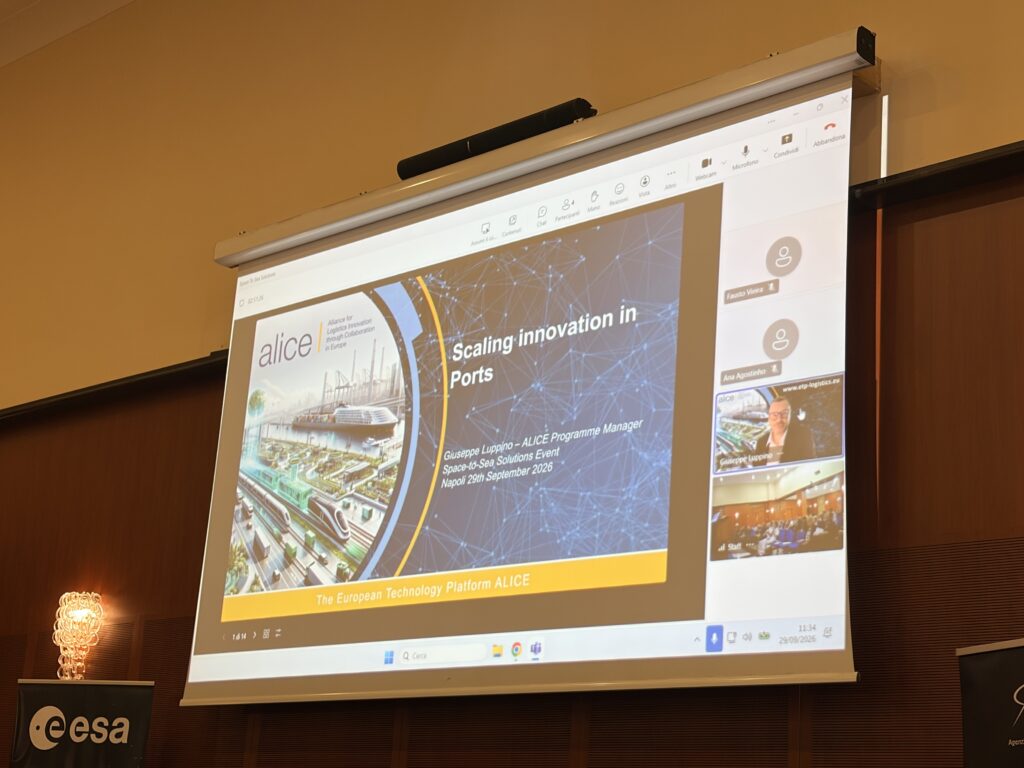
Giuseppe Luppino, ALICE Programme Manager, participated remotely, delivering a presentation entitled “Scaling Innovation in Ports”. His contribution focused on how ports can move from identifying operational challenges to implementing innovative solutions, and how space-enabled services can support this transition.
The event addressed maritime safety and security, smart logistics, digitalisation, connectivity and the role of ports as strategic nodes within wider transport and logistics networks.
A central message of ALICE’s presentation was that port innovation should begin with operational needs rather than individual technologies.
Ports face increasingly interconnected challenges involving operational safety and resilience, visibility of assets and cargo, congestion, infrastructure capacity, automation, environmental performance and coordination with hinterland transport networks.
Addressing these challenges requires solutions that respond to practical operational requirements and can be integrated into existing port systems and processes.
Giuseppe highlighted the importance of connecting technological innovation with the conditions needed for implementation, including interoperability, data sharing, investment, regulation and workforce skills.
From this perspective, space technologies offer valuable capabilities, but their effectiveness depends on how they complement other digital and physical infrastructure.
Earth Observation, satellite navigation and satellite communications can contribute to monitoring infrastructure and environmental conditions, improving vessel and cargo tracking, strengthening connectivity and supporting more informed operational decisions.
Combined with terrestrial sensors, the Internet of Things, artificial intelligence, digital twins and port management systems, these technologies can support better forecasting, planning and coordination across port operations.
The objective is not simply to introduce new technological capabilities, but to ensure that they contribute to safer, more efficient and more resilient logistics operations.
ALICE also emphasised the importance of looking beyond individual port boundaries.
Ports are essential interfaces between maritime transport, inland logistics hubs and European freight corridors. Their performance depends not only on internal terminal operations but also on effective connections with road, rail, inland waterways and the wider supply chain.
Improving visibility and coordination across these interfaces can help reduce inefficiencies, manage congestion and support more reliable multimodal transport operations.
This perspective is closely connected to ALICE’s developing Ports & Hubs activities, which aim to bring together operational needs, research and innovation results, technology providers and relevant stakeholders.
The objective is to help promising solutions move beyond isolated demonstrations towards wider implementation, replication and deployment across European ports and logistics hubs.
Experience from European research and innovation initiatives, including the PIONEERS project, provides a valuable foundation for identifying transferable approaches to port innovation and strengthening collaboration between ports.
An important development highlighted during the event was the announcement of ESA’s Space for Ports Working Group, established to connect the needs of port stakeholders with the capabilities of the space sector.
The working group had already begun its activities earlier in 2026, including a kick-off meeting in May. Its public announcement at Space-to-Sea Solutions provided an opportunity to highlight the initiative to a wider maritime and innovation audience.
The group offers a structured forum for port authorities and other stakeholders to identify common operational challenges, prioritise relevant use cases and explore opportunities for developing space-enabled solutions.
Its activities are intended to encourage cooperation between ports, technology providers and the space community, helping promising applications progress from initial concepts and demonstrations towards operational deployment.
This approach complements ALICE’s work on collaborative logistics innovation, particularly the importance of translating research results into practical solutions that can be scaled across organisations and networks.
The event also highlighted ESA’s Business Applications and Space Solutions programme and opportunities to support the development of commercially sustainable applications using space technologies.
ALICE’s participation in Space-to-Sea Solutions reflects the growing opportunities for cooperation between the logistics, maritime and space sectors.
Space-enabled technologies can provide valuable information and connectivity, but their wider impact will depend on collaboration with the organisations responsible for operating ports, terminals and hinterland transport networks.
For ALICE, the priority is to ensure that innovation addresses real operational needs, supports interoperability and contributes to more efficient and sustainable logistics systems.
The key message is that scaling port innovation requires connecting operational challenges, technological capabilities and the stakeholders able to turn promising solutions into practical applications.
Through continued engagement with ESA and the wider port innovation ecosystem, ALICE aims to support knowledge exchange, collaboration and the development of solutions that connect ports with Europe’s increasingly integrated logistics networks.
Further information: ESA Space-to-Sea Solutions event
Learn more about the Task Force: https://business.esa.int/space-for-logistics-and-resilient-infrastructure-task-force