
Monday, August 10th, 2026
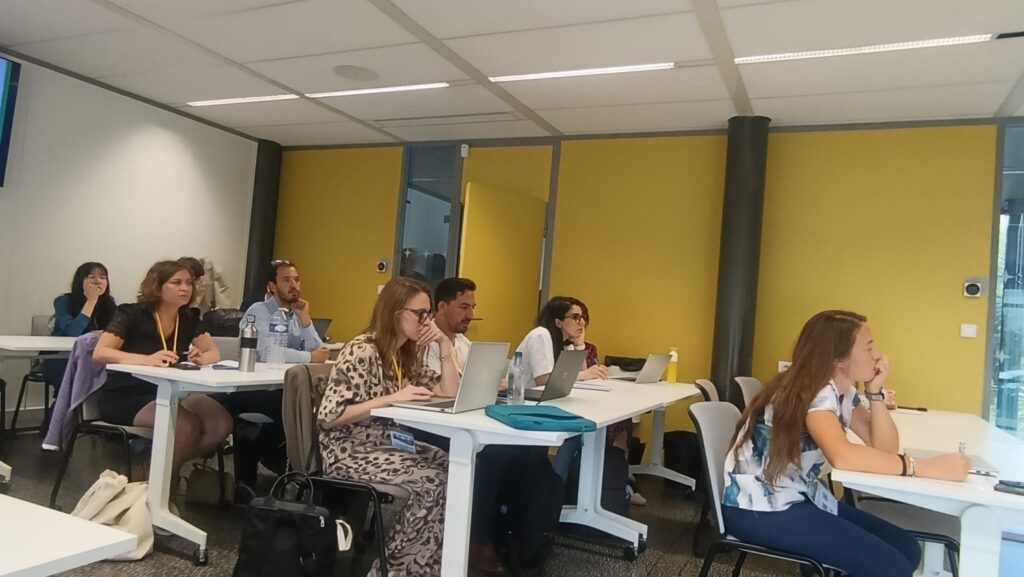
During IPIC 2026 in Bordeaux, the session “Multimodal Hubs, Ports and Deployable Nodes”, moderated by Paola Astegiano, brought together researchers and innovation projects exploring practical approaches to implementing Physical Internet concepts across logistics networks.
The session addressed several complementary dimensions of Physical Internet deployment, ranging from automation and digital twins to network optimisation, deployable logistics nodes and innovation scaling methodologies.
The session opened with the presentation of the AutoSUP project, which is developing a decision-support framework for automated multimodal supply chains based on Physical Internet principles.
Presented by Ilias Gkotsis, the work demonstrated how digital twins, information-flow modelling, stakeholder interdependency mapping and decision-support systems can be combined to help logistics stakeholders assess automation investments and operational improvements.
The framework evaluates connectivity, collaboration readiness, regulatory conditions and automation levels across logistics networks, supporting strategic decision-making in multimodal environments. Initial results from use cases in the Port of Trieste and the Port of Antwerp Bruges indicate potential benefits in operational efficiency, maintenance reliability and emissions reduction.
Hadjer Louzim presented a multi-echelon optimisation model designed to improve the circulation of Physical Internet containers across interconnected logistics networks.
The research combines routing optimisation, inventory management and container encapsulation strategies to minimise transportation costs, inventory holding costs and unused container space. The work highlights the importance of balancing multiple objectives and demonstrates how Physical Internet principles can support more efficient resource utilisation and freight consolidation.
Miguel Campos presented research on the use of digital shadows to validate deployable Physical Internet nodes within distributed modular construction networks.
The approach combines simulation models with operational data collected from pilot production environments to improve forecasting and decision-making before large-scale deployment. By integrating real-world observations and disruption scenarios, the digital shadow enables more accurate estimation of production performance and supports the future development of real-time digital twin capabilities.
Future developments include AI-supported disruption management and enhanced decision-support functions capable of evaluating alternative operational responses under uncertainty.
Paola Astegiano from the IKIGAI project presented methodology for identifying scaling mechanisms for logistics innovations aligned with Physical Internet principles. The methodology provides a structured framework to assess the maturity of logistics innovations, identify critical gaps and prioritise actions needed for large-scale deployment. The approach evaluates technological, operational, governance and regulatory dimensions, linking identified challenges with Physical Internet roadmaps and zero-emission logistics objectives.
The methodology is designed to support organisations in moving from pilot demonstrations towards scalable and replicable implementations capable of generating systemic impact across logistics ecosystems.
The session concluded with an interactive workshop done in the frame of the IKIGAI project and led by Stefania Pesavento exploring Physical Internet readiness across cities, regions and logistics ecosystems.
Using audience participation and collective intelligence methods, participants discussed key barriers and opportunities for implementation. Topics included stakeholder fragmentation, investment constraints, governance frameworks, interoperability, shared infrastructure and awareness-building. Participants highlighted the importance of regulation, trusted data exchange and collaborative environments in enabling the transition towards Physical Internet-enabled logistics systems.
Discussions also emphasised the need to increase awareness of Physical Internet concepts among public authorities, businesses and local communities, particularly in smaller cities and regions where adoption remains limited.
Together, the presentations illustrated the growing maturity of Physical Internet research and innovation activities. From digital twins and container optimisation to readiness assessment and scaling methodologies, the session demonstrated how the logistics community is increasingly focusing on practical deployment pathways capable of transforming innovative concepts into operational solutions.
The discussions reinforced a recurring message throughout IPIC 2026: achieving efficient, resilient and sustainable logistics systems requires not only technological innovation, but also the governance frameworks, collaboration mechanisms and deployment strategies necessary to scale solutions across interconnected logistics networks.