
Friday, October 30th, 2026
Humanoid robots are attracting growing attention across the logistics sector, promising new possibilities for automating tasks in warehouses and other operational environments. Yet important questions remain about their technological maturity, economic viability and readiness for everyday use.
On 8 October 2026, the ALICE Intralogistics Community brought together members to explore these questions, with presentations from Fraunhofer Institute for Material Flow and Logistics (Fraunhofer IML) and LIMOWA, the Finnish Logistics and Materials Handling Association.
The meeting examined the latest developments in humanoid robotics, emerging industrial applications and the practical steps needed to move from laboratory demonstrations to operational deployment. A central message emerged: while humanoid robots are beginning to demonstrate their potential in real logistics environments, their successful adoption depends on identifying suitable applications, testing performance and understanding how they complement existing automation technologies.
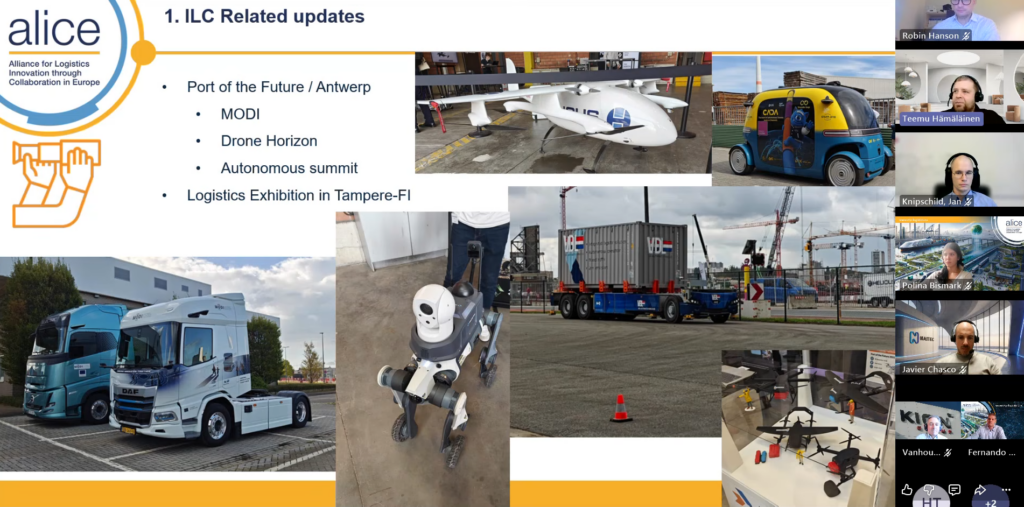
Dr Jan Knipschild from Fraunhofer IML presented the institute’s work on humanoid and cognitive robotics, highlighting advances in robot perception, movement and autonomous behaviour.
One of the main challenges in developing humanoid robots for logistics is enabling them to operate reliably in environments originally designed for people. Unlike conventional industrial robots, which typically perform predefined tasks in controlled settings, humanoid robots must be able to recognise objects, adapt their movements and interact with changing surroundings.
Fraunhofer IML is exploring different approaches to developing these capabilities, combining traditional robotic control methods with artificial intelligence.
The presentation introduced three approaches to robot manipulation: kinematic models supported by AI, imitation learning based on recorded human demonstrations, and reinforcement learning through simulation. These methods aim to improve the ability of robots to handle objects and perform tasks with increasing flexibility.
Particular attention was given to the transition from virtual environments to physical operations. Simulation allows researchers to develop and test robotic capabilities before transferring them into laboratory settings and, eventually, real logistics applications.
Fraunhofer IML also outlined a structured approach to implementation, beginning with an assessment of operational processes and potential use cases, followed by technology selection, concept development, prototyping and testing. The final stage involves introducing the solution into the company’s operational environment through a pilot application.
This approach emphasises that successful robotics deployment begins with understanding the logistics process, rather than selecting a technology first.
Risto Sivonen and Hannu Tapio from LIMOWA presented an overview of the global development of humanoid robotics, with particular attention to Finland’s emerging ecosystem and the needs of small and medium-sized enterprises (SMEs).
Their presentation highlighted how humanoid robots are beginning to move beyond demonstrations towards measurable industrial applications.
Examples included the use of Agility Robotics’ Digit robots in GXO logistics operations to transfer containers between existing automated systems, and Figure robots performing component-handling tasks in BMW’s manufacturing environment.
These examples demonstrate the potential of humanoid robotics for repetitive activities in human-designed workplaces. However, the speakers stressed that deployments remain limited in scale and that widespread commercial adoption has not yet been achieved.
An important distinction was made between humanoid robots and more established automation technologies, including autonomous mobile robots (AMRs) and collaborative robots (cobots).
AMRs are already widely used for transporting goods within facilities, while cobots can perform handling and manipulation tasks at designated workstations. Humanoid robots may offer additional flexibility in environments where tasks vary or where adapting the infrastructure for conventional automation would be difficult.
Nevertheless, their higher investment costs, technical complexity and uncertain return on investment mean that they are not necessarily the most suitable solution for every operation.
The conclusion was clear: humanoid robots should complement existing automation solutions, rather than be considered a universal replacement.
LIMOWA also shared insights into Finland’s developing humanoid robotics ecosystem, where suppliers, research institutions and industry organisations are beginning to explore practical applications.
Although humanoid robots are already available through Finnish suppliers and research laboratories, their routine use in logistics operations remains at an early stage.
To support companies in evaluating the technology, LIMOWA is involved in initiatives designed to provide access to testing environments and practical guidance.
One example is the Häme Humanoid Playbook, developed together with SYKLI for the period 2026-2028. The initiative aims to engage approximately 30 companies and conduct 10-15 practical workplace trials, helping SMEs understand where humanoid robotics could deliver operational benefits.
Through the LOBRA consortium, LIMOWA is also supporting the evaluation of new intralogistics technologies, including comparisons between humanoid robots, AMRs and combinations of mobile robots and cobots.
The objective is to help companies make informed investment decisions based on measurable operational performance, safety and economic feasibility.
Feedback collected from Finnish SMEs indicates that companies are interested in humanoid robotics but remain cautious. Their main questions concern technological reliability, costs, regulatory requirements, cybersecurity, workplace safety and employee acceptance.
These concerns underline the importance of practical demonstrations, transparent performance indicators and knowledge exchange between companies and research organisations.
The meeting also highlighted that introducing humanoid robots into logistics requires more than technical development.
Companies need to consider how robots interact with employees, how responsibilities are organised and how automated systems can be integrated into existing warehouse processes and digital infrastructure.
Safety and regulatory compliance remain important considerations, particularly as European requirements for artificial intelligence and machinery continue to evolve.
Workforce acceptance is equally important. Humanoid robots may help address labour shortages and support employees in physically demanding or repetitive activities, including handling goods, sorting, packing and working in challenging environments.
However, these benefits depend on appropriate training, supervision and the involvement of employees in the implementation process.
Rather than focusing exclusively on technological capabilities, the presentations encouraged companies to evaluate the operational problem they want to solve, the alternatives available and the measurable benefits of automation.
Building on the presentations, the meeting identified several opportunities for further exchange and collaboration among members of the ALICE Intralogistics Community.
One potential area is the sharing of evidence from European humanoid robotics pilots, including operational results, implementation challenges and lessons learned.
Developing common evaluation criteria could also help companies compare different automation technologies and assess which solutions are best suited to particular intralogistics activities.
Other opportunities include exchanging information on emerging safety standards and regulatory requirements, as well as developing practical guidance for SMEs considering their first robotics applications.
These activities reflect the wider purpose of the ALICE Intralogistics Community: connecting research, technology providers and logistics practitioners to accelerate the practical adoption of innovation.
By bringing together experiences from different countries and operational environments, the Community can help members move beyond individual demonstrations towards better-informed deployment decisions.
The meeting demonstrated that humanoid robotics is progressing, but that its future role in logistics will depend on proving its value in real operational conditions.
Fraunhofer IML’s research illustrated the technological advances required to develop robots capable of interacting with complex environments, while LIMOWA’s experience highlighted the importance of accessible testing opportunities and realistic business cases.
For logistics companies, the next step is not necessarily to invest in humanoid robots immediately, but to identify promising use cases, compare available solutions and participate in collaborative trials.
The ALICE Intralogistics Community will continue providing a platform for exchanging knowledge, identifying common challenges and exploring opportunities for cooperation in robotics, artificial intelligence and intralogistics automation.
Members interested in sharing their experiences, presenting pilot activities or contributing to future discussions are encouraged to engage with the Community.