
Thursday, October 22nd, 2026
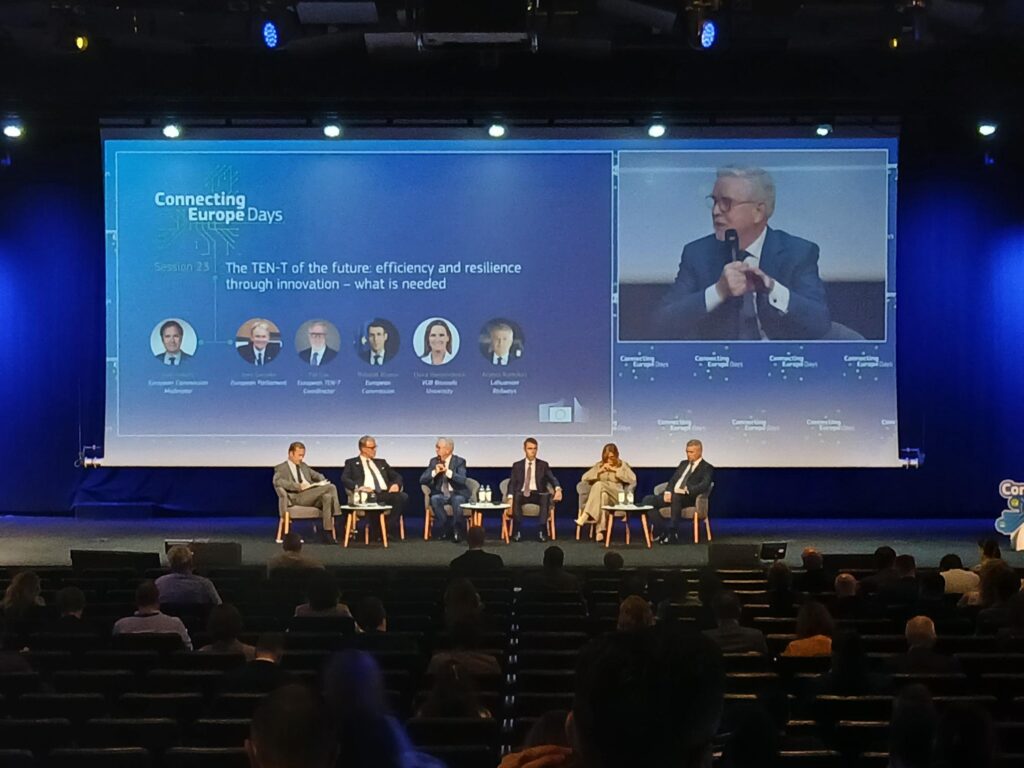
How can Europe develop a transport network that is more efficient, resilient and capable of responding to emerging economic, technological and security challenges? This question was explored during the session “The TEN-T of the future: efficiency and resilience through innovation – what is needed” at Connecting Europe Days 2026, held in Brussels from 28 September to 1 October.
Moderated by Axel Volkery, Head of Unit for Innovation and Urban Mobility at the European Commission’s Directorate-General for Mobility and Transport (DG MOVE), the session brought together representatives from the European Parliament, European Commission, transport corridor coordination, academia and the railway sector. Discussions focused on how governance, investment, digital technologies and cross-border cooperation can support the development of the Trans-European Transport Network (TEN-T).
Jens Gieseke, Member of the European Parliament, highlighted the scale of investment required to develop the next generation of European transport infrastructure. Against a challenging economic background, he emphasised the need for adequate funding and greater consideration of external threats, including climate change, security risks and geopolitical conflicts. Although international cooperation between Member States has progressed, cross-border infrastructure projects continue to face difficulties related to fragmented planning and insufficient coordination of access routes.
Pat Cox, European Coordinator for the Scandinavian–Mediterranean European Transport Corridor, stressed that the TEN-T’s multilevel governance structure is essential for improving efficiency and resilience. He noted that governance structures have been set up across all European regions, with ongoing projects reinforcing this approach, and warned that unexpected practical issues frequently arise that slow down infrastructure development. However, differences between national transport priorities and European commitments can delay infrastructure development, particularly when political changes affect previously agreed plans. When national transport plans promulgated by newly elected governments do not carry the same weight as European agreements, historically given commitments are rarely delivered on time. He emphasised the importance of clear standards, consistent implementation and stronger mechanisms to translate European agreements into completed infrastructure.
The discussion also addressed the limitations of relying exclusively on traditional public budgets. Gieseke pointed to the importance of financially viable arrangements that can attract private investment, including concessions, while Cox called for greater innovation in policy and project delivery. Cox highlighted the Danish public consultation model as good practice: after extensive consultation, a full stop is placed after the conclusion of consultations for a project, and the consensus reached is final. Both contributions highlighted the need to accelerate implementation while maintaining long-term commitments across different levels of government.
Thibaut Kleiner, Director for Future Networks at the European Commission’s DG CNECT, highlighted the growing convergence between digital technologies and transport infrastructure. He identified 5G connectivity as an important enabler of modernisation, alongside technologies such as sensors, artificial intelligence and digital twins, which can support infrastructure monitoring, planning and operational efficiency.
While many technological solutions are already available, their deployment requires stronger alignment between public investment priorities and industry needs. K Kleiner pointed to the strategic orientation being prepared for the resilience fund and its strong link with Horizon Europe and the wider work of the Commission. The competitiveness fund, he noted, will provide all the instruments needed, offering the opportunity to start from what Europe wants to achieve rather than how to get there. He also called for the Commission to “get out of the jargon” and speak plainly about the projects being done. Kleiner stressed the importance of defining concrete objectives and demonstrating the business benefits of innovation, referring to successful 5G corridor initiatives that responded to clear market demand.
He also addressed the relationship between digitalisation, security and European technological sovereignty. As transport networks become increasingly dependent on connected technologies, the security and reliability of digital components become critical considerations. Kleiner warned that certain components in European networks may be dangerous: products from certain countries can carry inherent risks, they can be switched off at a distance, and batteries can have explosive properties. Companies should verify the IT part of their products, and while European legislation should help, this requires a common effort. Strengthening Europe’s technological capabilities, reducing strategic dependencies and encouraging the development of European alternatives were identified as important priorities for future infrastructure investment.
Elvira Haezendonck, Professor at Vrije Universiteit Brussel (VUB), argued that the future development of TEN-T requires a broader systems perspective, combining digitalisation with stronger research capabilities and more integrated infrastructure planning.
She emphasised the importance of considering all transport modes and infrastructure connections at corridor level, including elements that may receive less attention in conventional transport planning, such as pipelines. However, she warned that funding deployment is hampered by the fact that too many actors hold a veto. Better coordination between different levels of the network could help identify underused capacity and address chronic underinvestment. She also called for a rethink of the general interest of Europe and of the continent’s strategic autonomy.
Haezendonck also highlighted challenges related to fragmented decision-making and chronic underinvestment. While public-private partnerships can deliver great value to Europe, she cautioned that they can also create infrastructure where access and maintenance at national and regional level becomes more expensive, so their long-term implications for accessibility, maintenance and costs must be carefully considered. She further stressed the importance of network redundancy and alternative connections to reduce vulnerabilities associated with technological dependencies and infrastructure disruptions.
Providing the perspective of a railway infrastructure and transport operator, Arūnas Rumskas, CEO of Lithuanian Railways (LTG), explained how geopolitical circumstances have made resilience a particularly important priority for Lithuania.
The country’s railway network faces inherited infrastructure challenges and requires continued investment to improve its performance and integration with the wider European transport system. Rumskas highlighted the need for clearer European agreements, regular and predictable investment, and pragmatic and smart regulations to standardise cross-border operations and make them smoother and quicker.
He argued that Europe needs to come to an agreement about which technologies to use, for the benefit of the resilience of operations and the comfort of customers, and that using similar or the same technologies prevents obstacles at borders. For railway operators, practical interoperability is therefore closely connected to both competitiveness and resilience.
The session highlighted several challenges directly relevant to European freight transport and logistics. Incomplete cross-border connections, inconsistent technical standards and fragmented infrastructure planning can limit the efficiency of logistics corridors, while insufficient network redundancy increases vulnerability to disruptions.
These discussions connect closely with ALICE’s priorities on multimodal transport, interconnected logistics networks, digitalisation and resilience. Developing a more effective TEN-T requires not only infrastructure investment, but also better coordination between transport modes, reliable data exchange and the integration of technological innovation into operational processes.
Digital technologies such as AI, sensors and digital twins can contribute to more informed infrastructure management and transport planning. However, their value depends on interoperability, practical deployment and alignment with the needs of transport operators, logistics service providers and infrastructure managers.
The session reinforced that the future TEN-T must combine physical connectivity with digital innovation, coordinated governance and long-term investment. Moving from strategic commitments to implementation, strengthening cross-border interoperability and improving network resilience will be essential for building a more competitive, secure and integrated European transport system.