
Friday, September 25th, 2026
On 21 September 2026, ALICE brought together ports, logistics hubs, research and innovation actors and Amazon Web Services (AWS) for the first workshop in a new Ports & Hubs series. The objective went beyond technology transfer: the session was designed to identify the operational challenges ports face today, understand what prevents digital and AI solutions from reaching deployment, and define where the ALICE Ports & Hubs Community should focus its future activities.
Ports and logistics hubs are increasingly important deployment environments for digitalisation, automation, zero-emission logistics and the Physical Internet. At the same time, their operations depend on complex interactions between infrastructure managers, terminal operators, transport operators, technology providers, public authorities and many other actors. This makes them particularly valuable places for ALICE to connect technological possibilities with operational needs.
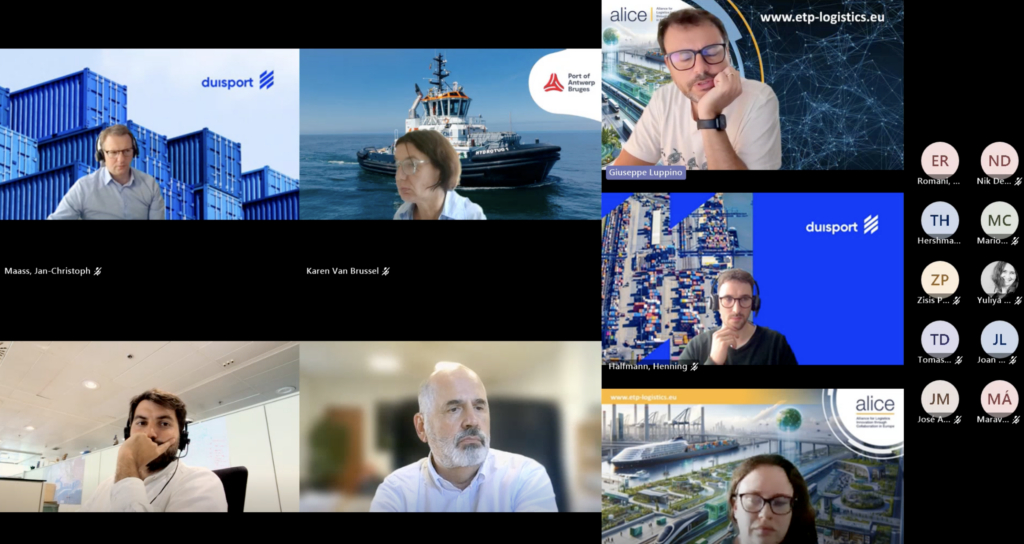
AWS shared examples of how artificial intelligence is already being applied across logistics operations, drawing in particular on experience from Amazon.
The examples ranged from forecasting and fulfilment decisions to defect detection, vehicle inspection, mapping, robotics and AI-supported operational processes. The presentation also addressed important implementation considerations, including data provenance, explainability, cost, organisational change and the selection of the right technology for the right problem.
One message provided a useful starting point for the discussion: “AI is a tool, not a destination.” Rather than beginning with the question of where AI could be introduced, participants were encouraged to start from the operational problem, the users affected by it and the value that a solution needs to create. The session then moved from examples towards an interactive discussion focused on the realities of port and hub operations.
Participants were invited to share their most pressing operational challenges. Participants highlighted six operational challenges during the live exchange:
The results highlight why deployment cannot be addressed through technology alone. Port call optimisation and just-in-time operations depend on timely and usable information across several organisations. Digital applications need to interact with existing systems and interfaces. Data may be incomplete or unavailable, while operational decisions remain constrained by physical capacity, infrastructure and space.
For ALICE, capturing these operational realities is an important part of the Community’s role. The aim is not simply to showcase available solutions, but to understand the conditions under which they can actually be adopted and scaled.
The workshop also connects closely with wider European developments. The European Commission adopted the EU Ports Strategy on 4 March 2026. Its priorities include competitiveness, innovation and digitalisation; the energy transition and sustainability; security and resilience; skills and quality employment; and access to finance and investment. The Strategy explicitly addresses the uptake and scaling of innovation in European ports.
ALICE’s Ports & Hubs work has already contributed to this policy process. Through the former Ports & Hubs Task Force, ALICE submitted input to the Commission’s consultation, including recommendations related to R&I funding, regulatory sandboxes, deployment of mature solutions, procurement, and the role of ports as energy and data hubs.
The next challenge is increasingly about implementation: connecting research and innovation with investment, operational readiness, interoperable systems, viable business models and the organisations that will ultimately deploy the solutions.
The issues raised during the AWS workshop, particularly data availability, legacy interfaces, communication and operational coordination, provide practical operational input that can help inform the Community’s future work.
The ALICE Ports & Hubs Community brings together ports, inland hubs, terminals and other relevant actors to address innovation from the perspective of logistics nodes themselves.
The ALICE Ports & Hubs Community is a focused operational domain within ALICE’s work on Corridors, Hubs and Synchromodality (TG2), while connecting with TG3 and other ALICE activities on digitalisation, automation, energy, resilience and the Physical Internet.
The Community creates value by learning from solutions, projects and experiences developed elsewhere, while research projects and technology providers gain direct operational feedback on requirements, barriers and deployment conditions.
The format of this first AWS workshop reflected exactly that approach: participants were not simply an audience. They were asked to bring problems, practical experience and constructive criticism so that subsequent activities can be shaped around real operational needs.
The challenges identified during this first workshop will now be used as input for the next Community discussions, where selected topics can be explored in greater depth together with ports, hubs, projects and technology actors. ALICE welcomes ports, inland hubs, terminal operators, logistics companies, technology providers, research organisations and other stakeholders interested in contributing to the Ports & Hubs Community. The Community provides a space to exchange experience, identify shared challenges and help shape future activities around innovation, digitalisation, automation and more sustainable logistics operations.
To learn more about the Community and how to get involved, please contact Giuseppe Luppino.