Thursday, September 17th, 2026
After four years of demonstrations and deployment-oriented work, the MODI project brought its results together at its Final Event on 15 September 2026 at the Port of Antwerp-Bruges. The project has demonstrated that Level 4 automated freight can operate in real logistics environments, while also identifying the wider operational, infrastructural and organisational conditions required to move from demonstration towards deployment.
MODI has tested highly automated freight operations along the Rotterdam-Oslo corridor and through use cases at major European logistics nodes. Bringing together 36 organisations from eight countries, the project has approached automated freight as a system challenge, examining vehicles alongside infrastructure, terminals, logistics operations, regulation and business models.
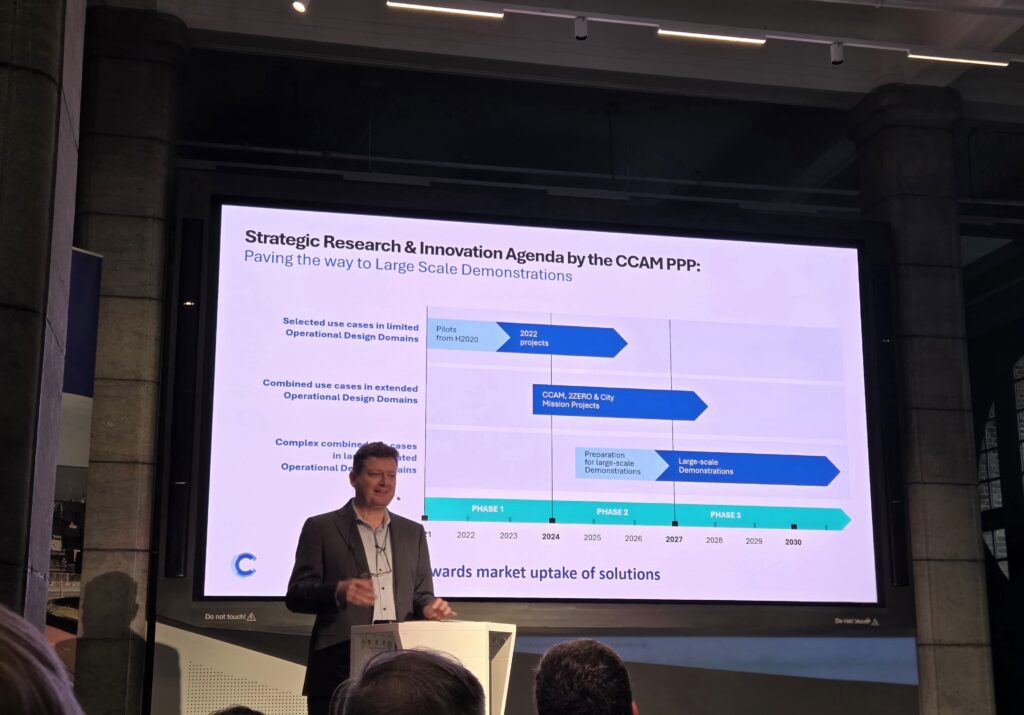
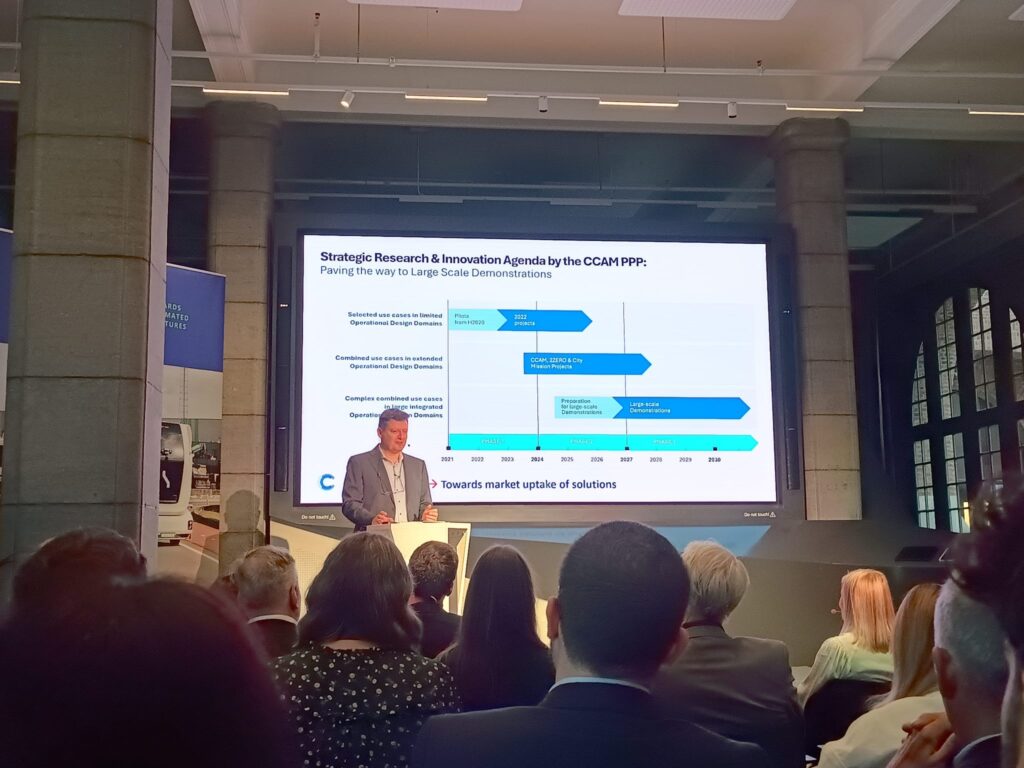
The Final Event reflected this integrated approach, presenting results on vehicle validation and regulatory approval, business and operational performance, wider impacts, infrastructure readiness and recommendations for scaling Level 4 freight in Europe. Discussions then addressed MODI’s legacy and the role of future Large-Scale Cross-Border Testbeds, Large-Scale CCAM Demonstrations and European Connected and Automated Vehicle Alliance (ECAVA) in supporting the next phase of logistics automation.
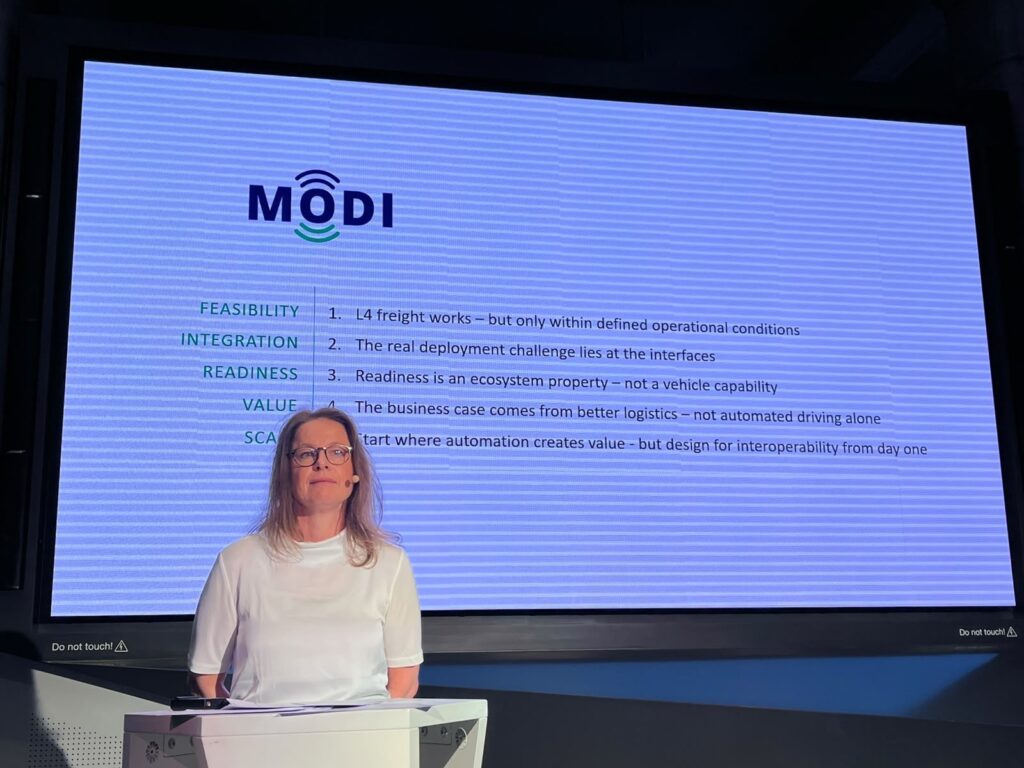
One of MODI’s key achievements is demonstrating Level 4 freight operations under real logistics conditions. Across the project’s use cases, automated vehicles have operated on public roads, within ports and terminals and across a national border.
The demonstrations also show that operational readiness cannot be described through vehicle capability alone. Conditions differ significantly between a controlled terminal environment, a public road or motorway and a cross-border operation involving different procedures, systems and responsibilities.
The deployment question therefore becomes increasingly specific: for which logistics operations, and under which operational conditions, is automated freight ready? Understanding these operational boundaries is essential when progressing from demonstrations towards commercial deployment.
Vehicle automation represents only one component of a freight operation. A truck may be capable of travelling autonomously from one point to another, but it still needs to interact with the wider logistics chain.
Vehicles must enter and leave terminals, pass through gates and access systems, be loaded and unloaded, connect to charging infrastructure and exchange the information and documentation associated with the goods. Procedures are also required for managing exceptions when operations do not proceed as expected.
Many of these functions are currently performed or supported by the driver. When the driver is removed from the vehicle, the functions remain and must instead be automated, digitally supported, redesigned or assigned elsewhere within the logistics process.
MODI’s Swedish use case illustrated this integrated approach by combining automated driving with remote supervision, automated loading and unloading, access control and charging. The resulting lesson is highly practical: automating the driving task without addressing the interfaces around it risks transferring operational bottlenecks rather than eliminating them.
MODI’s findings extend the concept of readiness beyond the vehicle itself. A technically capable automated truck still depends on an environment that can support its operation.
This includes physical and digital infrastructure, connectivity and positioning, access systems, logistics processes, regulatory conditions and clearly defined organisational responsibilities. These elements need to function together for automated freight operations to be deployed effectively.
Importantly, readiness is not necessarily uniform across an entire corridor. One section may offer strong connectivity and positioning but limited possibilities for safe stopping, while another may provide suitable physical infrastructure but lack the digital information required by the automated vehicle.
This means that assessing vehicle capability alone cannot determine whether a freight operation is ready for deployment. Infrastructure, logistics operations, digital systems and the regulatory and organisational environment need to be considered as interconnected components of ecosystem readiness.
MODI has also examined the conditions under which automation can create business value. The economic case cannot be reduced to removing the driver and calculating the associated labour-cost saving.
Automation can potentially enable higher vehicle utilisation, more predictable operations, reduced waiting times and new models of remote supervision in which one operator supports several vehicles. These factors can significantly influence the productivity and economic viability of an automated logistics operation.
At the same time, unresolved manual interfaces can reduce these gains. If an automated vehicle reaches a terminal but personnel are still required to open gates, process documentation, connect charging equipment or resolve every exception, much of the anticipated productivity improvement may disappear.
The business case therefore depends on the value created across the logistics operation as a whole. The relevant question is not only how driving can be automated, but how automation can improve the efficiency, predictability and utilisation of the complete logistics process.
MODI’s findings also provide indications of where early deployment may be most viable. Operations with predictable demand, repetitive movements and manageable operational environments -including hub-to-hub transport, repetitive movements within controlled terminal environments and shuttle operations – offer promising conditions for initial implementation.
Focused deployment can build operational experience, generate safety evidence and demonstrate business value before automated freight expands into more complex environments. However, successful deployment within one defined operation is different from achieving scale.
European deployment will require automated vehicles to interact with different terminals, infrastructure, communication systems, logistics platforms and national frameworks without requiring a new bespoke solution for every operation. MODI therefore points to two requirements that need to progress simultaneously: deployment should begin where automation creates clear operational value, while interoperability should be considered from the outset.
Successful pilots can demonstrate that individual solutions work. Interoperability is what enables different solutions, systems and organisations to work together and creates the basis for wider market deployment.
The transition from demonstration to deployment was a central focus of the Final Event. Following the presentation of MODI’s technical, operational, infrastructure and business findings, representatives from the logistics industry, automotive sector and public authorities reflected on how the project’s results can support future implementation.
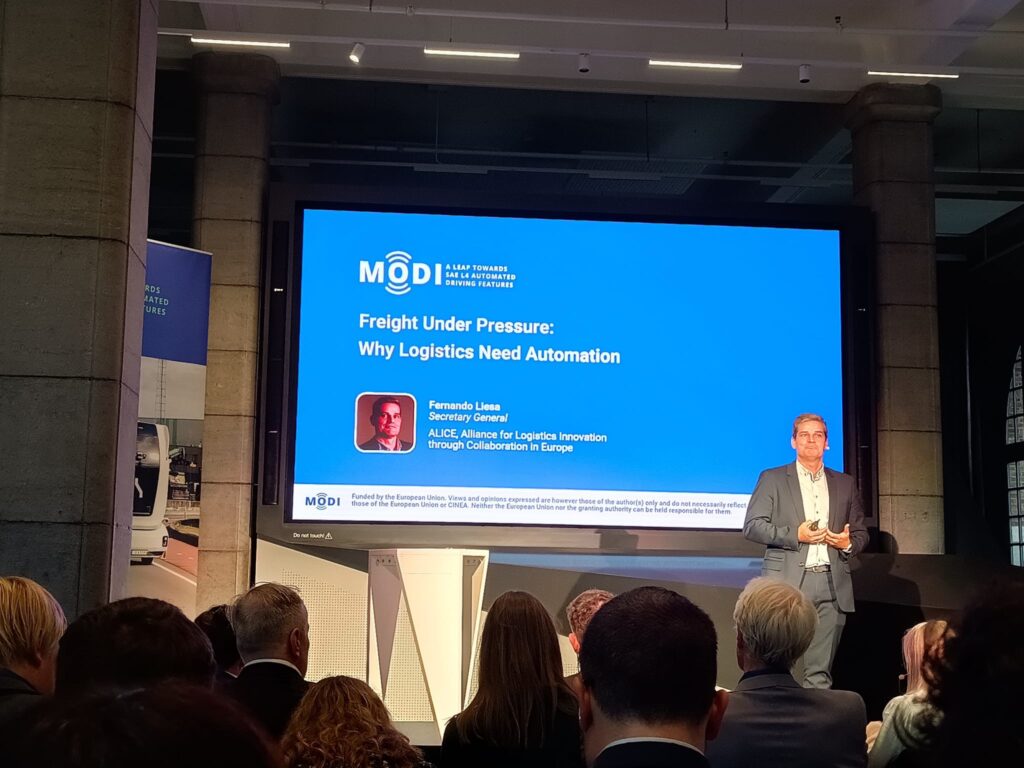
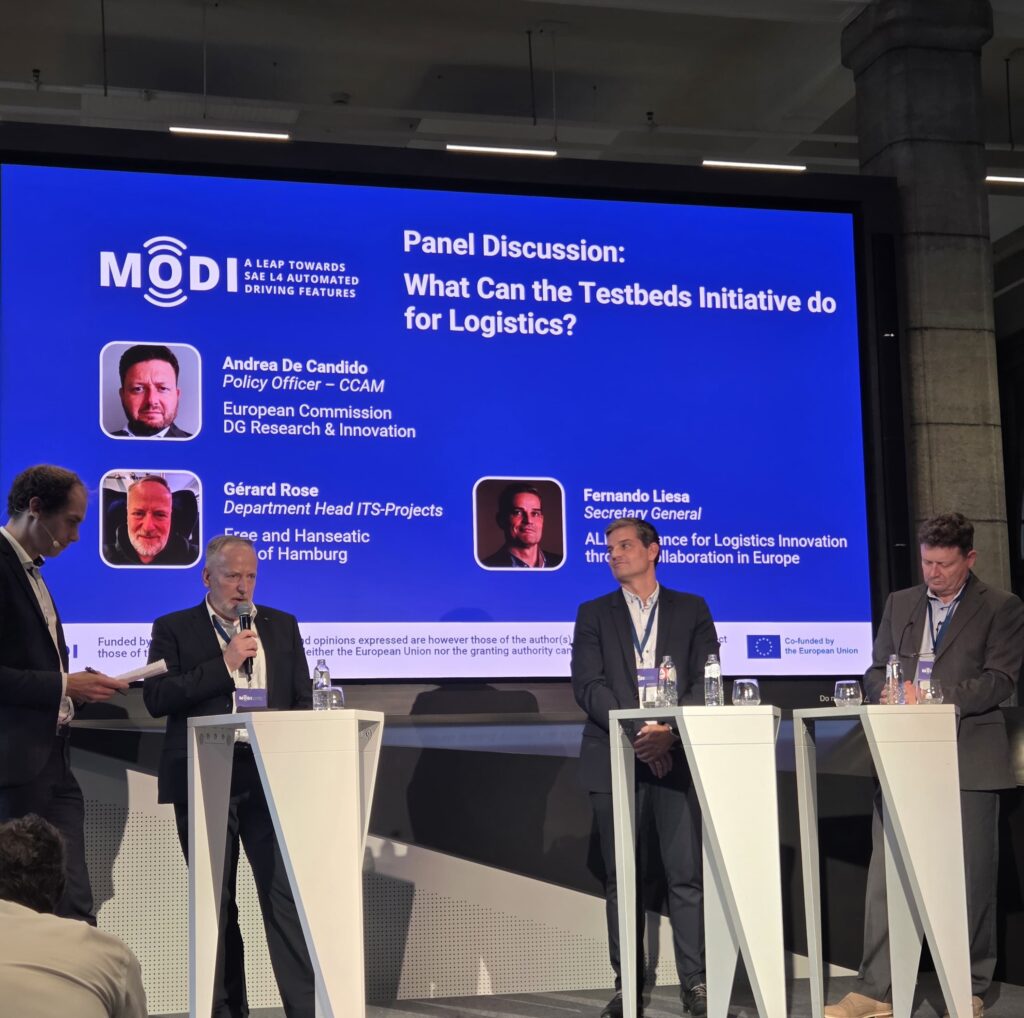
ALICE contributed throughout the event. Fernando Liesa delivered an opening keynote on EU Logistics Ambition and path towards Automation Scalability and participated in a panel discussion alongside Andrea De Candido (DG RTD), and Gerard Rose (City of Hamburg), moderated by Jakob Lohmann (DG MOVE), on what Large-Scale Cross-Border Testbeds can do for Logistics. Angjelo Andoni moderated “MODI Legacy – Scaling Logistics Automation in Europe”, bringing together representatives from DFDS, APM Terminals, and Port of Antwerp-Bruges to discuss how MODI’s results can be leveraged beyond the project. The programme subsequently connected MODI’s legacy with the emerging Large-Scale Cross-Border Testbeds, Large-Scale Demonstrations CCAM and their potential contribution to scaling logistics automation in Europe.
MODI’s legacy therefore extends beyond demonstrating that automated vehicles can operate successfully in real logistics environments. The project provides evidence about the wider conditions required for deployment: infrastructure and connectivity, terminal interfaces, loading and charging, remote supervision, regulatory procedures, business models and interoperability between organisations, systems and countries.
The next phase of automated freight will depend on bringing these elements together. MODI has shown that the transition towards deployment is not only about increasingly capable automated vehicles, but about creating integrated logistics operations in which vehicles, infrastructure, terminals, digital systems and organisations can work together. Moving from successful demonstrations towards scalable deployment therefore means moving from automated vehicles towards automated logistics.