
Tuesday, September 8th, 2026
The ALICE Intralogistics Community (ILC) resumed its online activities after the summer with a core member meeting on 27 August 2026, bringing together members to exchange knowledge, explore collaboration opportunities and discuss some of the technologies and trends shaping the future of intralogistics.
The meeting combined presentations from Fraunhofer IML and FLOX with insights from LIMOWA, which presented observations from LogiMAT 2026 and contributed to hosting the meeting together with ALICE. The discussion also drew on insights from SIL Barcelona and Odense Robotics Week.
Across the discussions, a common direction emerged: intralogistics is moving towards increasingly connected and intelligent environments in which automation, robotics, artificial intelligence, digital twins and collaborative platforms work together to improve material flows and logistics operations.
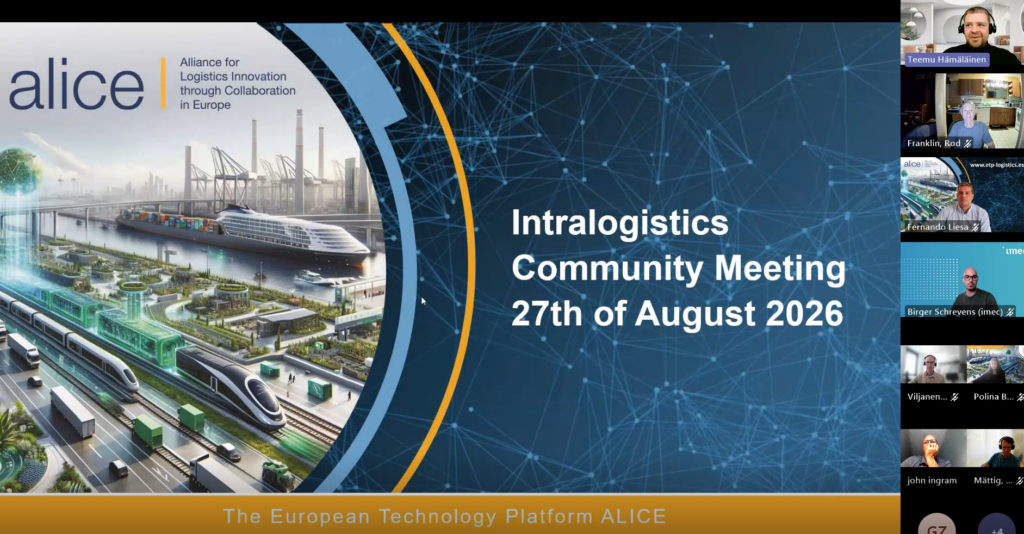
As the Intralogistics Community continues to develop, the focus remains on practical use cases, knowledge exchange and connections between members that can lead to concrete collaboration opportunities.
Benedikt Mättig presented Fraunhofer IML’s work across a broad range of intralogistics technologies, including autonomous guided vehicles (AGVs), humanoid and multifunctional robots, human-machine interaction, picking technologies, ergonomics, indoor localisation, machine vision, simulation and digital twins.
Looking towards future development, two areas were highlighted in particular. The first is robotics, including the development and deployment of AGVs, humanoid robots and multifunctional robotic systems for logistics applications. The second is AI-driven process optimisation, exploring how technologies including vision-language models, large language models and agentic AI can support activities such as object detection, counting and measurement, as well as broader improvements to intralogistics processes.
The presentation also demonstrated how these technologies are already moving into operational environments. One example was the @ILO digital twin, developed by Fraunhofer IML and Dachser. Using hundreds of optical scanning units installed near the ceiling and Data Matrix codes on pallets, the system creates a real-time digital representation of terminal operations. Pallets can be automatically located and terminal activities monitored without recording people, while forklift drivers receive information on where pallets need to be moved. According to the presentation, removing the need for manual pallet scans can reduce individual process times by up to 35%.
The discussion moved beyond individual technologies to consider how they can operate together. Potential areas for further work included combining expert systems, AI and humanoid robots; improving AGV routing and fleet management to prevent congestion; exploring optimisation algorithms; and assessing how solutions developed for individual companies could be transferred to other logistics environments. Participants also discussed possible applications of machine vision and robotics in areas such as fresh produce quality inspection and automated sorting of recycled materials.
John Ingram presented FLOX, an on-demand logistics and supply chain orchestration platform designed to enable horizontal collaboration and improve the use of available logistics capacity.
The platform currently focuses on warehousing and road transport. Warehouse operators can make available capacity, services and pricing visible, while transport providers can share route availability and spare capacity. By connecting these capabilities with warehouse and transport management systems, FLOX aims to improve visibility and support operational decision-making across logistics networks.
A potential pilot within the Intralogistics Community was discussed around connecting warehouse readiness, stock movements and dock activities with transport planning and collection and delivery milestones. FLOX offered platform capabilities, workflow design, data integration expertise and a pilot demonstration environment, while operational partners, sample data and a clearly defined challenge would be needed to develop the use case further.
The discussion also highlighted the potential of collaboration beyond individual sectors. Sharing unused transport capacity between organisations operating in different supply chains, for example, could improve resource utilisation and create new opportunities for horizontal collaboration. ALICE expressed interest in identifying and sharing practical examples of this type of cross-sector collaboration in both transport and warehousing.
LIMOWA presented observations from LogiMAT 2026, complemented by insights from SIL Barcelona and Odense Robotics Week, to provide a broader perspective on where intralogistics is heading. Three interconnected trends stood out: deeper integration of automation, machinery, software and services; growing adoption of practical AI applications; and increasing use of digital twins, real-time visualisation, 3D modelling and XR technologies.
Together, these developments point towards increasingly comprehensive intralogistics ecosystems. Rather than individual technologies operating separately, warehouses and other logistics nodes are beginning to combine automation systems, software platforms, AI and real-time operational data within more integrated environments.
The discussion also highlighted a broader transition from automation towards autonomy. Advances in machine vision, spatial intelligence and physical AI are making robots increasingly capable of understanding and interacting with their surroundings. Future intralogistics operations could therefore involve humans, conventional automation, AI systems and different types of robots working together, with responsibilities changing dynamically according to operational needs.
The meeting reinforced that the Intralogistics Community is intended to be practical, collaborative and shaped by its members. Participants were encouraged not only to present technologies and research activities, but also to bring forward operational challenges, use cases and opportunities where collaboration with other members could create value.
The role of SMEs was also discussed, particularly how the community could support wider adoption of robotics and AI among smaller logistics organisations. Participants recognised the potential of these technologies while also stressing that successful adoption depends on organisational capabilities and clearly identified business needs.
Future meetings will build on member feedback and move towards more focused discussions, providing greater space to explore individual topics and potential collaborations in depth. Members are encouraged to continue exchanges beyond the meetings and use the community as a space to connect expertise, operational needs and emerging technologies.
Based on member feedback, humanoid robots in logistics, AI adoption for intralogistics management and human-robot interaction emerged as preferred focus topics for upcoming Community meetings. These priorities will help guide more targeted exchanges around practical applications, implementation challenges and collaboration opportunities.
By bringing together technology developers, research organisations, logistics operators and other stakeholders, the ALICE Intralogistics Community aims to help turn emerging intralogistics technologies into practical applications and collaborative opportunities – supporting the development of more efficient, flexible and intelligent logistics operations.