
Wednesday, July 29th, 2026
Europe has no shortage of innovative logistics technologies. The challenge is turning successful pilots into solutions that are deployed at scale.
This was the central message shared by ALICE during the CrossFreight Final Conference, held on 1 July 2026 in Trieste and hosted by ARS Adriafer. Bringing together perspectives from ports, rail freight, maritime innovation, European projects and logistics innovation, the keynote panel explored how Europe can move beyond successful demonstrations and create the conditions for a more sustainable, digital and interconnected freight transport system.
The panel European Perspectives on Sustainable & Digital Freight was moderated by Angelo Giordano and featured contributions from:
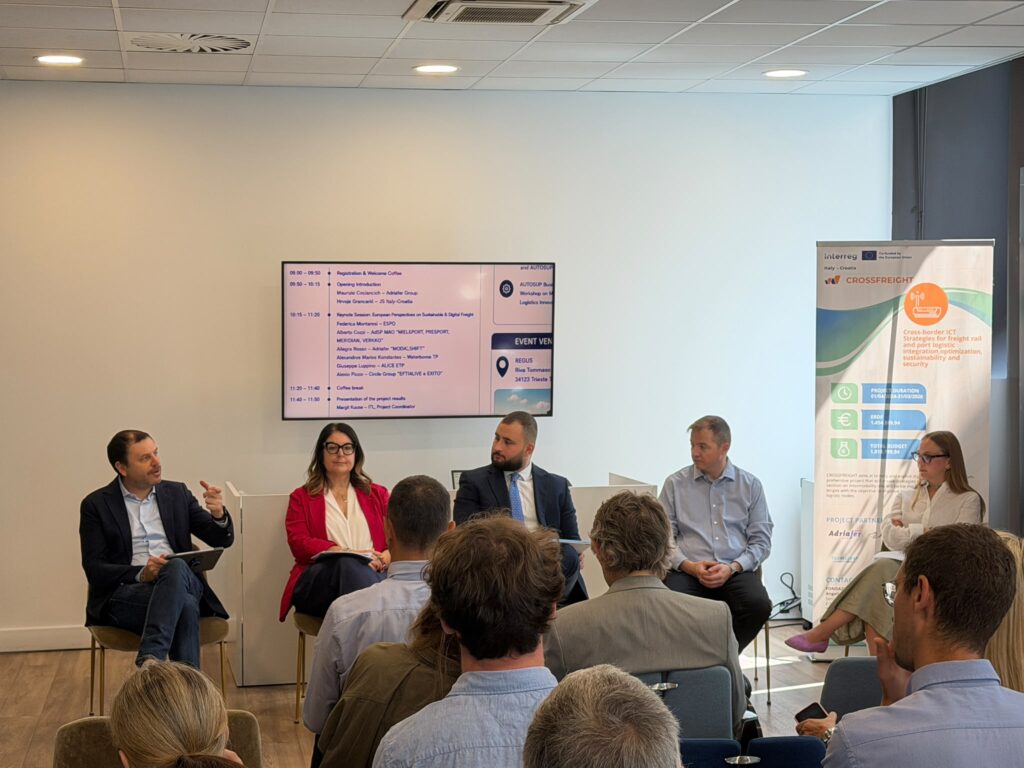
The discussion was organised around three key questions: where Europe stands today, which solutions are emerging, and what type of ecosystem is needed to enable collaborative, resilient and digitally integrated logistics in the coming years.
One of the first messages emerging from the panel was that ports are rapidly changing their role within the European logistics system. Ports are no longer only places where goods are loaded, unloaded and transferred between transport modes. They are increasingly becoming multifunctional ecosystem nodes, serving simultaneously as transport hubs, energy hubs, digital hubs, cybersecurity environments and strategic assets that contribute to European competitiveness, resilience and sustainability.
This evolution is also changing the role of Port Authorities. Rather than acting solely as landlords or regulators, they are increasingly expected to orchestrate complex ecosystems involving terminal operators, rail operators, logistics service providers, customs authorities, infrastructure managers, technology providers, public authorities, energy actors and local communities. Panel participants also stressed that improving port and corridor performance is no longer only about expanding physical infrastructure. Digital integration can improve decision-making, increase service quality, strengthen resilience and maximise the use of existing infrastructure, particularly at a time when investment cycles are long while operational needs evolve rapidly.
The discussion confirmed that Europe already has many digital systems operating across ports, terminals, rail operators, customs authorities, Port Community Systems and logistics service providers. However, these systems often remain fragmented, making it difficult to exchange information seamlessly or coordinate operations across organisations and transport modes.
Rail freight illustrated this challenge particularly well. While rail offers significant environmental and operational advantages, it depends on accurate planning and the ability to react quickly when disruptions occur. Delayed vessels, terminal congestion, infrastructure constraints or changes in cargo availability all require multiple stakeholders to coordinate decisions in real time. Without interoperable digital systems, rail struggles to offer the predictability and flexibility increasingly demanded by logistics users.
The discussion therefore reinforced that digitalisation should not be considered an objective in itself. Its real value lies in enabling better operational decisions, improving multimodal planning, supporting disruption management, optimising capacity and ultimately increasing the reliability of freight transport services.
Representing ALICE, Giuseppe Luppino highlighted that technology will continue to play a central role in the future of logistics. Continued innovation is needed in areas such as automation, artificial intelligence, Digital Twins, data sharing, digital platforms, decision-support systems, port operations, corridor management and zero-emission logistics.
However, technological progress alone will not transform the European logistics system. Europe already has an extensive portfolio of successful research projects and pilot demonstrations. The next challenge is ensuring that these innovations move beyond individual projects and become operational capabilities delivering market value, business opportunities and policy impact.
From the ALICE perspective, achieving this transition requires much more than mature technologies. It also depends on governance models, interoperability, common standards, trusted data-sharing frameworks, viable business models, investment conditions, regulatory alignment and user readiness. These elements are at the heart of the ALICE4IMPACT approach, which focuses on creating the conditions needed for innovation to move successfully from research into deployment.
A recurring theme throughout the panel was that Technical Readiness Levels (TRLs), while important, are no longer sufficient to measure innovation success. A technology may perform successfully during a demonstration project and still face significant barriers when introduced into real logistics operations involving multiple organisations, business models, regulations and operational environments.
This gap between successful research and widespread adoption is increasingly recognised as one of Europe’s biggest innovation challenges. According to ALICE, projects should therefore be designed from the beginning with deployment in mind, addressing not only technical maturity but also market readiness, user readiness, regulatory readiness, interoperability, investment conditions and long-term value creation.
Bridging this gap requires bringing together technology developers with the organisations that will ultimately deploy, operate and invest in these solutions, including shippers, logistics service providers, carriers, ports, terminals, infrastructure managers and public authorities.
Another important message emerging from the discussion was that collaboration should not be viewed as an optional aspect of innovation. Freight transport is inherently fragmented, involving numerous actors that each control only part of the logistics chain. Successfully deploying innovative solutions therefore depends on trusted collaboration across the entire ecosystem.
For ALICE, collaboration creates the conditions for coordinated decision-making, trusted data sharing and the development of common operational approaches while respecting competition rules, confidentiality and data sovereignty. Innovation developed in isolation may improve individual processes, but rarely delivers the systemic transformation needed across European logistics networks.
Panel participants also recognised the value of neutral organisations capable of facilitating collaboration, particularly where stakeholders require trusted environments to jointly test, validate and deploy innovative solutions.
Giuseppe Luppino also highlighted the Physical Internet as a long-term framework for transforming European logistics. Inspired by the principles of the digital internet, the Physical Internet promotes open, interconnected and interoperable logistics networks in which corridors act as links, ports and hubs function as intelligent gateways, and shared information enables better routing, greater resilience and more efficient use of assets.
This vision extends well beyond technology. It requires collaborative governance, common standards, interoperability and trusted data sharing across the logistics ecosystem. As discussed during the panel, a multimodal corridor is only as effective as its least connected node, making the digital and operational readiness of ports, terminals, hubs and logistics operators fundamental to future logistics performance.
Participants also discussed the growing importance of interoperability across the logistics ecosystem. Different transport modes and organisations often use different terminology to describe the same operational events, creating unnecessary barriers to information exchange and digital integration.
At the same time, mobility, logistics and energy data spaces continue to evolve separately, despite increasingly converging in multimodal transport operations. The panel agreed that harmonised standards, common semantic models and federated approaches to data sharing will be essential if digitalisation is to deliver genuine operational value rather than additional complexity.
The discussion repeatedly returned to the importance of deployment. Europe has already demonstrated its ability to generate innovative logistics technologies, but successful deployment requires more than technical validation. It also depends on governance arrangements, regulatory alignment, investment frameworks, operational testing, business models and user engagement.
Rather than focusing exclusively on technology development, Europe must create environments where innovations can be tested under real operational conditions and where technological, market, regulatory and organisational readiness mature together. This approach helps bridge the gap between innovation push and market demand, allowing promising solutions to move more rapidly towards commercial adoption.
The CrossFreight Final Conference reinforced several priorities that are central to ALICE’s vision for the future of European logistics. Technology remains essential, but technology alone is not enough. Europe must move beyond pilots, addressing not only technical readiness but also user readiness, market readiness, regulatory readiness, interoperability and viable business models. Trusted collaboration is an operational requirement, while the Physical Internet provides the long-term vision for creating more interconnected, efficient, resilient and sustainable logistics networks.
For ALICE, the key challenge is connecting innovation push with innovation demand by bringing together technology providers, logistics users, ports, hubs, carriers, shippers, policymakers and investors from the earliest stages of innovation. By acting as an ecosystem organiser, ALICE helps create the conditions for innovation to become operational capability, market value and policy impact.
“Technology remains essential, but technology alone is not enough. Europe has many promising logistics projects, pilots and solutions. The next challenge is to create the conditions for deployment: governance, interoperability, standards, business models, trust, user readiness and regulatory alignment. This is where ALICE can contribute, by bringing together the logistics ecosystem and connecting innovation push with real market demand.”
Giuseppe Luppino, ALICE
The CrossFreight Final Conference demonstrated that Europe already possesses many of the technologies needed to transform freight transport. The next step is ensuring these innovations reach deployment, scale and market impact. By creating the conditions where research, industry and public authorities work together, Europe can accelerate the transition towards a more connected, resilient and sustainable logistics system.