
Monday, July 27th, 2026
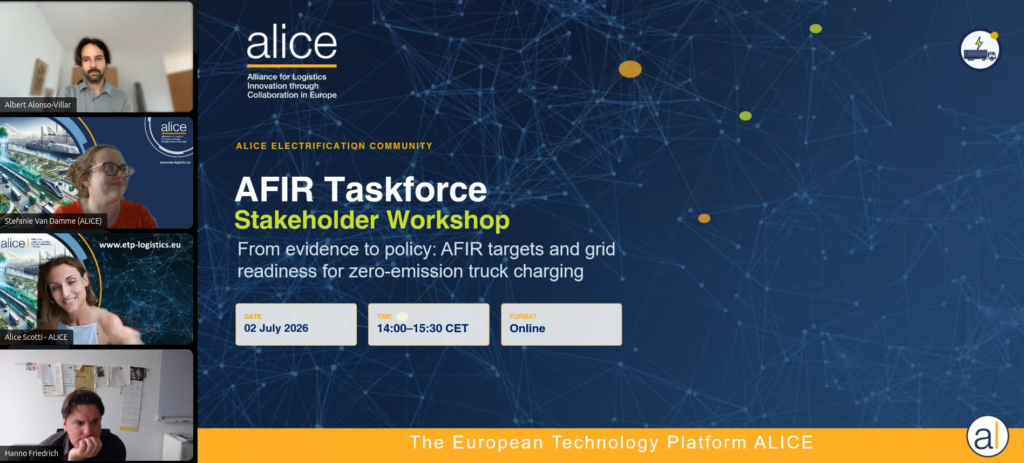
As the European Commission prepares to revise the Alternative Fuels Infrastructure Regulation (AFIR), ALICE brought together logistics operators, charging infrastructure providers, vehicle manufacturers, energy stakeholders, researchers and policymakers to discuss how the regulation can better support the deployment of zero-emission road freight.
The workshop, From evidence to policy: AFIR targets and grid readiness for zero-emission truck charging, formed part of ALICE’s structured contribution to the European Commission’s review process. The Commission launched a Call for Evidence between 23 March and 20 April 2026, receiving more than 1,000 contributions, and the public consultation remains open until 3 August 2026. A legislative proposal revising AFIR is expected in the fourth quarter of 2026.
The workshop built on evidence generated through the Horizon Europe projects ZEFES, FLEXMCS, MACBETH and BELOGIC, complemented by the latest modelling work from the VESUVIO project presented by the International Council on Clean Transportation (ICCT). Together, these initiatives provide practical evidence from demonstrations, modelling and real-world deployment to support the revision of the Regulation.
Opening the workshop, Alice Scotti (ALICE) explained that the objective was to consolidate practical experience from across the heavy-duty vehicle charging ecosystem into a coordinated ALICE contribution to the Commission’s consultation. She also introduced the newly established ALICE Electrification Community, which brings together expertise on vehicles, charging infrastructure, logistics operations, digital tools and legislation to accelerate the deployment of zero-emission freight transport.
Albert Alonso-Villar (ICCT) presented the latest results from the VESUVIO modelling project, showing that Europe could have around 150,000 battery-electric trucks by 2030, increasing to approximately 700,000 by 2035. While current AFIR targets broadly match projected charging demand until 2030, the analysis indicates that infrastructure requirements are likely to increase significantly beyond that date. The presentation also highlighted the growing importance of electricity grid planning, demonstrating that grid reinforcement and connection timelines are becoming critical constraints for charging infrastructure deployment.
The workshop objectives were to: (1) build shared evidence for the Commission consultation, (2) align positions of ALICE members and external stakeholders, and (3) prioritize the recommendations ALICE will submit. The discussion was organized around the main findings received through written contributions from experts both ALICE members and non-members. These 40 participants representing key actors in the value chain shared practical evidence and their viewpoint on the specific items now under review.
The three key themes corresponding to the European Commission’s consultation and discussed during the workshop were: heavy-duty charging targets and Megawatt Charging Systems (MCS), price transparency, and standards, interoperability and depot charging.
Discussions confirmed that AFIR has established an important European framework for charging infrastructure deployment and that its ambition should be maintained. However, participants agreed that achieving the Regulation’s objectives will require greater attention to implementation challenges, particularly grid capacity, permitting procedures and investment conditions.
The role of Megawatt Charging Systems, investigated through the FLEXMCS project, received considerable attention. Participants recognised MCS as the long-term charging solution for long-haul freight transport while acknowledging that conventional charging technologies will continue to play an important role during the transition.
Evidence from ZEFES, MACBETH and BELOGIC further demonstrated that electrification challenges extend beyond charging infrastructure itself. Battery performance, logistics operations, depot charging, interoperability, total cost of ownership, business models and system integration all need to be addressed together to enable large-scale deployment of zero-emission freight transport.
The workshop also highlighted the need for improved price transparency, harmonised technical standards and better access to charging infrastructure data while preserving sufficient commercial flexibility for logistics operators and charging service providers.
The session concluded with a prioritisation exercise identifying the recommendations that ALICE should emphasise in its response to the European Commission. Participants consistently highlighted grid readiness, faster connection procedures, support for Megawatt Charging Systems, harmonised technical standards and investment certainty as the highest priorities for the AFIR revision.
ALICE will now consolidate the evidence gathered during the workshop into its contribution to the ongoing AFIR public consultation, which remains open until 3 August 2026. The outcomes will also support the continued work of the ALICE Electrification Community, ensuring that practical experience from Horizon Europe projects contributes to future European legislation and the deployment of zero-emission freight transport.
Read the full report to explore the discussions, project evidence and recommendations in more detail.