
Tuesday, July 7th, 2026
ALICE has joined 84 European research, industry and innovation associations in signing a Joint Declaration calling for an ambitious and well-funded 10th Framework Programme for Research and Innovation (FP10). Coordinated by EARTO and BusinessEurope, the statement urges EU institutions to make research, development and innovation (RD&I) a central pillar of Europe’s future competitiveness.
The declaration comes at a crucial moment as discussions on the next Multiannual Financial Framework (2028-2034) accelerate. Echoing the recommendations of the Draghi Report on European Competitiveness, the signatories stress that Europe must significantly increase investment in research and innovation to strengthen productivity, accelerate the green and digital transitions, and reinforce its strategic autonomy.
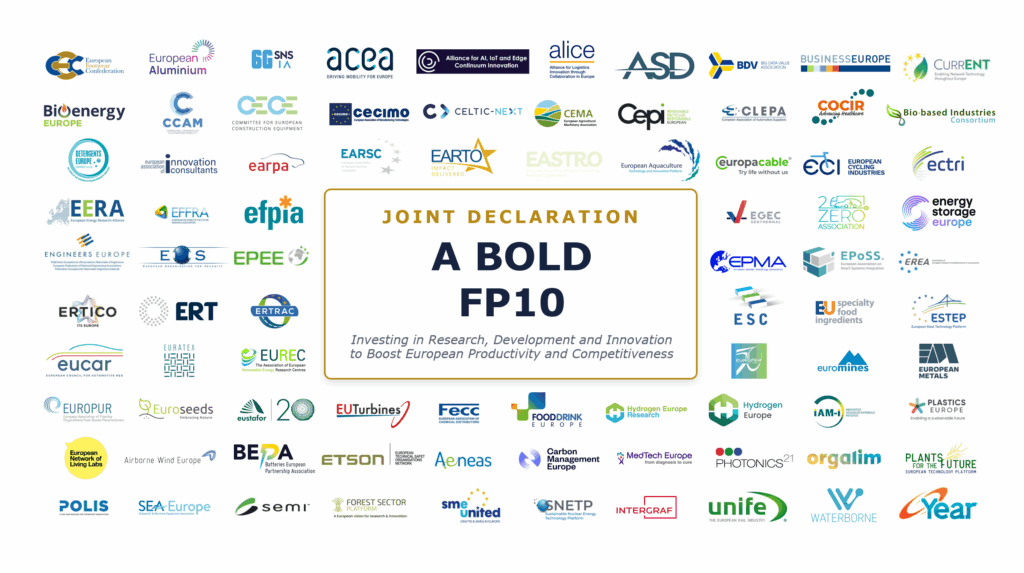
The Joint Declaration highlights that Europe faces growing global competition while productivity growth continues to slow. Research and innovation are identified as essential drivers of sustainable economic growth, enabling Europe to develop new technologies, strengthen industrial leadership and create resilient value chains.
The signatories underline that the next Framework Programme should reflect this ambition through a substantially increased budget and a strong commitment to collaborative, industry-driven research and innovation.
The Joint Declaration calls on the European institutions to:
According to the declaration, maintaining a strong collaborative research framework is essential to reduce investment risks, accelerate innovation uptake and strengthen Europe’s industrial base.
While supporting excellent research remains essential, ALICE believes Europe’s challenge is no longer only generating innovation – it is ensuring that innovation reaches deployment, scale and market impact.
Across freight transport and logistics, Europe has already developed many promising technologies and successful pilot projects. However, too often project results fail to progress into widespread operational deployment.
At the same time, logistics is undergoing several transformations simultaneously, including decarbonisation, the energy transition, digitalisation and Artificial Intelligence, automation, and increasing geopolitical and supply chain uncertainty. These transitions interact with one another, making innovation far more complex than simply advancing technologies through higher Technology Readiness Levels (TRLs).
Europe therefore needs innovation approaches that combine technology push with market demand pull, bringing technology developers together with companies, operators, customers, investors and policymakers in real deployment environments where technological, operational, business and regulatory readiness can evolve together.
For ALICE and the European logistics community, FP10 represents an opportunity not only to develop new technologies but also to accelerate their deployment across European freight transport systems.
Collaborative research has already delivered important advances in areas such as the Physical Internet, zero-emission freight transport, automation, digitalisation, data spaces and multimodal logistics. The next challenge is ensuring these innovations move beyond successful demonstrations and become widely adopted operational solutions.
This is the ambition behind ALICE4IMPACT, the framework presented by ALICE at TRA 2026. The approach recognises that competitiveness increasingly depends not on who develops technologies first, but on who creates the conditions for rapid adoption, scaling and market uptake.
FP10 should therefore strengthen the full pathway from research to impact by supporting:
By bringing together technology developers, industry, public authorities and investors around real operational challenges, FP10 can help bridge the gap between research results and market deployment while strengthening Europe’s competitiveness and resilience.
By joining the Joint Declaration alongside 83 other European associations, ALICE reaffirms its commitment to ensuring that research and innovation remain at the heart of Europe’s competitiveness strategy.
As negotiations on FP10 continue, ALICE will continue advocating for a Framework Programme that not only supports excellent research, but also creates the conditions for innovation deployment, market uptake and large-scale impact. Through the ALICE4IMPACT approach, ALICE will continue promoting stronger links between technology development, market demand, standards, policy and commercial implementation to help Europe translate innovation into competitiveness.