
Monday, June 29th, 2026
ALICE recently met with representatives of South Korea’s Tech Embassy for Land Infrastructure and Transport initiative to discuss future opportunities for research, innovation and logistics cooperation between Europe and Korea.
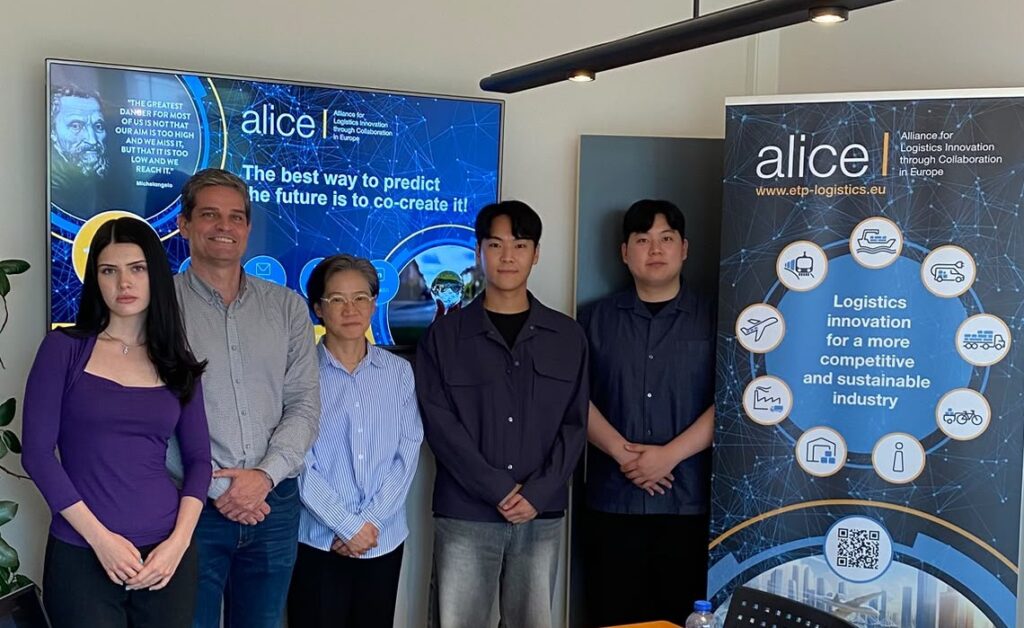
The meeting brought together Fernando Liesa, Secretary General of ALICE, with Jungwon Kim from Dark Matter Labs and researchers Jae Hyun Hwang and Matthew Junwoo Baik from Seoul National University. The delegation presented the objectives of the Tech Embassy initiative, a five-year project funded by the Korean Ministry of Land, Infrastructure and Transport (MOLIT) and supported by the Korea Agency for Infrastructure Technology Advancement (KAIA).
The discussion provided an opportunity to exchange views on logistics innovation, digitalisation, Physical Internet developments and the future of international research collaboration.
The Tech Embassy for Land Infrastructure and Transport was created to strengthen international research and innovation cooperation in areas related to transport, infrastructure and the built environment.
As South Korea expands its participation in international research programmes, including Horizon Europe, the initiative aims to create stronger links between Korean and European innovation ecosystems. The project is currently assessing how a future European hub could support long-term collaboration between researchers, industry, public authorities and innovation organisations.
Led by Seoul National University with support from Dark Matter Labs, the initiative is exploring Belgium, Germany and the United Kingdom as potential locations for a future European presence.
Rather than acting solely as a research office, the envisioned Tech Embassy would serve as a collaboration platform designed to identify research opportunities, build strategic partnerships and support technology deployment across borders.
The initiative also seeks to address a common challenge faced by many innovation programmes: how to move technologies from research environments into real-world implementation. By creating stronger links between European and Korean stakeholders, the project aims to facilitate demonstrations, living labs and pilot deployments that allow innovations to be tested and adapted to different regulatory, operational and market conditions.
The Tech Embassy initiative focuses on a range of strategic technology domains shaping the future of mobility, logistics and sustainable urban development. Current priorities include autonomous driving, digital logistics systems, smart infrastructure, artificial intelligence, carbon-neutral cities and advanced mobility solutions. At the same time, the initiative remains open to additional strategic areas as technological developments and policy priorities continue to evolve in both Europe and South Korea.
For logistics and freight transport, particular attention is being given to digital logistics systems and technologies that improve the efficiency, sustainability and resilience of supply chains. The initiative also seeks to create pathways for technology localisation by helping Korean innovations access European testbeds and demonstration environments while enabling European technologies to be tested and adapted within Korean operational contexts.
By supporting two-way knowledge exchange, technology validation and future deployment activities, the Tech Embassy aims to strengthen collaboration between European and Korean innovation ecosystems while remaining responsive to emerging technological and policy priorities.
As part of the current phase of the project, the delegation is conducting a series of visits across Europe to better understand how innovation ecosystems operate and how international cooperation can be organised effectively.
The meeting with ALICE formed part of this broader effort to map relevant stakeholders, identify collaboration opportunities and explore mechanisms that support innovation deployment.
During the discussion, the delegation sought insights into how European logistics stakeholders collaborate within research and innovation programmes, how priorities are identified, and how innovations move from research projects into market applications.
Topics discussed included Physical Internet developments, digital freight transport information, automation, data sharing, artificial intelligence and innovation adoption. Particular interest was shown in Europe’s progress towards digital freight transport processes and the implementation of regulatory frameworks that support the digital exchange of logistics information.
Fernando Liesa also shared ALICE’s experience in bringing together industry, research organisations and public authorities to accelerate the adoption of innovative logistics solutions and support more sustainable and resilient freight transport systems.
The Tech Embassy initiative is currently preparing recommendations on the future location, governance model and operating structure of its planned European hub.
The findings gathered through visits in Belgium, Germany and the United Kingdom will help shape the next phase of the project and support decisions on how future cooperation activities will be organised.
For ALICE, the discussion highlighted the growing importance of international collaboration in addressing common challenges such as digitalisation, automation, decarbonisation and supply chain resilience.
As both Europe and South Korea continue investing in transport and logistics innovation, initiatives such as the Tech Embassy create valuable opportunities to strengthen connections between innovation ecosystems, facilitate knowledge exchange and accelerate the deployment of solutions that contribute to more sustainable and efficient freight transport systems.