
Tuesday, June 2nd, 2026
On 19-20 May 2026, the Seas to Skies side event at TRA 2026 brought together ports, airports, industry representatives, researchers and EU-funded projects to discuss how multimodal hubs can accelerate the transition towards climate-neutral transport systems.
The sessions explored how ports and airports are evolving into integrated energy and logistics hubs through the deployment of Sustainable Aviation Fuels (SAF), hydrogen, smart energy systems, digitalisation and automation. Across the discussions, speakers highlighted that decarbonisation requires not only new technologies, but also stronger collaboration across logistics ecosystems, infrastructure operators and policymakers.
One of the central sessions of the event focused on the role of alternative fuels in transforming airport and port operations. The discussion brought together experts from the Royal Schiphol Group, Fraunhofer IML and University of Hasselt to explore the future of SAF and hydrogen supply chains.
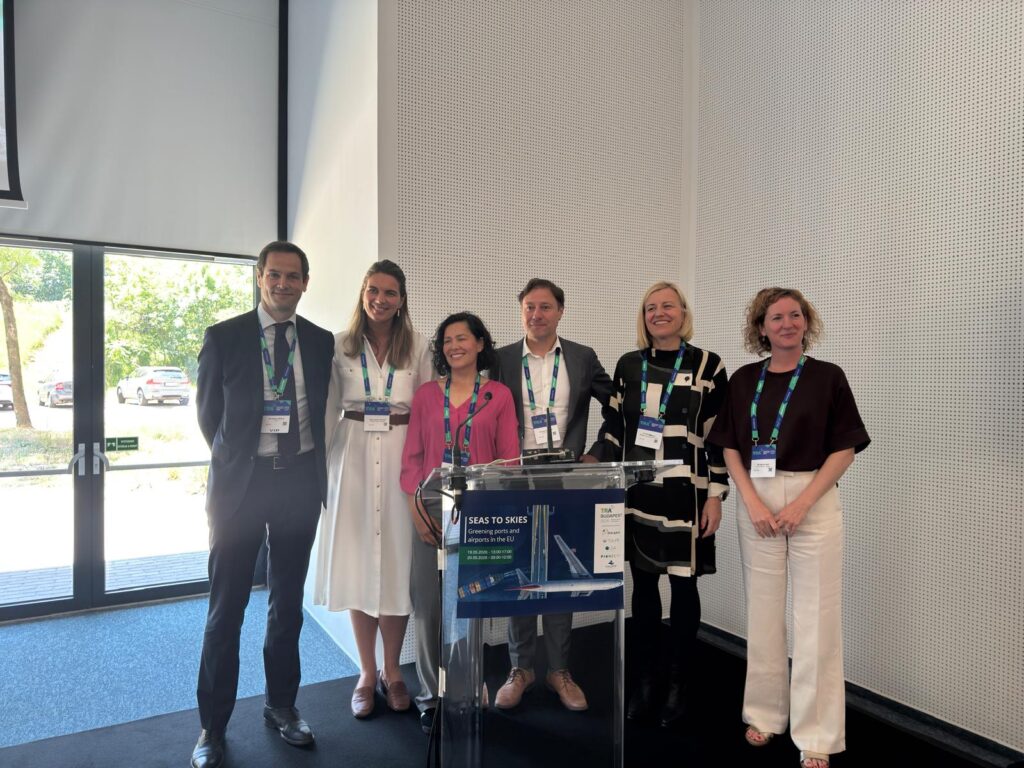
The session highlighted that Sustainable Aviation Fuel is currently one of the most mature solutions for reducing aviation emissions because it can be integrated into existing airport and aircraft infrastructure. However, scaling deployment remains a major challenge due to blending infrastructure, logistics coordination and limited production capacity.
Upscaling SAF and future challenges at Schiphol
During the presentation by Royal Schiphol Group, participants learned how the Netherlands has positioned itself as an early frontrunner in SAF deployment. The presentation outlined Schiphol’s involvement in:
A key example presented was the large-scale blending operation connecting the Port of Amsterdam to Schiphol Airport through the CEPS pipeline system. The operation successfully blended and distributed nearly 100,000 tonnes of SAF blend, demonstrating the feasibility of large-scale airport fuel integration.
At the same time, speakers stressed that future e-SAF production will strongly depend on access to affordable green hydrogen and renewable electricity.
Another session focused on downstream SAF logistics and airport operations, highlighting that decarbonisation challenges do not stop at fuel production.
The presentation explained how SAF scaling requires coordinated fuel ecosystems linking:
A case study from Brussels Airport explored the concept of mobile blending infrastructure developed within the STARGATE project. Rather than replacing large centralised blending terminals, the concept aims to provide flexibility for smaller SAF volumes and emerging fuel pathways during the market ramp-up phase.
Speakers also highlighted several operational challenges:
The discussion reinforced the importance of stronger regional coordination between ports and airports to support scalable and reliable SAF deployment across Europe.
Hydrogen was another major focus of the event, particularly its role in future airport ground operations.
The session presented demonstrations involving hydrogen-powered Ground Support Equipment (GSE), including hydrogen GPUs, tow tractors and refuelling stations developed within the TULIPS project.
Speakers explained that hydrogen GSE is no longer only a concept. Demonstrations already provide operational learning on:
A major message from the session was that the real challenge starts upstream: securing reliable hydrogen supply chains and scaling infrastructure beyond demonstration projects.
The presentation addressed key questions including:
The discussion also highlighted that hydrogen deployment will require coordinated progress across operational readiness, supply readiness and business models before large-scale airport deployment becomes possible.
The PIONEERS project demonstrated how automation and digital technologies can support greener and more efficient port operations. Presentations highlighted the deployment of autonomous and remotely operated solutions across inland waterways, port logistics and terminal environments.
One of the key demonstrations focused on remote vessel operations developed by CFAR. The solution enables inland vessels to be monitored and controlled from dedicated Remote Operations Centres using real-time camera feeds, radar systems, sensors and advanced communication networks. The approach aims to address growing workforce shortages in inland navigation while improving operational efficiency and safety.
The project also showcased developments in enhanced situational awareness technologies, combining object detection, sensor fusion and decision-support tools to support remote navigation. Speakers stressed that regulatory alignment, connectivity and cross-border operational frameworks remain critical challenges for large-scale deployment.
Beyond vessel operations, PIONEERS demonstrated a broad portfolio of innovations supporting greener ports, including autonomous mobility solutions, smart energy management systems, hydrogen-powered equipment, digital infrastructure and communication technologies. These demonstrations contribute to the development of future-ready ports that combine decarbonisation, automation and operational resilience.
The TULIPS project also presented its work on Smart Energy Hubs, demonstrating how airports can manage increasing electrification, grid congestion and energy demand through integrated energy systems.
Case studies from Schiphol, Stavanger, Torino and Larnaca illustrated how airports face different energy realities depending on their local grid constraints, climate conditions and regulatory environments.
The session presented several demonstrations and technologies, including:
One demonstration at Schiphol showed how an Iron Flow Battery system could support electric Ground Power Units without requiring additional grid reinforcement. Another example demonstrated thermal storage systems replacing natural gas boilers while significantly reducing peak electricity demand.
The project emphasised that airports and ports should not replicate technologies directly, but rather replicate decision-making frameworks adapted to local conditions.
The OLGA project contributes to the European Green Deal by accelerating the transition towards low-carbon airport operations through the deployment of sustainable energy solutions, alternative fuels and innovative infrastructure.
As one of the flagship Green Deal aviation projects presented during the Seas to Skies event, OLGA works alongside STARGATE and TULIPS to demonstrate practical pathways for reducing airport emissions while maintaining operational performance and connectivity. The project focuses on integrating renewable energy, supporting sustainable aviation fuel deployment, improving energy efficiency and preparing airport ecosystems for future low-emission technologies.
A recurring theme throughout the discussions was the importance of collaboration between airports, ports, fuel suppliers, infrastructure operators and public authorities. OLGA contributes to this ecosystem approach by supporting solutions that can be replicated across different airport environments and scaled beyond individual demonstration sites.
Together with the other Green Deal projects, OLGA illustrates how research and innovation can bridge the gap between pilot demonstrations and large-scale implementation, supporting Europe’s objective of achieving climate-neutral transport systems.
Digitalisation and data sharing were explored during the MAGPIE session on smart and green logistics tools for ports.
The project presented a suite of digital tools designed to support:
Several tools were demonstrated, including:
The project also highlighted the importance of interoperable data sharing infrastructures and digital twin architectures for future smart ports.
While most tools currently rely on historical and synthetic data, the next phase will focus on integrating real-time operational data to support fully operational port digital twins and smarter decision-making systems.
Across all Seas to Skies sessions, a consistent message emerged: achieving climate-neutral logistics requires combining the green and digital transitions.
Ports and airports are increasingly becoming interconnected hubs for:
The event demonstrated that collaboration between public authorities, infrastructure operators, industry and research organisations will be essential to scale innovations from pilot projects into deployable and economically viable logistics solutions supporting Europe’s long-term climate and competitiveness objectives.