
Wednesday, May 27th, 2026
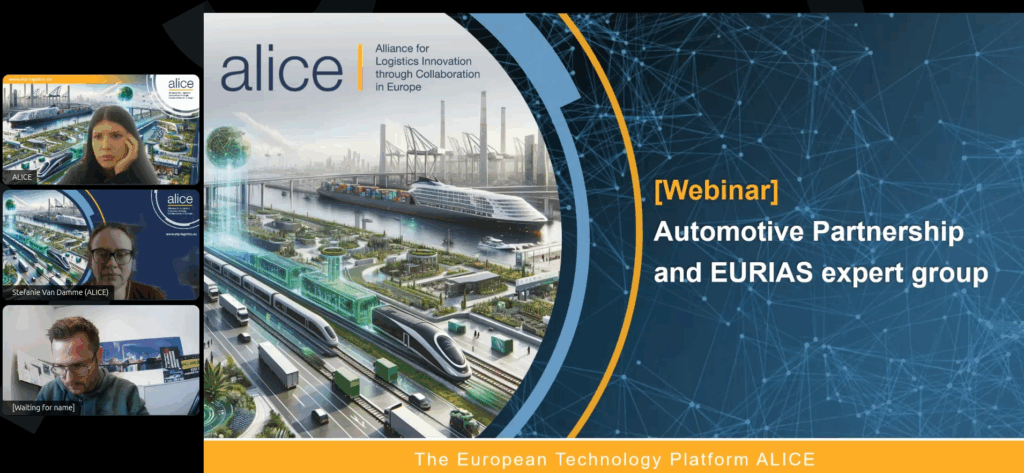
The webinar on the Automotive Partnership and the EURIAS expert group, held on 27 April 2026, brought together ALICE members and key stakeholders from across the automotive, logistics and research communities to discuss the future direction of European innovation in the sector. The session provided an overview of the ongoing preparation of the European Automotive Partnership and the development of the Strategic Research, Innovation and Deployment Agenda (SRIDA), which will shape priorities under the next EU funding framework (FP10).
ALICE invites its members to actively engage in the Automotive Partnership process, by sharing expertise, experiences and current barriers experienced bringing innovations into practice. In this way we can, influence the content of the SRIDA, and ensure logistics and real‑world deployment needs are embedded in FP10.
The webinar also connected to the legacy of ongoing EU-funded projects such as FLEXMCS, MACBETH, MODI and ZEFES. The projects contribute to advancing electrification, automation and logistics innovation in Europe and their insights and recommendations should be taken into account into FP10.
The webinar was opened by Stefanie Van Damme (ALICE), together with Fernando Liesa (ALICE), who introduced the policy context and explained why this process is particularly important for logistics and commercial vehicles. They highlighted that the Automotive Partnership, launched following the Memorandum of Understanding signed in September 2025, is expected to become a central instrument for defining future EU research and innovation priorities. Two key documents already published in 2026: the Joint EU Vision on Research and Innovation for the Technological Competitiveness of the EU Automotive Sector and the Preliminary Overview of the International Automotive Industry State of Play – provide the initial foundation for this work.
A central element of the process is the development of the SRIDA, which goes beyond traditional research agendas by explicitly including deployment. This shift reflects a broader policy direction: moving from research excellence alone towards real-world impact. The SRIDA is currently being developed by the EURIAS expert group (European Union Research and Innovation for the Automotive Sector). ALICE is an active member of the EURIAS expert group and is working closely with its members and partner platforms, including 2ZERO, ERTRAC, CCAM and EUCAR, to ensure that logistics and commercial vehicle perspectives are well represented. Together, eight Flagships are being defined to address key bottlenecks in innovation deployment, which will be integrated in the 4 sub-groups proposed by the Commission.
The expert group is structured around the four sub-groups: 1) electric vehicle technologies, 2) digital and connected vehicles, 3) road mobility ecosystem, and 4) automotive industrial processes, and will work intensively throughout spring 2026. In parallel, the European Commission is expected to launch a Call for Evidence, allowing a wider range of stakeholders to contribute to the process.
Throughout the webinar, speakers consistently emphasised the importance of aligning innovation with real deployment needs. Rather than focusing only on technological development, the future approach must consider the full ecosystem, including infrastructure, energy systems, regulation, business models and logistics operations.
This ecosystem perspective was strongly reflected in the contribution from Sofie Vennersten (Volvo Group), who co-chairs the Road Mobility Ecosystem subgroup.She explained that the subgroup will among other things focus on enabling conditions for system transformation such as integration with the energy ecosystem, digital infrastructure and gaps related to deployment of technologies. From Volvo’s perspective, the transition to zero-emission mobility depends on multiple factors working together – vehicles, infrastructure, energy availability, costs and coordinated action across the value chain. Without alignment across these elements, deployment cannot scale.
The webinar also highlighted the role of the Flagships, which are large-scale initiatives designed to connect research, validation and market uptake. Among them, Flagship 1 on software-defined and autonomous vehicle systems, presented through slides prepared by Oihana Otaegui (Vicomtech), nfocuses on AI, data sovereignty, validation and governance aspects of future vehicle systems.
Flagship 6 on commercial vehicles (CV), was presented by Fernando Liesa (ALICE). This Flagship aims to ensure that innovation in road transport is anchored in real business operations. He stressed that the economic impact of logistics far exceeds the value of vehicles themselves, meaning that successful innovation must work across the entire logistics ecosystem. The initiative will focus on zero-emission freight, automation, total cost of ownership and operational viability, covering use cases from long-haul transport to last-mile delivery.
Concrete examples of deployment challenges and opportunities were shared by ALICE members.
Bastiaan Krosse (TNO) presented developments in the Netherlands, including pilot initiatives supported by the Dutch government and the Rotterdam-Antwerp corridor for connected and automated transport. His intervention illustrated how deployment requires continuous learning and coordination between technology, infrastructure, regulation and logistics actors.
Pia Wijk (Einride) highlighted the importance of integrating electrification, automation and digitalisation in real operations. Einride’s experience, deploying electric and autonomous vehicles supported by its digital freight platform, demonstrates that operational data and real-world testing are essential to understand system performance and scale solutions effectively.
Andrea Condotta (Gruber Logistics) provided a practical logistics perspective, underlining that the concept of “ecosystem” is often underestimated. Drawing on experience with hydrogen truck deployment, he explained how real-world implementation depends on a wide range of factors, from regulatory approvals and infrastructure compatibility to customer demand and operational planning. His example showed that even when technology is available, deployment can be delayed or blocked by practical barriers, reinforcing the need for a more holistic policy and funding approach.
The discussion also addressed how stakeholders can contribute to the process. Participants were encouraged to share ideas through ALICE and to engage with upcoming consultation opportunities, particularly the Call for Evidence. While detailed topics will be defined at a later stage, early input is considered essential to ensure that priorities are reflected in the SRIDA and future EU calls.
The webinar concluded with a reflection on competitiveness. As noted by Sofie Vennersten (Volvo Group), Europe currently holds a strong position in the commercial vehicle sector, but maintaining this leadership will depend on its ability to translate innovation into industrial production and market uptake. If investment and development shift elsewhere, Europe risks losing both technological leadership and economic value.
Overall, the session highlighted that the future of automotive innovation in Europe will depend not only on technological progress, but on ecosystem level and on how effectively research, policy, industry and logistics stakeholders can work together to deliver solutions at scale. For ALICE and its members, active engagement in the EURIAS process represents a key opportunity to ensure that logistics and real-world deployment remain at the centre of this transformation.
Read the full report to explore the use cases, insights and lessons in detail.