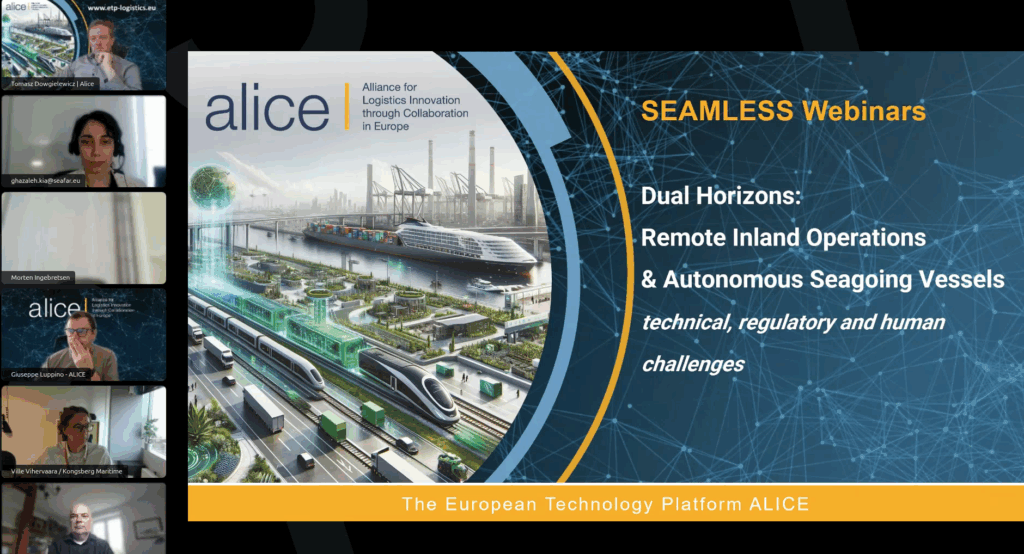
Key takeaways from SEAMLESS webinar Dual Horizons: Remote Inland Operations & Autonomous Seagoing Vessels technical, regulatory and human challenges
Thursday, April 23rd, 2026
Remote operation of vessels is often seen as a breakthrough driven by advanced technologies. However, as highlighted during the recent SEAMLESS webinar organised by ALICE, technology is only one part of a much broader transformation.
The session brought together industry and operational perspectives to explore what it really takes to move from pilot projects to real-world deployment of remote vessel operations. A key message quickly emerged: scaling remote operations is not just about scaling technology, but about scaling an entire operating model.
Opening the webinar, Tomasz Dowgielewicz (ALICE) set the scene by emphasising that remote operation centres are a critical enabler of more automated and digitalised waterborne transport systems. At the same time, their deployment depends on alignment across regulation, operations and organisational readiness.
From an industry perspective, Ville Vihervaara (Kongsberg Maritime) outlined how maritime operations are gradually evolving from onboard control to shore-based models. While many of the required technologies are already available, integrating them into reliable and scalable systems remains a key challenge. This transition is expected to happen progressively, supported by improvements in connectivity, automation and decision-support tools.
Providing a complementary view, Ghazaleh Kia and Nancy Scheijven (Seafar) shared practical experience from real-world deployment. Their insights highlighted that the main barriers to scaling are not technological, but systemic. Regulatory frameworks, operational integration and workforce transformation all play a crucial role in determining how quickly remote operations can be adopted.
The discussion also underlined the importance of factors such as connectivity, cybersecurity and business models, as well as the need to integrate remote vessel operations into broader logistics chains, including port and hinterland activities.
Overall, the webinar confirmed that remote operations are becoming a reality, but their large-scale deployment will depend on collaboration across stakeholders and the ability to adapt existing systems and frameworks.
Read the full report to explore the insights, use cases and key challenges in more detail.