

KEYSTONE supports the development of a sustainable, efficient and safe transport system by enabling enforcement authorities to access reliable digital data for compliance checks.
The project focuses on improving how transport information is shared between logistics operators and authorities, moving towards a more interoperable and standardised digital environment. By building on existing use cases and adapting them to operational needs, KEYSTONE contributes to the transition from fragmented processes to a more integrated European transport system.
At the core of the project is the development of a digital ecosystem, the KEYSTONE Web App, that supports seamless data exchange, reduces administrative burden, and improves safety and efficiency across transport operations.
The KEYSTONE Project has successfully moved from data to action by developing and demonstrating the KEYSTONE Web App, designed to support compliance processes and data exchange between stakeholders.
This solution has been tested through two real-world pilots: a) a road transport pilot from the port of La Spezia (Italy) to the Bologna Interport (Italy) and b) an intermodal pilot from the Port of Rotterdam (The Netherlands) to the Novara Interport (Italy). These pilots validate how digital tools can support transport operations in practice, ensuring that solutions are not only technically sound but also applicable in real-life cross-border scenarios.
KEYSTONE focuses on enabling the conditions for a seamless, interoperable and intermodal transport ecosystem.
The project tailors standardised digital solutions from existing use cases and applies them to transport operations. It has developed the KEYSTONE Web App to support compliance checks, while also defining API standards that enable structured and secure data exchange between operators and enforcement authorities.
In parallel, KEYSTONE contributes to reducing costs and CO₂ emissions, improving safety conditions, and supporting the uptake of connected, cooperative and automated mobility (CCAM) technologies.
KEYSTONE’s web app is built around three dedicated interfaces for: a) drivers, b) road enforcement authorities, and c) port authorities, each tailored to different operational needs. The Driver view provides estimated arrival times, delay alerts, and transport data, while the enforcement interface supports document review, compliance validation, and QR code verification. The Road Enforcement Authority Interface supports compliance checks by providing access to verified operational and transport-related data. Finally, the Port Authority Interface gives officials real-time visibility into scheduled truck arrivals and departures, congestion, and access points. It also allows authorities to send messages to drivers during disruptions and to create fast lanes for vehicles that have already been fully validated in the system.
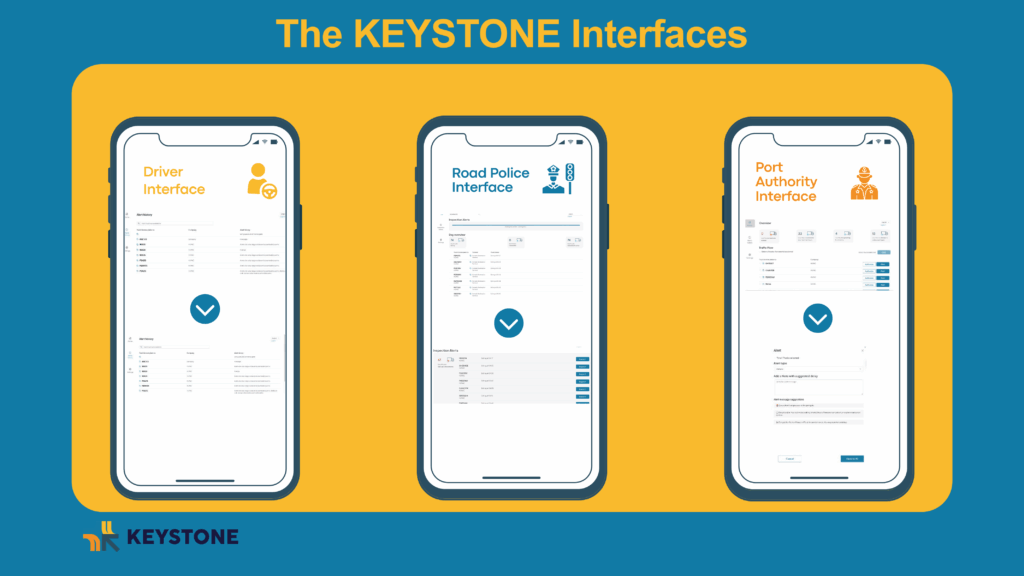
Through these functionalities, the system contributes to more efficient and transparent transport operations.
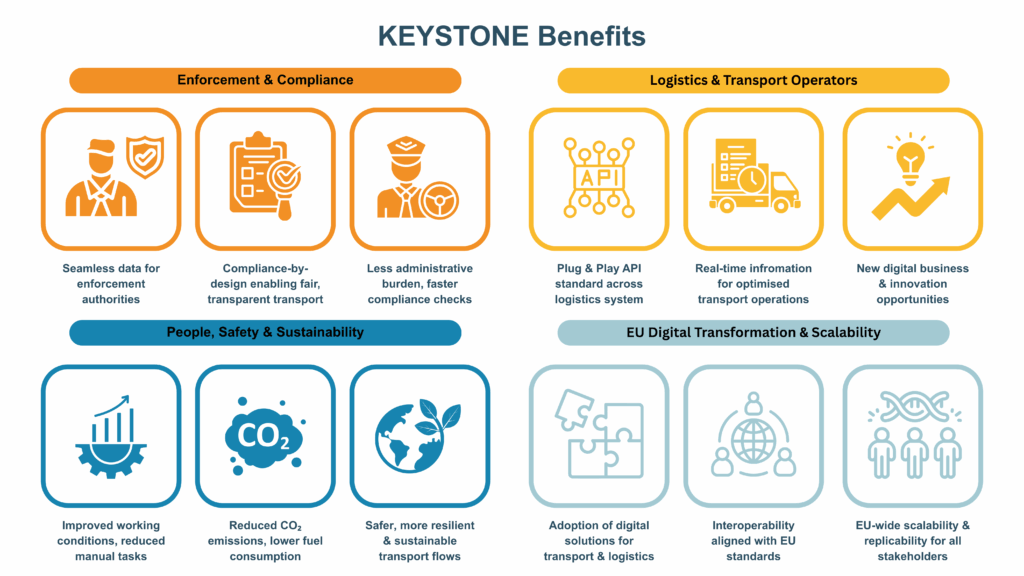
KEYSTONE supports the digital transformation of logistics by enabling secure and interoperable data exchange between logistics operators, transport stakeholders and enforcement authorities.
By facilitating real-time information sharing, the project helps reduce administrative burden, improve compliance and enforcement processes, and optimise transport operations. At the same time, it contributes to safer, more efficient and more sustainable transport flows, while promoting solutions that can be scaled and replicated across Europe.
The KEYSTONE consortium consists of 16 partners from six European countries, bringing together expertise from across the transport and logistics sector.
The project’s pilot activities take place along corridors connecting Northern Italy to the Benelux coast, supporting validation of the developed solutions in a cross-border context.
The participation of stakeholders is a key element of the KEYSTONE approach.
The project brings together a stakeholder community including experts from academia, logistics, and data management. These stakeholders contribute throughout all phases of the project, from identifying sector needs and analysing challenges to designing and validating digital solutions.
Through events, demonstrations and feedback activities, stakeholders play an active role in shaping the development and adoption of KEYSTONE’s digital solutions.
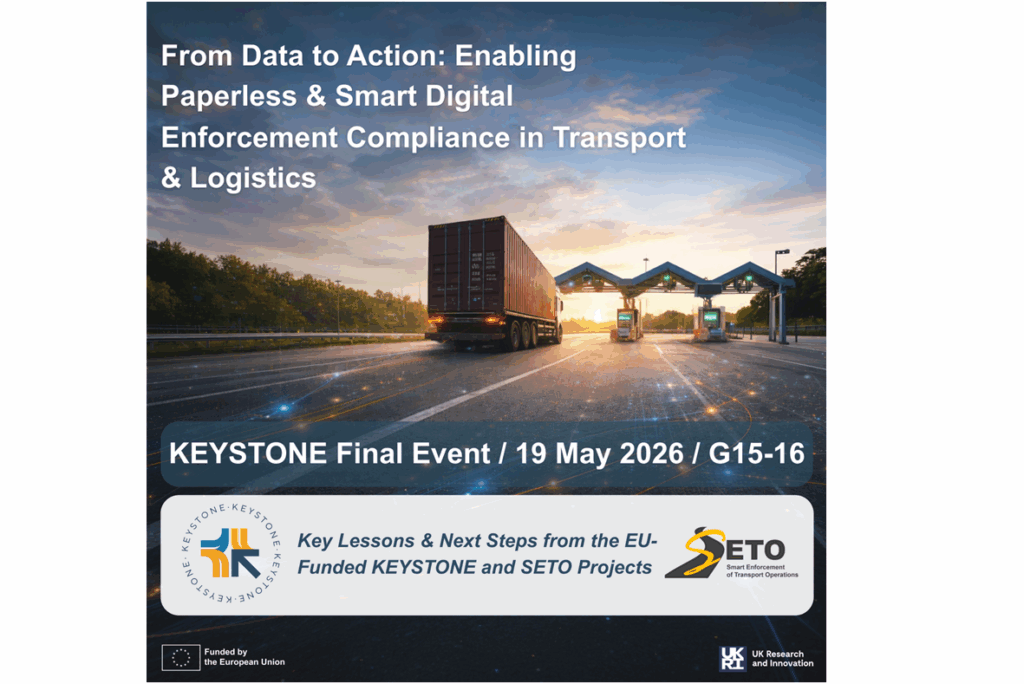
KEYSTONE will also conclude with its Final Event, taking place within Transport Research Arena 2026 (TRA2026).
Organised alongside the sister project SETO, the event “From Data to Action: Enabling Paperless and Smart Digital Enforcement Compliance in Transport & Logistics – Key Lessons and Next Steps from the EU-funded KEYSTONE and SETO Projects” will be held on 19 May 2026, from 09:00 to 12:00 CET, at Pavilion C, Room G15–G16.
The event will showcase the KEYSTONE Web App, present key results and lessons learned from three years of work, and bring together stakeholders from across the European transport and logistics sector. Through interactive panel discussions, it will highlight insights from real-world pilots, explore challenges and opportunities, and discuss how project results can support future interoperable and scalable transport solutions across Europe.
KEYSTONE runs from 1 June 2023 to 31 May 2026.
The project is funded by the European Commission, with a total maximum grant amount of €3,522,881.25, and by UK Research & Innovation (UKRI), with a total grant amount of £401,904.00.
KEYSTONE has received funding from the Horizon Europe research and innovation programme under grant agreement No. 101103740.
Funded by the European Union. Views and opinions expressed are those of the author(s) only and do not necessarily reflect those of the European Union or CINEA. Neither the European Union nor the granting authority can be held responsible for them.