
Wednesday, April 22nd, 2026
Rotterdam, 14-15 April 2026
On 14 and 15 April 2026, partners, stakeholders and invited guests gathered at the Port of Rotterdam for the MODI Use Case Netherlands Public Demonstration Event, organised by TNO as the UCNL leader. Over two days, the programme moved from a live technology demonstration at Portlantis and APM Terminals Maasvlakte II to a conference session, where presentations and a panel discussion addressed the broader question of what it will take to scale automated freight in Europe commercially.
Day one began at Portlantis, the Port of Rotterdam’s visitor and knowledge centre, where the afternoon programme included an introduction to the MODI project, live demonstrations of CCAM integration in logistics operations, an in-depth technology overview, and a bus tour of the port area. terminal showcased its advanced level of automation, currently operating 74 automated guided vehicles (AGVs) powered electrically and charged by battery swapping technology. As part of its ongoing expansion, the terminal is also preparing for the deployment of autonomous yard trucks.
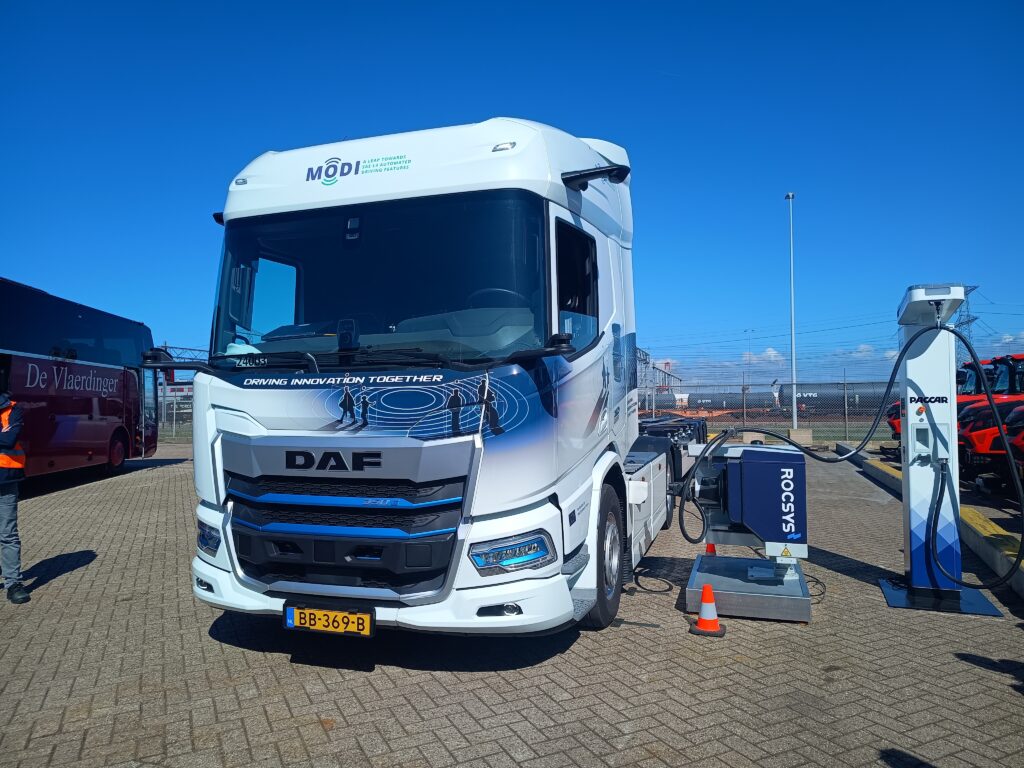
A key highlight of the day was the demonstration of the SAE L4 capable autonomous truck developed by DAF Trucks, with contributions from TNO in mapping, route planning and logistic integration. Due to current regulatory constraints and no permit tot drive at public roads, the vehicle was driven manually to the terminal and warehouse area, where automated functionalities, as reversed parking and charging, could be safely demonstrated.
The truck was assigned a logistics mission within the terminal: reversing into a designated parking position. Once activated, the vehicle switched to autonomous mode, indicated by teal lighting, and executed the manoeuvre smoothly and precisely – achieving a parking accuracy within just 3.5 cm. While slightly slower than an experienced human driver, the operation was completed flawlessly, demonstrating strong potential for further optimisation.
The demonstration also highlighted the vehicle’s perception system, combining radar, lidar, and camera technologies, as well as sensors on the trailer to support trailer positioning and alignment. These systems enable safe operation in controlled, low-speed environments such as terminals, with further enhancements expected for higher-speed applications.
In addition, automated charging technology was presented using the Rocsys system. The solution features a robotic arm enabling plug-and-charge functionality, illustrating ongoing innovation in communication protocols and standardisation for automated electric freight operations.
The autonomous truck was able to respond dynamically to its environment, stopping for oncoming traffic and resuming operation once the path was clear. The test cycle was repeated multiple times, demonstrating consistent and reliable behaviour under real operational conditions.
Day one demonstrated how automation, electrification, and intelligent systems are converging in real-world logistics environments. The demonstration at APM Terminal included the L4 DAF truck operating alongside legacy AGVs and manually driven vehicles in normal conditions.
The second day moved to a structured conference programme. The session opened with three presentations on the logistics interest in CCAM: ALICE presented “Beyond the Pilot: MODI Netherlands and the Path to Large-Scale Freight Automation in Europe”; APM Terminals covered CCAM for port operations; and Maersk addressed scaling L4 freight in Europe with lessons from the MODI Netherlands drayage use case. This was followed by supporting results from MODI: TNO presented its assessment of CCAM in logistics drayage operations, and BASt provided deployment recommendations derived from the Netherlands use case.
The ALICE’s presentation was delivered by Angjelo Andoni, Deputy Programme Manager, who covered where Europe stands on the deployment of automated freight and how the UCNL evidence base connects to four EU initiatives now taking shape: the Horizon Europe Large-Scale CCAM Demonstrations call, the Cross-Border Testbeds initiative under the EC Automotive Action Plan, ECAVA- the European Connected and Autonomous Vehicle Alliance, and EURIAS- the expert group shaping EU automotive research and innovation priorities for 2028-2034.
The programme closed with a panel discussion titled “From Recommendations to Realisation: What Needs to Be Done?” bringing together representatives from ALICE, APM Terminals, Maersk, TNO, and BASt, moderated by TNO. The discussion addressed the practical steps required to move from demonstration to commercial operation.