
May 20, 2026

Towards Resilient and Intelligent Multimodal Transport Networks – ReMuNet and SARIL Final Event

Monday, April 13th, 2026
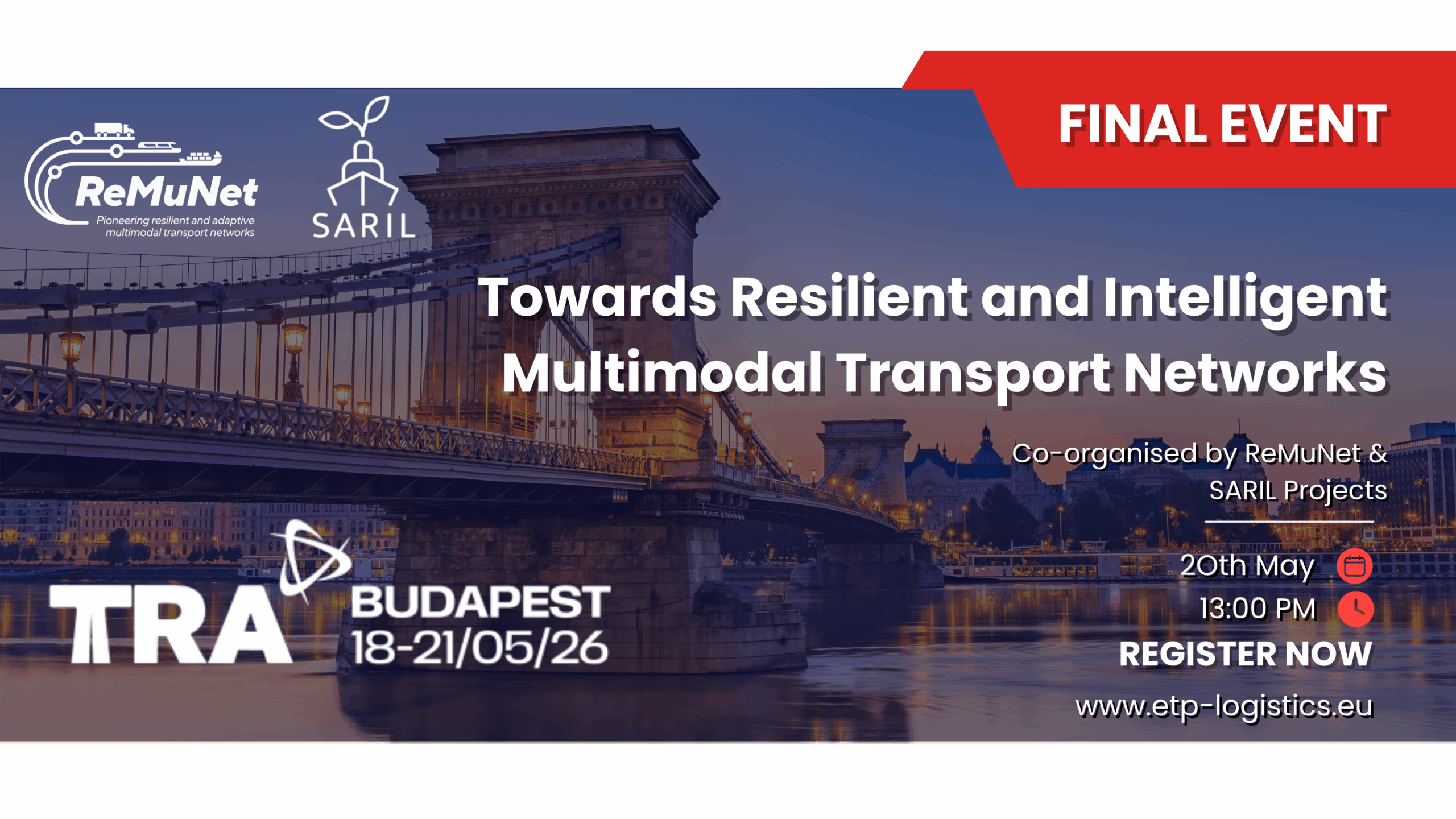
Date: 20 May 2026

Time: 13:00 to 17:00, followed by informal networking until 17:30

Location: Budapest, Hungary, during TRA 2026

Join the final event of the ReMuNet and SARIL projects at TRA 2026 in Budapest.

This joint event will bring together representatives from research, industry and policy to explore how Europe can strengthen the resilience, adaptability and sustainability of multimodal freight transport networks. The event will present the main results, tools and recommendations developed by both projects, with a particular focus on how digital solutions, collaboration and innovation can support freight transport in the face of disruptions.

The session will also provide an opportunity to discuss how project outcomes can support future research, operational uptake and policy development at European level.

Why attend

Participants will have the opportunity to:

  • learn about the final results of the ReMuNet and SARIL projects
  • discover tools and approaches for improving resilience in multimodal freight transport
  • explore how digital innovation can support disruption management and adaptive planning
  • hear perspectives from research, industry and policy
  • join the discussion on future implementation pathways and collaboration opportunities

Preliminary programme

Opening of the session, including the wider context of TRA 2026 and the European research landscape.

  • project overview, consortium, vision and key challenges
  • ReMuNet’s approach to resilient multimodal transport networks
  • platform development and architecture
  • advanced routing algorithms
  • Reinforcement Learning approaches
  • linear programming optimisation
  • key results and lessons learned
  • future research directions and exploitation potential
  • project overview, concept and stakeholder engagement
  • scenario development and use cases
  • the SARIL toolkit, its functionalities and applications
  • business models and strategic recommendations
  • end-user perspectives and practical relevance

Discussion topics:

  • bridging research, policy and industry needs
  • integrating digital solutions and data across transport modes
  • addressing disruptions and enhancing system adaptability
  • opportunities for scaling and cross-sector collaboration

An open discussion with participants focused on project results, implementation pathways, audience reflections and feedback.

Final reflections and opportunities for continued collaboration.

Register to attend

Registration for this event is now open. Please complete the form below to secure your place.

Practical information

The event will take place as part of TRA 2026 in Budapest, Hungary. Further practical details, including room information and confirmed speakers, will be added to this page in due course.

About the projects

ReMuNet: Resilient Multimodal Freight Transport Network focuses on improving the resilience of multimodal transport corridors by identifying disruptive events, assessing their impacts and supporting faster, more adaptive responses. The project combines standardised network descriptions, advanced routing algorithms, collaborative digital tools and AI-based modelling to support synchromodal relay transport across rail, road and inland waterways.

SARIL: Sustainability And Resilience for Infrastructure and Logistics networks addresses the resilience of freight transport and logistics networks while integrating environmental performance. The project develops indicators, models and tools to assess both resistance to disruptions and the environmental burden of freight transport across regional, national and international scenarios.

Together, the two projects offer complementary perspectives on resilient and sustainable multimodal logistics, with strong relevance for European transport policy and operational practice.


SARIL is funded by the European Union under grant agreement number 101103978. ReMuNet is funded by the European Union under grant agreement number 101104072.Views and opinions expressed are however those of the author(s) only and do not necessarily reflect those of the European Union or the European Climate, Infrastructure and Environment Executive Agency (CINEA). Neither the European Union nor the granting authority can be held responsible for them.


Back to overview