
Friday, March 27th, 2026
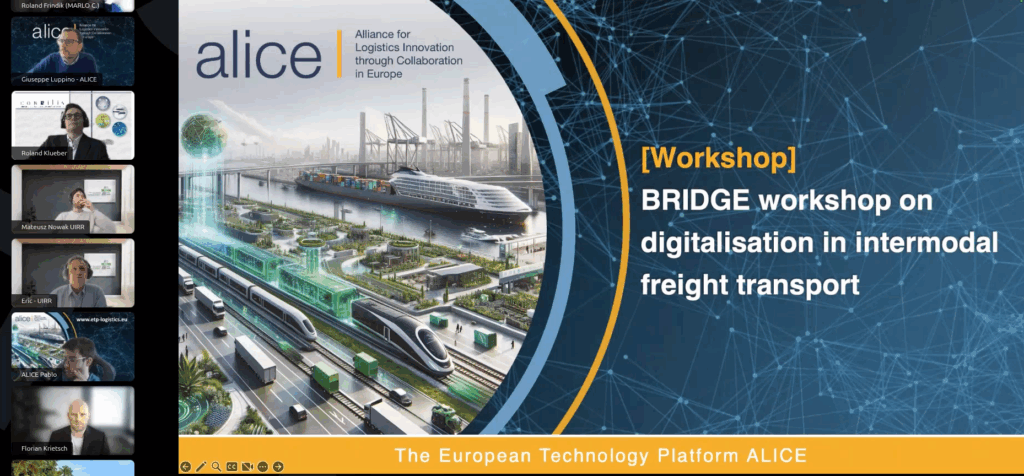
ALICE, in collaboration with UIRR and the EU-funded BRIDGE project, organised an online workshop on the digitalisation of intermodal freight transport, bringing together stakeholders to discuss how better data exchange can support more efficient, reliable and interoperable door-to-door logistics.
The session focused on road-rail-maritime transport chains and explored how digitalisation can improve coordination across the many actors involved in combined transport. The workshop combined project presentations, early survey findings and interactive discussion, with the aim of identifying practical priorities for future work.
The workshop was opened by Giuseppe Luppino (ALICE), who positioned the discussion within ALICE’s wider work on innovation uptake and data exchange in freight transport and logistics. He highlighted the importance of digitalisation as a practical enabler for improving reliability, capacity and interoperability across multimodal operations, particularly in relation to corridors, hubs and synchromodality.
Eric Feyen (UIRR) then introduced the BRIDGE project and its overall purpose. He explained that BRIDGE is designed to support the development of a more coherent digital ecosystem for intermodal freight transport, with a strong focus on standardisation, door-to-door data exchange and measurable service improvements. A key message from the presentation was that digitalisation should not be pursued for its own sake, but to improve the quality, transparency and efficiency of services for customers and operational stakeholders alike.
The workshop then moved into the challenges of current data exchange practices. Roland Klueber (Consilis) presented early reflections on the need for improved and standardised information sharing across the intermodal chain. He highlighted that many actors still face uncertainty about which data should be shared, with whom, and for what purpose. This creates inefficiencies, misunderstandings and unnecessary complexity. At the same time, the issue is not simply a lack of data. In some cases, too much information is exchanged without clear added value. This is why the BRIDGE project is developing the concept of a minimum viable data set, intended to help identify the most relevant information that should be shared across the supply chain while avoiding unnecessary burden.
First results from the BRIDGE door-to-door survey confirmed that there is significant room for improvement. According to the initial findings, service quality and data quality in combined transport are still often seen as falling short of expectations. Respondents also pointed to interoperability challenges, especially across rail-related interfaces, which continue to make intermodal operations more complex than they should be.
A forward-looking perspective was presented by Roland Frindik (MARLO), who outlined a broader vision for 2030. His intervention highlighted that future digitalisation efforts will need to go beyond technical interfaces alone. Governance, contractual frameworks, data protection, business models and standardisation all need to be considered as part of a broader digital ecosystem. The challenge is not only to digitise existing processes, but to do so in a way that supports both business needs and regulatory requirements.
The interactive part of the workshop reinforced several common priorities. Tracking and tracing emerged as a key area where stakeholders expect further digital progress, alongside timetable exchange, capacity-related information and better exception handling. At the same time, the discussion made clear that different actors need different levels of detail. Railway and infrastructure actors may require highly granular operational information, while customers and logistics operators often need filtered, actionable updates rather than large volumes of raw data.
Overall, the workshop showed that digitalisation in intermodal freight transport is not simply about more connectivity, but about smarter and more purposeful data exchange. It also confirmed that future progress will depend on common standards, clearer roles, better integration of terminals and operators, and stronger alignment between operational practice and policy developments.
There is still time until 3 April 2026 to actively contribute to this study, which is receiving close attention from the European Commission. Stakeholders – in particular, but not limited to, freight forwarders – are invited to take part by completing the dedicated questionnaire available at the following link: https://ec.europa.eu/eusurvey/runner/2a5fd3c3-2c28-4ca5-9dc7-bd25a6666aa6.
Through BRIDGE, ALICE, UIRR and project partners are working to translate these needs into practical solutions and a shared roadmap for a more interoperable and deployment-oriented intermodal freight ecosystem in Europe.
The full workshop report is available exclusively to ALICE members via the Knowledge Platform.